Amongst Women by John McGahern

McGahern (1)

AMONGST WOMEN

 John McGahern

 About John McGahern (1934 – 2006)

One of Ireland’s most widely read authors John McGahern was born on November 12th, 1934.  The family lived in Leitrim until his mother’s death in 1945, when they moved to their father’s home at the police barracks in Cootehall, County Roscommon.  In his early twenties McGahern worked as a teacher and wrote an unpublished novel, The End and the Beginning of Love.  His first published novel, The Barracks (1963), won the AE Memorial Award and earned him an Arts Council Macauley Fellowship.  His next novel, The Dark (1965), was widely praised and drew comparisons to James Joyce, but it also offended the Archbishop of Dublin and the state censor, who banned the book and he was also sacked from his teaching position.

He refused, however, to capitalise on this notoriety, instead continuing to publish quietly.  Three novels followed – The Leavetaking (1974), The Pornographer (1979), and Amongst Women (1990; winner of the Irish Times Award and short-listed for the Booker Prize).  McGahern’s four volumes of short stories were published in The Collected Stories in 1992.

His final novel That They May Face the Rising Sun (published in the United States as By the Lake) is an elegiac portrait of a year in the life of a rural lakeside community. McGahern himself lived on a lakeshore and drew on his own experiences whilst writing the book. Lyrically written, it explores the meaning in prosaic lives. He claimed that “the ordinary fascinates me” and “the ordinary is the most precious thing in life”.  The main characters have – just like McGahern and his second wife, Madeline Green – returned from London to live on a farm. Most of the violence of the father-figure has disappeared now, and life in the country seems much more relaxed and prosperous than in The Dark or Amongst Women.

During his writing career, he served as a visiting professor at Colgate University and the University of Victoria, British Columbia, and he was writer-in-residence at Trinity College, Dublin in 1989.  He died from cancer in the Mater Hospital in Dublin on 30 March 2006, aged 71. He is buried in St Patrick’s Church Aughawillan alongside his mother.
 McGahern (3)

Historical and Literary Background

This novel is set in Ireland in the years following the Irish War of Independence.  We hear references to reviving Monaghan Day, which is obviously a tradition of the time.  The story is set in the country and outlines the position of the family of the time.  It may be worth mentioning that Patrick Kavanagh’s The Great Hunger was written about rural life in Ireland about this time also.  Are there any similarities between Moran and the character of Paddy Maguire?

During these years, post War of Independence and pre World War II, McGahern tells us family bonds were strong.  The Moran family is united, in spite of their father’s erratic temperament.  Luke is the only exception to this happy picture of family solidarity.

Women married securely in this society.  Secure jobs such as the civil service were recommended.  Study at the university was not financially possible for Sheila.  The profession of doctor is also not acceptable within this family because the doctors had emerged as the bigwigs in the country that Moran had fought for during the war.

We also see the faithful practice of the rosary.  This is a prayer that is said by the family every night.  Moran makes use of this to assert his dominance over the family while refusing to face his own shortcomings.

One of Moran’s big fears is being poor.  For this reason he is miserly with money and even though he eventually gets two pensions he still exerts a tight control over the finances.  He also takes pride in the land he owns.  He uses the land as a refuge, many times escaping from the house to work furiously at hay-making or reaping whenever he loses control of himself.

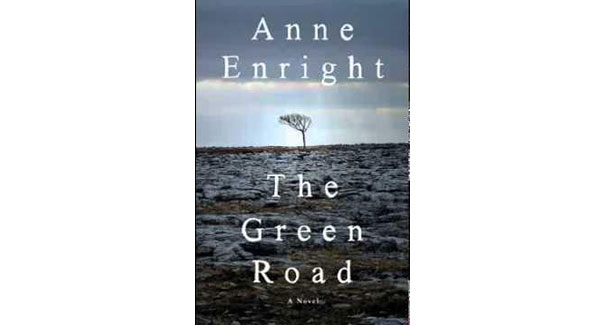
At the end, on his death, Moran is given the typical Republican burial with the tricolour draped over his coffin. (Check the front cover of the novel!)
John-McGahern (4)
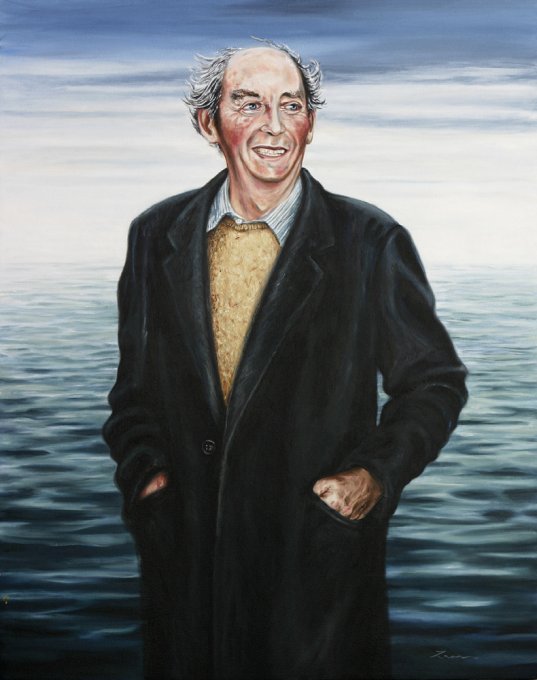
Dr. John McGahern by Zaan Claassens

THE STORY

The story is based on the Moran family who live in Mohill, Co. Leitrim.  The house is called Great Meadow.  The story is told in flashback and is framed at beginning and end with Moran in a depressed state and wishing for death.  Moran is an old Republican who was a guerrilla leader in the War of Independence.  His wife is dead and he is left to bring up their five children; three girls and two boys.  Luke is the oldest and he has gone to work in London because he will not tolerate his father’s violent behaviour.  Moran can never forget the authority he wielded during the war and tries to behave in the same way within his household.  He continually uses the rosary to regain control and power over his family.  Moran marries a girl called Rose Brady when he is beginning to get old.  Initially Rose is very idealistic about the marriage, but she soon discovers the true nature of Moran and his capacity for violence and dark moods.

Rose is a very selfless person who clearly loves Moran in spite of his strong character and difficult temperament.  She encourages the girls to become independent and achieve the best they can in life.  Maggie settles in London and eventually marries, as does Sheila.  Mona gets a good job in the civil service and remains single.  Michael, the youngest, leaves and marries.  Luke’s refusal to return to Great Meadow, the family home, frustrates and angers Moran greatly.  All the rest of the family visit him regularly in spite of the fact that he has been domineering and violent.  They are all happy together and have learned to accept Moran’s peculiar temperament.  Moran dies at the conclusion.  Everyone except Luke turns up at his funeral and acclaim him as a truly great and heroic man

McGahern (2)

 LITERARY GENRE

This is a novel of social realism, which is written in the third person omniscient narrative voice.  It can, therefore, be classed as a social document that is set in Ireland in the period following the War of Independence.  There are no official chapters; the narrative is broken into sections separated by a short space.  Much of the story is told through dialogue, which gives a vivid insight into the various characters.   The first section is written towards the conclusion of the story when Moran becomes sick.  The rest of the story gives an extended account in flashback about the life of the Moran family in Great Meadow.

There is a great similarity between Amongst Women and William Shakespeare’s great tragedy, King Lear.  By insisting that each of his daughters proclaim her love for him to win her share of his kingdom, Lear sets in motion a plot that reveals the complex dynamic at work among an elderly patriarch and his three daughters.  Like King Lear, Amongst Women investigates the love between a father and his children, the struggle to maintain strength in advancing age, and the difficulty of negotiating between independence and an identity tied to family roots.
mcgahern (5)

THEMES AND ISSUES

There are a number of themes and issues raised in the novel.  The main themes dealt with here are:

  • Power/Control/Patriarchy
  • The Family
  • The Role of Women

Power/Control/Patriarchy

Moran has been a guerrilla fighter in the War of Independence.  He never got used to the failure of that war, and so he tries all his life to master his family and dominate them.  It is only when he feels he is in control and the centre of things that he can manage to deal with issues in life.  Much of his power is achieved through violence and physical abuse.  He also uses the rosary as a weapon to establish his control in the house.  When he marries Rose Brady things change slowly but subtly.  He verbally abuses her several times but her firm reaction chastens him and shows him the need for self-control.  When there are difficulties with young Michael who begins to drink and womanise, Moran threatens to use physical violence to control him, as he had once done with Luke.  Michael runs away to England and gets a job.  Moran is left on his own with Rose and simply becomes more introverted and depressed.  As an old man he loses the ability to exert control through his mood swings and violence.  He changes and writes a letter of apology to his oldest son Luke who has left him a long time ago.

***

 Amongst Women can be seen as a critique of patriarchy.  McGahern connects nationalism, Catholicism and patriarchy in an unholy trinity.  In the novel McGahern is turning away from the Big House novel, that had played such a big part in earlier Irish fiction, to what might be termed the small house novel, portraying rural Catholic family life.  In the novel death frames the novel, but the intervening narrative is an extended flashback to family life in Great Meadow with Moran bestriding his little kingdom as a crusty, would-be Colossus.  The relationship between him and his wife and children is the principal focus of this plotless novel.  The focus is on scenes in which some or all of the family are assembled and the narrative moves in and out of the consciousness of various members of the group.   In this novel, for the first time in his writing, the subject of patriarchy assumes a central theme.

‘Only women could live with Daddy,’ Moran’s alienated son, Luke, comments, and the novel, to some extent, endorses this viewpoint.  Moran is first encountered ‘amongst women’, an ailing old man fussed over by his wife and three daughters.  The theme of the relationship between power and gender is announced in the opening sentence.  Moran’s physical weakness has transformed relations between him and his womenfolk to one of fear on his part and dominance on theirs.  However, even at his most physically incapacitated, Moran has still not lost his hold over his daughters: he ‘was so implanted in their lives, that they had never left Great Meadow’ (p.1).

The narrative pulse of Amongst Women is one of homecoming and leave-taking: welcomes and farewells at the train station; cars turning in the open gate of Great Meadow under the poisonous yew; children leaving home to embark on their adult lives, all but one drawn back with increasing frequency as the years pass; happy family reunions and the sad final reunion at Moran’s funeral.  Initially the rhythm is homecoming, and the verb ‘come’ is repeated seven times on the first page.  The reader is being drawn into this world where Moran is at the centre.  By the end of the second paragraph we have been introduced to its setting and principal characters: the ‘once powerful’ Moran, his second wife, Rose, his three daughters, Maggie, Mona, and Sheila, his younger son, Michael, and the eldest, Luke, distinguished from the rest by his refusal to come back to Great Meadow.

Patriarchy in Amongst Women can be seen to derive to a great extent from patriotism.  Moran is the hero of the War of Independence, who has failed to make a successful career in the Irish army in peacetime, directs his frustrated drive for power into a diminished form of home rule.  His status as a former guerrilla fighter is repeatedly emphasised at the outset by the device of juxtaposing two episodes which celebrate his youthful exploits as leader of a flying column, thereby ensuring that all his subsequent conduct is ‘placed’ in the light of this wartime experience.  Monaghan Day, a fair day in late February when he received an annual visit from McQuaid, his former lieutenant, and the two reminisced over their youthful heroics, is Moran’s equivalent of Remembrance Day.  The novel opens with his daughters’ revival of Monaghan Day when Moran is old and ill.  On this occasion he deglamourises his role as freedom fighter and refers to his flying column as ‘a bunch of killers’ (p.5).  That he has never lost his own killer instinct is demonstrated next morning when he rises from his sickbed to shoot a jackdaw.  His targets may have diminished, but he is still prepared to resort to violence to assert his limited power.  The incident rather pathetically demonstrates his present impotence, yet he himself uses it to illustrate his connection between intimacy and mastery:

The closest I ever got to any man was when I had him in the sights of my rifle and I never missed. (p.7)

Moran is at pains to tell his wife and daughters that his flying column did not shoot women or children, treating both categories as minors or inferiors.

Beginning on P. 8 we are given another flashback to the last Monaghan Day.  In this episode Moran’s bullying of his teenage daughters is contrasted with his inability to gain power over McQuaid.  He terrorises his daughters, so that in his presence they ‘sink into a beseeching drabness, cower as close to being invisible’ (p.8) as possible, but it is obvious now that his power does not extend outside his own family.  McQuaid, who has long outstripped Moran in terms of worldly achievement, is happy to indulge in war memories for an evening, but he is unwilling to perpetuate his former role of junior officer.  His visit brings something of the secular, commercial outlook of modern Ireland into the pious, traditional world of Great Meadow.  Here again the rhythms of arrival and departure are evident as the annual ritual of Monaghan Day is brought to an end with McQuaid’s abrupt exit.  Henceforth, the cars that turn ‘into the open gate under the yew tree’ will convey returning Morans.  From here on Great Meadow becomes a house hospitable only to its own family.

As has been said already, Amongst Women offers a penetrating critique of patriarchy.  McGahern goes even further and shows that patriarchy as a refuge of the socially ill-adjusted and emotionally immature man and asks probing questions about the cult of family.  Moran has transformed his inadequacies into a show of strength by making his home his castle.  Denied a role as founding father in the Irish state he sets up his own dominion.  Actually, Great Meadow, bought with his redundancy pay from the army, should be a monument to Moran’s failure to live up to his youthful promise.  Though it is not an ancestral home it becomes, under his regime, a family seat, more cut off from the life of the surrounding village than any Big House.  Because of an inability to relate to his fellow-villagers, Moran turns his family into a closed community and the absence of any outside contacts further strengthens his own paternal supremacy.  He successfully indoctrinates his children with the idea that such reclusiveness denotes exclusiveness, that to be ‘proud’ and ‘separate’ is a mark of distinction, to be friendly and extroverted a sign of commonness.  House and family are connected in exhortations to his daughters: ‘Be careful never to do anything to let yourselves or the house down.’ (p. 82).  He thus forges an association between family and farmstead, roots his children in a ‘perpetual place’.  As the founder of a new dynasty Moran acts as if he were self-propagated and never refers to his own parents.  His cult of family does not include any filial loyalties which might conflict with the prior claim of being a Moran of Great Meadow, so he actively discourages his wife’s visits to her family home.

Moran’s family is an extension, a ‘larger version’ of himself.  When he promotes the values of home and family he is obliquely bolstering his own self-importance.  The ‘good of the family’ provides him with a virtuous, unselfish motivation for suiting himself.  When he is about to remarry, for instance, he tells his daughter Maggie that he is doing so in the best interests of the family, though it has just been revealed to the reader that his only motive is his own future welfare.  He also repeatedly stresses that all his children are equal, further emphasising his own unique superiority.  The ex-officer promotes esprit de corps, though his theatre of operations is a hayfield and not a battlefield: ‘Together we can do anything.’  Such affirmation of solidarity and de-emphasising of individual differences serve to bind the family into ‘something very close to a single presence.’

In view of the novel’s critique of patriarchy it is interesting to note the effect this has on his daughters at the end of the novel.  Turning the page at the end of the novel, we are given a glimpse of what ‘becoming Daddy’ means.  A reversal of gender roles takes place as brother and husbands, seen from a patriarchal perspective, are transformed into wives.  It is obvious that Moran’s honorary male daughters have inherited his contempt for the feminine, which they associate with levity and amusement:

‘Will you look at the men.  They’re more like a crowd of women,’ Sheila said, remarking on the slow frivolity of their pace.  ‘The way Michael, the skit, is getting Sean and Mark to laugh you’d think they were coming from a dance’ (p. 184)

Their exclusiveness as Morans of Great Meadow is such that it does not even embrace their own husbands and children.

It is also worthwhile to consider here the links between Catholicism and patriarchy.  These links are forged in the novel by its most repetitive narrative ritual and the family prayer from which it derives its title.  Moran’s devotion to the rosary is explained on familial and patriarchal grounds.  ‘The family that prays together stays together,’ he observes, quoting the Rosary-crusader priest, Father Peyton.  As in many Irish homes, (in the past?)  the rosary in the Moran household is a public prayer that reinforces a hierarchical social structure: it is presided over by the head of the family and the five decades are allocated from eldest to youngest in descending order of importance.  Though the rosary repeatedly pronounces Mary as ‘Blessed … amongst women’,  because she was chosen to be the mother of Christ, in the Moran household, the character, blessed amongst women, is Moran himself.  He even manages to die ‘amongst women’, since his son Michael is temporarily absent!  The Rosary is peculiarly identified with Moran and it is a very clever device used by McGahern to emphasise the narrative repetitiveness, which is a feature of this novel.  Over and over again the newspapers are spread on the floor, Moran spills his beads from his little black purse, and all kneel in prayer.  The stability conferred by ritual and repeated phraseology underscores the disruptions and changes that the passage of time brings to Great Meadow.

Yet we should not be over negative in our assessment of Moran and his little kingdom.  He does exhibit some inherent attractive qualities.  Indeed his portrait is the most imaginatively generous picture of a father in McGahern’s many novels and short stories.  He radiates enormous energy and this surely can be seen as a redeeming feature.  He also shows great anguish for the son who is lost to him and he also shows a certain bafflement and frustration in the face of oncoming death.  In particular he is associated with the annual haymaking, an activity shared by the whole family.  From distant London or Dublin, Great Meadow in summer appears a therapeutic, pastoral world: ‘The remembered light on the empty hayfields would grow magical, the green shade of the beeches would give out a delicious coolness as they tasted again the sardines between slices of bread: when they were away the house would become the summer light and shade above their whole lives’ (p.85).  Such memories turn Moran’s children into true Romantics, sustained ‘amid the din of town and cities’ by images of their fatherland.

Therefore, McGahern manages to balance the attractive and the repellent aspects of patriarchy in this novel.  The glorious revolution that brought about the Irish State is so remote by the time of Moran’s death that the fellow revolutionary who tends to the faded tricolour on the coffin seems as old as Fionn or Oisín.  Nevertheless, the legacy of the War of Independence, seen by some as a triumphalist, masculine ethic of dominance, has been passed on to the next generation.

Irish people everywhere seem to have an often inexplicable affection for their country, whether they be urban, suburban, rural or living in Boston.  This love for ‘the ould sod’ is turned on its head here in this novel in McGahern’s examination of home, farm and fatherland.  Idyllic though Great Meadow often appears, access to it involves passing under ‘the poisonous yew.’

The Family

In Amongst Women we see the powerful bond of the family and how it can withstand so many difficulties.  Even though Moran is stubborn and mercurial in temperament, the family remain strongly bound together.  Together they feel invincible in the face of the outside world, and when they gather together at Great Meadow, each member feels bound by this strong family unit.

 The novel pulls us into a tight family circle with its first sentence – ‘As he weakened, Moran became afraid of his daughters’ (p.1).  A ‘once powerful man’ (p.1), Michael Moran was an officer in the Irish War of Independence in the 1920’s.  He was intelligent, fierce and deadly, but like many soldiers after a war, he felt displaced, unwilling to continue in the military during peacetime and unable to make a good living in any other way.  ‘The war was the best part of our lives,’ Moran asserts.  ‘Things were never so simple and clear again’ (p.6).  While the army provided the security of structure, rules, and clear lines of power, Moran’s life after the war has consisted of raising two sons and three daughters on a farm and scraping out a living with hard manual labour.  A widower, Moran confuses his identity with the communal identity of his family in a gesture that divides and conquers.  Moran’s daughters are ‘a completed world’ separate from ‘the tides of Dublin and London’ (p.2).  As such, he can control them, as when he discourages one from accepting a university scholarship.  No longer powerful, Moran is repeatedly described as withdrawing into himself ‘and that larger self of family’ (p.12) in order to channel his aggressions into a shrunken realm he attempts to control.  He can be tender with his children, but he also berates and beats them.  His adjustment from guerrilla fighter to father is never complete, and the question of how to maintain authority over children while allowing them room to grow is central to the novel.

Nowhere is this struggle between dependence and independence more pronounced than in the character of Luke, the oldest son who runs away from Moran’s overbearing authority, never to return.  Rejecting his father, Ireland, and all of the violence and provincialism he associates with both, Luke flees to England.  He ignores all but one of Moran’s many letters, and he doesn’t return to Ireland except at the end of the novel when his sister gets married.  ‘Please don’t do anything to upset Daddy,’ one of the sisters pleads, typically trying to placate her father.  ‘Of course not I won’t exist today,’ Luke replies (p.152).  His best weapon against Moran’s control is absence.  Whereas the daughters, ‘like a shoal of fish moving within a net’ (p.79), find individuality painful compared to the protection of their familial identity, Luke gains strength in departure.  ‘I left Ireland a long time ago’ (p.155), Luke announces gravely.  As it does for Stephen Dedalus in James Joyce’s A Portrait of the Artist as a Young Man, life in Ireland seems like imprisonment.

‘I’m afraid we might all die in Ireland if we don’t get out fast’ (p.155-156), says Moran’s younger son, Michael.  Like other Irish writers, McGahern asks whether exile offers the only hope for freedom and individuality.  How does the political turmoil which has long suffused Irish history affect the smaller unit of the family?  How do other elements of Irish life contribute to familial dysfunction?  In the claustrophobic world McGahern portrays, escape proves sustaining for a character like Luke, but it is not an unequivocal good.  Luke is strong but cruel like his father.  His sisters, on the other hand, not only fail to break away from the family, but by the time of their father’s death, ‘each of them in their different ways had become Daddy’ (p.183).  Their identification with and loyalty to Moran threatens to subsume them, but it also gives them a kind of strength, as Michael seems to understand: ‘In the frail way that people assembled themselves he, like the girls, looked to Great Meadow for recognition, for a mark of his continuing existence’ (p.147).

The Role of Women

(This theme has obviously to be examined in the light of what has already been said about Patriarchy.)

With the exception of Moran and his young son Michael, this story centres on many women characters.  Rose Brady is the main character who makes life bearable for everyone in Great Meadow.  At every stage she is deeply loyal to Moran and never allows herself to criticise him or his fickle actions in front of  the others.  She loves him deeply and when he treats her badly she is quick to assert her rights.  She does this in a quiet but strong way.  She becomes a strong moral power in the house, and through this strength she manages to control Moran and get him to change his bad temperament subtly.

When Moran marries Rose it is obvious that he never intended a marriage of equals.  She is to serve as a loyal and devoted second in command and at some future date, when his children have departed, to become his sole subordinate.  Rose, a woman in her late thirties at the time of her marriage, is ideally suited to the role of compliant wife and surrogate mother.  Her previous profession has been that of valued servant: a children’s nursemaid, and the valet her former master would have chosen had his wife permitted it.  She has acquired the social skills that please employers, learned to indulge their whims.  That she is good at ironing takes on a metaphorical significance, since she has spent much of her married life ‘smoothing’ out household difficulties.  She is attracted by Moran’s aloofness and, ironically, she sees marriage as an opportunity to become mistress of her own establishment.  For all his local notoriety as a strategist in the war, Moran doesn’t seem to be able to exercise much control in the matter of his marriage.  He is continually out-manoeuvred by Rose, who mounts a shrewd, tactical campaign to get her way when he would prefer to retreat or delay.

Once married, Rose proves to be an angel of the house: a kind, caring, capable homemaker, whose warmth and good humour contrast sharply with Moran’s sudden rages and unpredictable mood swings.  Her genuine interest in each child’s welfare contrasts with Moran’s inability to value his children’s individual identity and autonomy.  However, it must be said that Rose colludes in perpetuating Moran’s patriarchal regime.  She is unfailingly loyal to him and she refuses to entertain his children’s criticism of his petulant behaviour.  In his children’s presence she always refers to Moran as ‘Daddy’, the title by which he himself insists that they address him.

Rose’s strategy is to become indispensable to the household.  The tea-ceremony on her first evening is very revealing of the future status quo.  She takes on the role of a kind of superior servant, co-opting the girls as helpers, and humouring her disgruntled husband by treating him ‘like a lord’:

Rose and the girls smiled as the tea and the plates circled around him.  They were already conspirators.  They were mastered and yet they were controlling together what they were mastered by. (p.46)

Later on this is viewed in a more negative way:

Then, like a shoal of fish moving within a net, Rose and the girls started to clear the table. (p. 79)

Here the women are seen as victims, trapped in the tense atmosphere which Moran generates.  A shift in power relations has occurred and Rose is no longer in control.  Her status is now equal with that of Moran’s children.

The power struggle between Rose and her husband centres on two episodes.  In the first he is compelled to apologise and she is rewarded with a mini-honeymoon, but she has been made aware of his ‘darkness’ and decides to concentrate her strategy on diverting his attacks – cutting him off at the pass, so to speak.  In the second episode he embarks on a prolonged campaign to crush her and she attempts to conciliate and pacify him, until she discovers that she can ‘give up no more ground and live’ (p.71).  Her tactic now is to threaten to leave him, a shrewd stroke; since she knows that Moran is already obsessed with Luke’s departure.  This power struggle between the two is several times alluded to in military terms.  It is a ‘hidden battle’ from which she, apparently, emerges victorious, her objective having been to ensure her ‘place in the house could never be attacked or threatened again’ (p73).  What she has settled for, however, is the limited right to be treated like a member of Moran’s family, to swim like a fish in his net.

Moran’s daughters adapt to life by avoiding confrontation.  Indeed, there seem to be very limited options in counteracting Moran’s dominance.  Compliance, continual confrontation, or departure are the three choices facing Moran’s household.   The strategy of the womenfolk, at least, is to ‘slip away’ or try to appear invisible.  Such evasion is a tactical manoeuvre, a recognition of their own defencelessness.  Beneath their cringing exterior, Mona and Sheila each conceals a forceful character.  Mona is ‘unnaturally acquiescent’, ‘full of hidden violence’; Sheila, even as a young child, knows better than ‘to challenge authority on poor ground’.  They bide their time until their jobs in the Civil Service set them free from Moran’s daily oppression, though Sheila comes near to confrontation before surrendering her opportunity to attend university.  They show their attitude to parental domination in their advice to Michael, to make the best of it until he has finished school and is in a position to choose a career of his own.

In view of their unhappy childhood why do Moran’s children, with the exception of Luke, turn Great Meadow into a place of pilgrimage and their father into a cult figure?  What McGahern presents in Amongst Women is the charisma of patriarchy, which consists in its exercise of sole and absolute authority, the power to approve or disapprove, endorse or withdraw support, affirm or reject, and thereby, to nurture an emotional dependency.  Though in their last years at home, the Moran children flourish under Rose’s benign dispensation, their primary relationship is with their father.  Because his second marriage does not occur until his daughters are in their teens, Rose’s advent does not alter Moran’s status as a dominant single parent, the permanent emotional focus of their lives.  They never allude to their dead mother, and the novel ignores the ‘umbilical debt’, according her no influence whatever on their upbringing.

A large part of the fascination the handsome Moran holds for Rose and for his daughters is sexual.  Rose loves him; his daughters also experience an ‘oedipal’ attachment.  He is their ‘first man’.  He looks on their husbands and male friends as rivals and is content when these prove ‘no threat’ to his primal place in their affections.  Neither Maggie nor Sheila marry dominant men, and Mona resists marriage altogether.  Sheila is the only one to violate this ‘incestuous’ relationship with her father when she leaves him in the hayfield to go indoors and makes love to Sean.

As the novel ends the reader’s sympathies are drawn towards the ailing and dying Moran, so that we share the family’s grief at his death.  His corpse is taken to the church on a ‘heartbreakingly lovely May evening’ and buried on a morning when the ‘Plains were bathed in sunshine’ and ‘the unhoused cattle were grazing greedily on the early grass’ (p.182).  The sadness of this final parting from the fertile spring world is rendered all the more poignant by the baffled love Moran experiences for his own land in old age.  He is shown walking it, ‘field by blind field’, ‘like a blind man trying to see’.  In his last month he repeatedly escapes from his sickbed to stare at the beauty of his meadow.  At the end of his life Moran eventually arrives at a deep appreciation of the ‘amazing glory he is part of’ (p.179).  Maybe this final epiphany is the blessing he always craved and was unable to receive, a blessing hinted at in the name Rose?

barrie_cooke
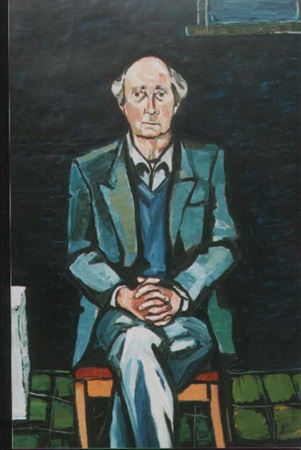
John McGahern, oil on canvas, by Barrie Cooke, 1997/8.

GENERAL VISION AND VIEWPOINT

This is a realistic novel, which traces the history of an Irish rural family in the early twentieth century.  McGahern focuses on one family and one house and we follow the subtle changes that take place in the comings and goings of various members of the family.  He has created a microcosm in Great Meadow from which to view and comment on the changes which have come about after the War of Independence.  Even though there is a timeless quality to the novel and no dates are mentioned we are being asked to pass judgement on the new State that has emerged and was beginning to find its feet under the influence of the 1937 Constitution.  De Valera’s vision of this New Ireland eulogised the role of women as mothers and home-makers and he painted an idealised picture of life in the Irish countryside:

A land whose countryside would be bright with cosy homesteads, whose fields and villages would be joyous with sounds of industry, the romping of sturdy children, the contests of athletic youths, the laughter of comely maidens; whose firesides would be the forums of the wisdom of serene old age.

McGahern in Leitrim and Kavanagh in Monaghan both knew that the realities of life for poor, farm families were radically different from this version offered by de Valera.

McGahern shows  that the power of family bonds to withstand all difficulties is clearly evident throughout every aspect of this story.  At the centre of this story is Moran and his wielding of mesmeric power over his children but it obvious also that Rose Brady is truly the moral centre of the novel.  It is she who silently manages to improve things within the Moran household, and by doing this she controls a good deal of the violence latent in Moran.  It is her undoubted love and loyalty to Moran and her spirit of self-sacrifice in the household, which creates this extraordinary bond of strength which each of the members feel among themselves.

The implication at the conclusion is that Moran’s family is stronger than ever in their love and allegiance to one another.  They truly recognise that Moran played a central part in all their lives.  Their attendance at his funeral strengthens this bond between them even more.  They realise that each one of them, in different ways, has truly imbibed Moran’s beliefs and values.  They remain loyal to his person and beliefs in spite of everything.  Only Luke remains obstinate in his decision not to return home – a reminder that even he has inherited a great deal of stubbornness and pride from his father.

BIBLIOGRAPHY

Sampson, Denis. 1993, Outstaring Nature’s Eye – The Fiction of John McGahern. The Lilliput Press, Dublin.

Quinn, Antoinette. 1991, A Prayer For My Daughters: Patriarchy in Amongst Women in The Canadian Journal of Irish Studies (Special Issue on John McGahern), Volume 17, Number 1, July, 1991
John-McGahern(6)

Read also ‘Close Analysis of John McGahern’s ‘That They May Face the Rising Sun’ here

‘Of Mice and Men’: Brief Analysis of Characters, Metaphors and Themes.


Courtesy of carra-lucia - books .co.uk
Courtesy of carra-lucia – books .co.uk

The title that Steinbeck finally chose for his novel emphasises the unpredictable nature of existence as well as its promise, George and Lennie’s blasted dream to ‘live of the fatta the lan’.  Taken from a poem by Robert Burns, the Scottish poet, the novel’s title suggests the transitory quality of even ‘best laid schemes’.  Burns’s poem tells of an unfortunate field mouse whose home is flattened by a plough:

But Mousie, thy art no thy lane,

In proving foresight may be vain:

The best laid schemes o’ mice an’ men

Gang aft a-gley

An’ lea’e us nought but grief an’ pain

For promised joy.

___________________________________________

Steinbeck 

CHARACTER PROFILES

GEORGE: George is the story’s main protagonist, a small, quick man with well-defined features.  A migrant ranch worker, George dreams of one day saving enough money to buy his own place and be his own boss, living off the land.  The hindrance to his objective is his mentally handicapped companion, Lennie, with whom he has travelled and worked since Lennie’s Aunt Clara, whom George knew, died.  The majority of George’s energy is devoted to looking after Lennie, whose blunders prevent George from working toward his dream, or even living the life of a normal rancher.  Thus, George’s conflict arises in Lennie, to whom he has the ties of long-time companionship that he so often yearns to break in order to live the life of which he dreams.  This tension strains George into demonstrating various emotions, ranging from anger to patience to sadness to pride and to hope.

LENNIE:  George’s companion, the source of the novel’s conflict.  Lennie, enormous, ungainly, and mentally slow, is George’s polar opposite both mentally and physically. Lennie’s ignorance and innocence and helplessness, his childish actions, such as his desire to pet soft things, contrast his physical bulk, making him likeable to readers.  Although devoid of cruel intentions, Lennie’s stupidity and carelessness cause him to unwittingly harm animals and people, which creates trouble for both him and George.  Lennie is tirelessly devoted to George and delights in hearing him tell of the dream of having a farm, but he does not desire the dream of the American worker in the same way that George does.  His understanding of George’s dream is more childish and he grows excited at the possibility of tending the future rabbits, most likely because it will afford him a chance to pet their soft fur as much as he wishes.  Nevertheless, a dream is a dream, different for everyone, and George and Lennie share the similar attribute of desiring what they haven’t got.  Lennie, however, is helpless to attain his dream, and remains a static character throughout, relying on George to fuel his hope and save him from trouble.

CANDY:  He is the old, one-handed swamper who is the first to befriend George and Lennie at Soledad.  He is humble and weary and seems to be at the end of his line after Carlson shoots his last possession and companion, his old, blind, dog.  ‘When they can me here I wisht somebody’d shoot me’, Candy confesses to George and Lennie, hoping for a similar fate as his dog.  But when he hears the two talking of their little place, Candy offers all his money and his meagre services to be in on the dream.  His substantial sum of money and the fact that he knows of a place make it impossible for George to refuse him.  Candy clings to this hope of a future as a drowning man would to a piece of driftwood.  It rekindles life within him, but it also becomes an obsession, and in his excitement and indignation, he lets the secret slip to both Crooks and Curley’s wife.  And when Lennie kills Curley’s wife and shatters the reality of the dream, Candy becomes hopeless and full of anguish, the broken shell of a man.

CURLEY:  He is the boxer, the son of the boss, the angry and hot-headed obstacle to George’s attempt to keep Lennie out of trouble at Soledad.  Insecure because of his size and over-protective of his wife, Curley is eager to fight anyone he perceives as a threat to his self-image.  Lennie unwittingly incurs Curley’s antagonism simply because of his size, and the reader immediately braces for future confrontation.  Curley remains undeveloped, forever little and forever mean, poking his head in at various points in the novel, either to look for his wife or to stir up trouble on account of her.

CURLEY’S WIFE:  Nameless and flirtatious, Curley’s wife is perceived by Candy to be the cause of all that goes wrong at Soledad: ‘Ever’body knowed you’d mess things up.  You wasn’t no good’, he says to her dead body in his grief.  The workers, George included, see her as having ‘the eye’ for every guy on the ranch, and they cite this as the reason for Curley’s insecurity and hot-headed temperament.  But Curley’s wife adds complexity to her own characterisation, confessing to Lennie that she dislikes Curley because he is angry all the time and saying that she comes around because she is lonely and just wants someone to talk to.  Like George and Lennie, she once had a dream of becoming an actress and living in Hollywood, but it went unrealised, leaving her full of self-pity, married to an angry man, living on a ranch without friends, and viewed as a trouble-maker by everyone.

CROOKS:  called such because of a crooked spine, Steinbeck does not develop Crooks, the Negro stable buck, until Chapter Four, describing him as a ‘proud, aloof man.  He kept his distance and demanded that other people keep theirs’.  Crooks is bitter, indignant, angry, and ultimately frustrated by his helplessness as a black man in a racist culture.  Wise and observant, Crooks listens to Lennie’s talk of the dream of the farm with cynicism.  Although tempted by Candy, Lennie and George’s plan to buy their own place, Crooks is constantly reminded (in this case by Curley’s wife) that he is inferior to whites and, out of pride, he refuses to take part in their future farm.

SLIM:  The tall, jerkline skinner whom Steinbeck describes as something of a living legend: ‘He moved with a majesty only achieved by royalty and master craftsmen.  He was a jerkline skinner, the prince of the ranch, capable of driving ten, sixteen, even twenty mules with a single line to the leaders.  He was capable of killing a fly on the wheeler’s butt with a bull whip without touching the mule.  There was gravity in his manner and a quiet so profound that all talk stopped when he spoke ….. His hatchet face was ageless.  He might have been thirty-five or fifty.  His ear heard more than was said to him, and his slow speech had overtones not of thought, but of understanding beyond thought.’  Slim lingers in the shadow of this overwhelming description throughout the novel.  He serves as the fearless, decision-maker when conflicts arise among the workers and wins the confidence of George, offering advice, comfort, and quiet words of wisdom.

______________________________________

Speed Read 'Of Mice and Men' (Courtesy of www.irisreading.com)

 METAPHOR ANALYSIS

 CANDY’S DOG:  ‘A dragfooted sheepdog, gray of muzzle, and with pale, blind old eyes’, Candy’s dog is a far cry from his sheepherding days.  Carlson says to Candy, in regard to the dog: ‘Got no teeth, he’s all stiff with rheumatism.  He ain’t no good to you, Candy. An’ he ain’t no good to himself.  Why’n’t you shoot him, Candy?  And Candy is left with no other option, but to shoot his longtime companion.  This sub-plot is an obvious metaphor for what George must do to Lennie, who proves top be no good to George and no good to himself.  Steinbeck re-emphasises the significance of Candy’s dog when Candy says to George that he wishes someone would shoot him when he’s no longer any good.  And when Carlson’s gun goes off, Lennie is the only other man not inside the bunk house, Steinbeck having placed him outside with the dog, away from the other men, his gun shot saved for the novel’s end.

THE CRIPPLES:  Four of Steinbeck’s characters are handicapped: Candy is missing a hand, Crooks has a crooked spine, Lennie is mentally slow, and Curley acquires a mangled hand in the course of the novel.  They are physical manifestations of one of the novel’s major themes: the schemes of men go awry.  Here, to reiterate the point, Steinbeck has the actual bodies of his characters go awry.  It is as if nature herself is often doomed to errors in her scheme.  And whether they be caused at birth, or by a horse, or by another man, the physical deformities occur regardless of the handicapped person’s will or desire to be otherwise, just as George and Lennie’s dream goes wrong despite how much they want it to be fulfilled.

 SOLITAIRE:  George is often in the habit of playing solitaire, a card game that requires only one person, while he is in the bunk house.  He never asks Lennie to play cards with him because he knows that Lennie would be incapable of such a mental task.  Solitaire, which means alone, is a metaphor for the loneliness of the characters in the novel, who have no one but themselves.  It is also a metaphor for George’s desire to be ‘solitaire’, to be no longer burdened with Lennie’s company, and his constant playing of the game foreshadows his eventual decision to become a solitary man.

THE DEAD MOUSE AND THE DEAD DOG: These two soft, furry creatures that Lennie accidentally kills are both metaphors and foreshadowing devices.  As metaphors, they serve as a physical representation of what will happen to George and Lennie’s dream: they (Lennie in particular) will destroy it.  Lennie never intends to kill the thing he loves, the soft things he wants more than anything, but they die on him nonetheless.  The dead mouse is also an allusion to the novel’s title – Of Mice and Men, a reminder that dreams will go wrong, even the desire to pet a mouse.  And because bad things come in threes, Lennie’s two accidental killings of animals foreshadow the final killing of Curley’s wife, an accident that seals his fate and ruins the dream for him, George and Candy.

___________________________________

Steinbeck 6

THEME ANALYSIS

When discussing the various themes in Steinbeck’s novel, we would do well to first examine the title, which is an allusion to a line from one of Robert Burns’s poems: ‘The best laid schemes o’ mice an’ men gang aft aglay.’  Translated into modern English, this line reads: ‘The best laid schemes of mice and men often go awry.’  This cynical statement is at the heart of the novel’s action and serves as a foreshadowing prophecy of all that is to come.  For, indeed, the novel’s two main characters do have a scheme, a specific dream of changing their current way of life in order to have their own place and work only for themselves.  The tragedy, of course, lies in the fact that no matter how elaborately our heroes plan, regardless of how intensely they hope and dream, their plan does not find fulfilment.

This is a novel of defeated hope and the harsh reality of the American Dream.  George and Lennie are poor homeless migrant workers, doomed to a life of wandering and toil in which they are never able to reap the fruits of their labour.  Their desires may not seem so unfamiliar to any other American: a place of their own, the opportunity to work for themselves and harvest what they sow with no one to take anything from them or give them orders.  George and Lennie desperately cling to the notion that they are different from other workers who drift from ranch to ranch because, unlike the others, they have a future and each other.  But characters like Crooks and Curley’s wife serve as reminders that George and Lennie are no different from anyone who wants something of his or her own.

All the characters (all the ones that Steinbeck has developed, at least) wish to change their lives in some fashion, but none are capable of doing so; they all have dreams, and it is only the dream that varies from person to person.  Curley’s wife has already had her dream of being an actress pass her by and now must live a life of empty hope.  Crooks’ situation hints at a much deeper oppression than that of the white worker in America – the oppression of the black people.  Through Crooks, Steinbeck exposes the bitterness, the anger, and the helplessness of the black American who struggles to be recognised as a human being, let alone have a place of his own.  Crooks’ hopelessness underlies that of George and Lennie’s and Candy’s and Curley’s wife.  But all share the despair of wanting to change the way they live and attain something better.  Even Slim, despite his Zen-like wisdom and confidence, has nothing to call his own and will, by every indication, remain a migrant worker until his death.  Slim differs from the others in the fact that he does not seem to want something outside of what he has, he is not beaten by a dream, he has not laid any schemes.  Slim seems to have somehow reached the sad conclusion indicated by the novel’s title, that to dream leads to despair.

Another key element is the companionship between George and Lennie.  The two men are not unique for wanting a place and a life of their own, but they are unique in that they have each other.  Their companionship contrasts with the loneliness that surrounds them – the loneliness of the homeless ranch worker, the loneliness of the outcast black man, the loneliness of Curley’s wife, the loneliness of the old, helpless cripple – and it arouses curiosity in the characters that they encounter, Slim included.  And indeed, the reader becomes curious as to their friendship as well.  And can we call it friendship?  Lennie would call George a friend, but George would perhaps be hard-pressed to admit the same of Lennie.  As he tells Slim, he has simply become so used to having Lennie around that he, ‘can’t get rid of him’.  Despite his annoyance, George also demonstrates protectiveness, patience, and pride when it comes to Lennie.  He is perhaps motivated to stay with Lennie by a sense of guilt, or responsibility, or pity, or a desire to not be alone himself.  Most likely it is a combination of all these motivations.  Yet it seems strange that George would choose to remain with Lennie, given the danger that Lennie poses for the both of them.  George is not blind to the fact that life would be easier without Lennie, and he often yearns for independence when Lennie becomes troublesome, creating a major source of tension in the novel.  This tension is not resolved until the final gunshot by the riverside, when the strain of Lennie’s company makes it impossible for George to survive with his companion.

By killing Lennie, George eliminates a monumental burden and a threat to his own life (Lennie, of course, never threatened George directly, but his actions endangered the life of George, who took responsibility for him).  The tragedy is that George, in effect, is forced to shoot both his companion, who made him different from the other lonely workers, as well as his own dream, and he is forced to admit that it has gone hopelessly awry.  His new burden is now hopelessness and loneliness, the life of the homeless ranch worker.  Slim’s comfort at the end (‘You hadda George’), indicates the sad truth that one has to surrender one’s dream in order to survive, not the easiest thing to do in America, the Land of Promise, the land of the Free and the Home of the Brave.

Courtesy of www.slideshare.net
(Courtesy of http://www.slideshare.net)

Stony Grey Soil by Patrick Kavanagh

Patrick Kavanagh - Stony Grey Soil (1)

Stony Grey Soil

by Patrick Kavanagh

O stony grey soil of Monaghan
The laugh from my love you thieved;
You took the gay child of my passion
And gave me your clod-conceived.

You clogged the feet of my boyhood
And I believed that my stumble
Had the poise and stride of Apollo
And his voice my thick tongued mumble.

You told me the plough was immortal!
O green-life conquering plough!
The mandril stained, your coulter blunted
In the smooth lea-field of my brow.

You sang on steaming dunghills
A song of cowards’ brood,
You perfumed my clothes with weasel itch,
You fed me on swinish food

You flung a ditch on my vision
Of beauty, love and truth.
O stony grey soil of Monaghan
You burgled my bank of youth!

Lost the long hours of pleasure
All the women that love young men.
O can I stilll stroke the monster’s back
Or write with unpoisoned pen.

His name in these lonely verses
Or mention the dark fields where
The first gay flight of my lyric
Got caught in a peasant’s prayer.

Mullahinsa, Drummeril, Black Shanco-
Wherever I turn I see
In the stony grey soil of Monaghan
Dead loves that were born for me.

Kavanagh spent the first half of his life farming ‘the stony grey soil’ of his native Monaghan.  In Ireland in the 1930’s and ‘40’s this usually meant a life of dull, hard work.   He recalls the hardship, misery and austerity in this poem and also, of course, in his major opus, ‘The Great Hunger’.  In ‘Stony Grey Soil’ Kavanagh regrets having wasted his youth in a barbarous, bleak place.  The very title, ‘Stony Grey Soil’ suggests a hard, harsh, dull, unimaginative world – not an ideal environment for a poet.

In this poem, Kavanagh sees himself as a victim who was deprived, deceived, lied to, cheated and robbed by his homeplace and the way of life it imposed on him.  The poem is an outpouring of anger and accusations against Monaghan for what it did to the poet.  The soil of Monaghan is personified in the poem in very unflattering terms.  Because he is personifying Monaghan, he has to use metaphor extensively.  The soil is represented as a thief, a cheat, a depriver, a liar, a burglar; it is seen as one who ‘flung a ditch’ on his vision; as one who weighed down his feet to prevent his flight into the world of poetic imagination.

In harsh metaphor after harsh metaphor, he pours out a sustained and strident angry tirade against the place where he feels his youth was wasted and his potential inhibited and stunted.  Monaghan and the farming way of life is a thief, ‘the laugh from my love you thieved’.  It is a cheat, it dealt falsely with him, ‘you took the gay child of my passion and gave me your clod conceived’.  It gave him poison for perfume, ‘you perfumed my clothes with weasel-itch’.  It is a liar, ‘you told me the plough was immortal’.  The soil and the rural way of life are seen as a robber, ‘you burgled my bank of youth’.  It tried to blind his vision and limit his potential, ‘you flung a ditch on my vision of beauty love and truth’.

To summarise, Kavanagh is bitterly attacking and blaming Monaghan and the drudgery of farm life.  It stole the fun and humour of his youth and gave him instead the ‘clod-conceived’, which suggests perhaps, practical, pragmatic ideas about crops and cattle.  His ambition and self-belief were ruined.  He was aware of his own potential; he believed that he had ‘the stride of Apollo’ but Monaghan dragged him down and ‘clogged the feet of my boyhood’.

Monaghan flung a ditch on his vision.  It limited and confined him, instead of providing inspiration it fed him ‘on swinish food’.  This is a particularly harsh metaphor, suggesting that the whole atmosphere of farming life was totally without any aesthetic dimension.  The people among whom he lived his life are represented as ‘cowards’ brood’.  This seems to suggest that they were slave-minded and without the courage to break out of their dull, drab routine.  Hardly fit company for a poet!

We have seen how Kavanagh’s bitterness is shown in the harsh metaphors which he uses to describe his victimisation.  The tone of the poem – in particular the first five stanzas – is extremely bitter.  Perhaps it could best be described as accusatory.  Notice the recurring accusations in the repeated ‘you’: ‘you thieved’, ‘you took’, ‘you clogged’, ‘you told’, ‘you fed’, ‘you perfumed’, ‘you flung’, ‘you burgled’.  We all know that if you want to start an argument the best word to use to begin it is ‘you’!

However, the poet is unable to sustain this tirade to the bitter end and in the final three stanzas he relents and his great love for his native place surfaces at last.  The accusatory ‘you’ occurs no more and now he is sadly reflective, almost nostalgic (which suggests that the poem is written from a distance in both time and place).  He mentions the hallowed place names of his native place with reverence, almost as if in a religious litany: ‘Mullahinsha, Drummeril, Black Shanco’.  He is, after all, mourning what might have been.  At a very human level he is regretting the romances that never formed part of his young manhood.  Wherever he looks in Monaghan he sees ‘dead loves’ that were born for him.  These represent not only the romantic loves that never happened in that barren place but also all his unfulfilled potential as a poet.

‘Oh, can I still stroke the monster’s back or write with unpoisoned pen…’

2015 in review

The WordPress.com stats helper monkeys prepared a 2015 annual report for this blog.

Here’s an excerpt:

The concert hall at the Sydney Opera House holds 2,700 people. This blog was viewed about 16,000 times in 2015. If it were a concert at Sydney Opera House, it would take about 6 sold-out performances for that many people to see it.

Click here to see the complete report.

Satin Island by Tom McCarthy

satin_island_cover_3212907a

Satin Island: A Novel for the Google Generation.

I came away from this novel knowing, like the fakir of old, that I was merely touching the flank of the elephant.  So, my review, if such it is, like all reviews is limited and very subjective.  I’m reminded here of the acerbic comment of John B. Keane, the great playwright from Listowel, County Kerry, who once remarked about critics and reviewers of his plays, that, “They are like eunuchs – they see it happening each night in front of their eyes, but they can’t do it themselves”.

The chief narrator of this novel is called U.  He is an anthropologist, an ethnographer working for a nameless, faceless Corporation and he is answerable only to the almighty Peyman (sic).  As an anthropologist, U doesn’t like Corporations: “Forget family, or ethnic or religious groupings: corporations have supplanted all these as the primary structure of the modern tribe.”  U’s assorted, seemingly unconnected, ramblings, dreams, visions and hallucinations are presented to us, the reader, as learned treatise/thesis/dissertation/official report with their accompanying sections and clauses and sub-clauses.

U is a loner, he is obsessive, highly intelligent and a perfect cipher for our modern age.  He is, of course, an expert in all things IT, and is surrounded by the latest gadgetry at all times, laptops, phones, TV’s, servers.  He spends his days in the bowels of this giant Corporation, clicking and scrolling and buffering his way to new, seemingly unconnected, pieces of information, which he then gathers in dossiers for inclusion in his Great Report.  This report has been commissioned by his boss, Peyman, and the mysterious promoters of the Koob-Sassen Project.

Like many a modern protagonist before him, U’s life is narrow and relatively unexciting.  The novel has a number of recurring touchstone motifs; his only friend Petr, his workplace colleague Daniel, his lover Madison and his obsessive building of dossiers on oil slick occurrences across the globe, coupled with the strange recurring incidents of parachutists being killed when their chutes don’t open.

Despite its formal appearance and structure, the novel often reads like a dramatic monologue, a very modern stream of consciousness, akin to Joyce’s, Finnegan’s Wake.  There are long, almost Biblical-like tracts of visions, revelations, fantasies and dreams – and the ever-present references to The Great Report.  So, despite appearing like a report, what we have here is a narrator who has the skills and the training of an academic report writer who decides to cut loose and in the guise of a report, he writes a novel of substance – what we are presented with here, therefore, is a novel masquerading as a report!

In Chapter 11, U recounts a very germane anecdote, which may go far to explaining this conundrum and also the mercurial mindset of the novel’s narrator: How come this very official looking Report/Treatise/Thesis is full of dream sequences, chance meetings and sometimes barely credible events?  U tells us that in his book, Tristes Tropiques, his hero, Levi-Strauss (with a hyphen!), the famous anthropologist, speaks of having spent months with the Nambikwara tribe deep in the tropical jungle, with no prospect of an early egress, marooned by the onset of the rainy season, rivers flooded and un-navigable, all food, wine, bottled water, cigarettes consumed or traded. Then bored out of his skull, he says he fell prey to what he called “a mental disorder” that can sometimes affect anthropologists – he started to compose an epic drama on the back of the sheets of paper containing his research notes. If I could use a rather dated analogy: what U produces here is a vinyl B side – while he psyches himself to compile his Great Report, which will define his career, and be the report to beat all other reports; while he flounders in the urban jungles of Stockholm or New York or London, waiting for inspiration and motivation and for this bout of procrastination to abate and before The Big Idea for The Great Report takes hold – he gives us Satin Island!

U has been patiently waiting for someone like Tom McCarthy to come along and put him under the microscope for some time now.  Who is he?  He is an urban anthropologist of the NOW, the Present, The Contemporary.  He is, like the Jesuits of old, masters of the art of discernment: he is essentially a Discerner of the Zeitgeist.  He tells us himself: “I am an anthropologist. Structure of kinship; systems of exchange, barter and gift; symbolic operation lurking on the flip side of the habitual and the banal: identifying these, prising them out and holding them up, kicking and wriggling, to the light – that’s my racket.”  He tells us that his modus operandi is to feed, “vanguard theory, almost always from the left side of the spectrum, back into the corporate machine”.  He sees his role as one of purveying cultural insight.  By this he means, ‘that we unpick the fibre of a culture, it’s weft and warp – the situation it throws up, the beliefs that underpin and nourish it – and let a client in on how they can best get traction on this fibre so that they can introduce into the weave their own fine, silken (Satin?) thread, strategically embroider or detail it with a mini-narrative, i.e. sell their product’.

U is a proponent, maybe the inventor of the term Present-Tense AnthropologyTM, “an anthropology that bathes in presence, and in nowness – bathed in it as in a deep, bubbling and nymph-saturated well”.  In Chapter 9 he goes to a conference in Frankfurt to deliver a paper, “on the anthropology of The Contemporary”.  He delivers his paper and gets an under-whelming response from those attending.  Typical of his character, he returns to his underground lair in London and in a powerful dream-like sequence delivers the paper he should have delivered in Frankfurt to great imagined acclaim – his fifteen minutes of fame?

Throughout the novel we are treated to glimpses of U’s viewpoint and his wry humour.  By his own admission, anthropologists are two-a-penny, “A famous anthropologist, even one with a real book out, is about as well known as a third-division footballer”.  As already mentioned, he is a firm believer in the Present, the Now.  According to U, “the Future is the biggest shaggy dog story of all”.  Elsewhere he gives us this chilling reminder of our Now world: “Walk down any stretch of street, and you’re being filmed by three cameras at once – and even if you aren’t the phone you carry in your pocket pinpoints and logs your location at each given moment.  Each website that you visit, every click-through, every keystroke is archived: even if you hit delete, wipe, empty trash, it’s still lodged somewhere, in some fold or enclave, some occluded avenue of circuitry”.

So, U, is both a product and a student of our age and this novel is aimed at the many bright, highly qualified, trapped individuals, who do the work for faceless Corporations, quietly in the background in their little well organised, disconnected cadres, in their underground offices, the underworld of bandwidth, servers, computers, cables, bits and bytes and megabytes, memory banks, satellite dishes – and of course, the constant curse of buffering!

As you can see, my focus has been, and rightly so, on U, the main protagonist.  Where then does the title, Satin Island, come from?  If anything the novel should be titled, Staten Island, but maybe that’s already out there!  Satin fits in with his overall obsession with the soft, velvety, viscosity of oil and the earlier references to the weave and warp and weft of the work of an anthropologist.  Anyway, the title comes to U in “a splendid dream” in Chapter 12!  In this dream he flies (like Icarus?) over a harbour, by a city.  Later, he describes beautifully the frenetic movement around, “the half-completed Freedom Towers” where, “the thrum of a sight-seeing helicopter…. its glass nose sniffing the ground…… the intermittent beep-beep-beep of reversing buses broke up the chopper blades deep gut-vibrating frequencies”.  He makes a rather pointless journey to Battery Park and South Ferry to take the ferry to Staten Island only to balk at the very last moment, deciding, rather annoyingly, not to take the ferry after all.

However, I hope you can see that I’ve enjoyed reading Satin Island by Tom McCarthy.  Jonathan Cape pulled out all the stops here.  The book feels good, and it looks good and oily and velvety!  I even liked the typeset Dante MT – all these things are vitally important for booklovers and readers!  There are odd moments in the novel, let’s be honest, when you feel like the little boy who announces that the Emperor has no clothes – but these are very rare.  I haven’t been as excited about a shortlisted Booker novel since Seamus Deane’s, Reading in the Dark, in 1996 – so my run of honourable runners-up continues! Tom McCarthy’s novel is innovative, well crafted and challenging.  It contains great modern insights, great humour and the odd ‘epiphanic tingling’ along the way.

It is, in effect, a novel for the Google Generation. (In fact, how did he write the novel without mentioning that corporate word!).  It is written for all those restless readers who scroll and search and tweet and like and befriend online; those users of WiFi and 3G and 4G – their iPhone and iPad at the ready to comment, to blog, to email their Nowness to the world.

I predict this novel will be a runaway success in the airport bookstores at Torino-Caselle and all the other homogeneous airport hubs around our restless world, wherever people like U and his contemporaries bide their time between connecting flights!

This novel is breaking new ground, a breath of fresh air, at times a tour de force.  I highly recommend you to be bold and to venture forth and feel the elephant’s flank!

Tom Mc Carthy, Literarischer Salon Hannover

Themes and Issues in the Poetry of Elizabeth Bishop

 Bishop (2)

The main purpose of these notes is to assist you in forming an overview of Bishop’s work.  For this reason the material is structured as a series of ‘thinking points’, grouped under general headings.  These cover the poet’s main preoccupations and methods, but they are not exhaustive.  Neither are they ‘carved in stone’, to be memorised: ideally they should be altered, added to or deleted as you develop your own set of notes.  This priceless pearl of wisdom can be applied to the poetry of Elizabeth Bishop but it equally applies to all the other poets on your course as well!

The poems that we will analyse are: The Fish, Filling Station, The Prodigal.  (These are also on the Ordinary Level Course.) and also First Death in Nova Scotia,  In the Waiting Room, At the Fishhouses and Questions of Travel.

Bishop (3)

Major Themes in Bishop’s Poetry

Childhood

  • Many of her poems have their roots in childhood memories, indeed are based on her own childhood (‘First Death in Nova Scotia’, ‘In the Waiting Room’).
  • The perspective is mostly that of adult reminiscence (‘In the Waiting Room’), but occasionally the child’s viewpoint is used (‘First Death in Nova Scotia’).
  • The lessons of childhood are chiefly about pain and loss (‘First Death in Nova Scotia’, ‘In the Waiting Room’).
  • There is a strong tension between the need to return to childhood and the need to escape from that childhood (‘In the Waiting Room’, ‘At the Fishhouses); she even returns in dreams in a poem called ‘The Moose’.
  • Perhaps this is based on the notion of childhood as the completion of the self, and the poems are a search for the self? (Don’t mind me I’m just showing off!)
  • We know she attended counselling to find the origins of her alcoholism and depression. Yet her reconstructions of childhood do not seem to function as Freudian therapy.  She doesn’t seem to alter her direction or attitudes as a result of drawing her past into the conscious, though she does seem to find a deal of comfort and a greater acceptance in the later poem, ‘The Moose’.  She is not trying to apportion blame, neither is she trying to be forgiving or sympathetic.  In general she seems neutral and detached (‘First Death in Nova Scotia’).
  • She also deals with the end of childhood and the awakening to adulthood (‘In the Waiting Room’).

Her life was her subject matter

Bishop was ‘a poet of deep subjectivity’, as Harold Bloom said.  She wrote out of her own experience, dealing with such topics as

  • Her incompleteness (‘In the Waiting Room’)
  • Alcoholism (‘The Prodigal’)
  • Achieving adulthood and the confusion of that (‘In the Waiting Room’)
  • Travel, her wanderlust (‘Questions of Travel’), her favourite places (‘At the Fishhouses’)
  • Even her hobbies, such as fishing (‘The Fish’).

The poet and travel

  • As her own wanderings show, she was a restless spirit, constantly on the move: Nova Scotia, Florida, Brazil, Europe, New York, San Francisco, Harvard.
  • Many of the places she visited (Nova Scotia, the Straits of Magellan, the Amazon Estuary, Key West, Florida) stand at the boundary between land and sea.   There is a tension between land and sea in the poetry of Elizabeth Bishop (‘At the Fishhouses’, ‘Questions of Travel’), with the sea viewed as a strange, indifferent, encircling power (‘At the Fishhouses’).  Perhaps this is a metaphor for the conflict between the artist and life?  Quite a few of her poems are set at this juncture between land and sea (‘At the Fishhouses’, ‘The Fish’).
  • She seemed to be fascinated by geographical extremities: straits, peninsulas, wharves; mountains, jungle, outback (‘Questions of Travel’). Perhaps she was attracted to the near-isolation of these places.  They are almost isolated in her poems.  One critic viewed these as the sensual organs of a living earth, ‘fingers of water or land that are the sensory receptors of a large mass.’  The poet is seen as making sensuous contact with the living earth.
  • Bishop has an eye for the exotic and the unusual (‘Questions of Travel’) but also for the ordinary (‘Filling Station’).
  • She dwells on the difficulty of ever really knowing another culture (‘Questions of Travel’), but this did not prevent her trying!
  • Travel and journeying can be seen as a metaphor for discovery of truth in some poems (‘Questions of Travel’).

Bishop and the natural world

  • Nature is central to her poetry, either as an active element central to the experience of the poem or by making an intrusion into the domestic scene (in a minority of poems such as ‘Filling Station’, ‘First Death in Nova Scotia’, and ‘In the Waiting Room’).
  • The experience of really looking at and encountering the natural is central to her poetic process (‘The Fish’, ‘Questions of Travel’).
  • Our ability to understand the natural is sometimes limited, yet there are great moments of awe and insight in our encounters with the otherworldly spirit of nature (‘The Fish’).
  • Bishop is always aware of the sheer beauty of nature (‘Questions of Travel’) and this is obviously tied in with her fascination with travel and her already mentioned interest in the exotic.
  • She tends to domesticate the strangeness of nature through language and description (see ‘The Prodigal’).
  • You should also consider again some of the points already made, such as how geographical extremes fascinated her, her beloved places, and the significance of journeys for her.

The domestic and the strange

  • The importance of the domestic is also a central ground in her poetry. Domesticity is one of the unifying principles of life.  It gives meaning to our existence (‘Filling Station’).
  • The comfort of people, of domestic affections, is important (‘Filling Station’).
  • Yet the heart of the domestic scene can sometimes be enigmatic. This strangeness, even at the centre of the domestic, is a powerful element in human life (‘First Death in Nova Scotia’, ‘In the Waiting Room’).  One can be ambushed by the strange at any time, even in the security of the domestic scene (‘In the Waiting Room’)

Bishop’s philosophy as revealed in the poems

  • Bishop’s is a secular (non-religious) world view: there is no sense of ultimate purpose, and in this she relates to modernist American poets like Frost and Stevens.
  • Hers is very much a here-and-now, existential philosophy: the experience is everything. There is some sense of tradition or linear movement in her life view, but tradition is just an accumulation of experience.  The transience of knowledge (‘At the Fishhouses’) and the limits to our knowing (‘Questions of Travel’) contribute to this outlook.
  • Her ecological outlook is at the basis of her philosophy, as we have seen: humans communing with nature, discovering, encountering, not domineering (‘The Fish’).
  • She demonstrates the importance of the domestic (‘Filling Station’).
  • Her view of the human being is as fractured and incomplete (‘Chemin de Fer’). This duality has been described by Anne Newman (in Elizabeth Bishop: Modern Critical Views, edited by Harold Bloom) as follows: ‘She sees the ideal and the real, permanence and decay, affirmation and denial in both man and nature’; a sort of ’fractured but balanced’ view of humanity’.  Examine ‘Filling Station’ and ‘In the Waiting Room’ for signs of this.
  • A person may not always be entirely free to choose her location (‘Questions of Travel’), yet she can make a choice about how her life is spent. Life is not totally determined (‘The Prodigal’).
  • The bleaker side of life is often stressed, the pain, loss and trauma (‘The Prodigal’, ‘First Death in Nova Scotia’, ‘In the Waiting Room’), yet she is not without humour (‘At the Fishhouses’, ‘Filling Station’).
  • She believes we need to experience our dreams (‘Questions of Travel’).
  • Is her overall view of humankind that of the eternal traveller, journeying? And is the journey all?
  • She expresses the unknowable strangeness of death (‘First Death in Nova Scotia’).
  • Yet there is a sort of heroism evident in her poems. Many of the poems feature a crisis or conflict of some sort, with which the narrator deals courageously, often learning in the process (‘The Fish’, ‘In the Waiting Room’).

Bishop and Women’s Writing

  • Are you conscious of the femininity of the speaker in Bishop’s poems? Some critics have argued that the importance of the domestic principle in her philosophy (‘Filling Station’) and the attitudes of care and sympathy in the poems (for the fish, the prodigal, the animals and birds) and even the occupational metaphors, for example of housekeeping (‘Filling Station’) and dressmaking and map colouring in other poems, all indicate a strong feminine point of view in her poetry.
  • Other critics have argued that her rhetoric is completely asexual, that the poet’s persona is neutral, the Bishop ‘I’ is the eye of the traveller or the child recapturing an innocence that avoids sex roles altogether, an asexual self that frees her from any sex-determined role.  Examine ‘Questions of Travel’ and ‘First Death in Nova Scotia’ in this regard.
  • We have already encountered something of her treatment of her own sexuality and her attitude as a child to female sexuality (‘In the Waiting Room’ and other poems).

Bishop (4)

Style and Technique

Variety of verse forms

  • Though she was not often attracted to formal patterns, there are a variety of verse forms found in Bishop’s poetry: sonnet, sestina, villanelle, etc. (‘The Prodigal’, ‘Sestina’).
  • She used a variety of metres but often-favoured trimeter lines (resulting in those long thin poems!).
  • She was happiest using free verse (‘Questions of Travel’. ‘At the Fishhouses’).

Her descriptions

  • The surface of a Bishop poem is often deceptively simple.
  • A favourite technique is ‘making the familiar strange’ (‘Questions of Travel’).
  • Her detailed descriptions function as repossession or domestication of the object by the artist. This is how she gradually apprehends her subject, through the accumulation of detail (‘The Fish’).
  • Bishop often insisted on the truth of her descriptions, but the reality is more complex than that. Her descriptions are both recreation and creation, creating veracity but also using poetic licence (‘In the Waiting Room’).
  • Her similes and metaphors are often surprising, like conceits. They can be both exciting and exact.

Control and feeling

  • Many of her poems deal with emotive subjects (‘In the Waiting Room’).
  • There is an element of spontaneity and naturalness in the tone. Consider the opening of ‘In the Waiting Room’ and ‘Filling Station’.  ‘The sense of the mind actively encountering reality, giving off the impression of involved immediate discovery, is one of Bishop’s links to the Romantics,’ as the critic Penelope Laurans put it.
  • The matter-of-fact tone avoids sentimentality. The use of understatement controls feeling (‘In the Waiting Room’).

The absence of moralising

  • Her dislike of didacticism is well documented. She disliked ‘modern religiosity and moral superiority’, and so she avoids overt moralising in her poems.  The scenes offer up their wisdom gradually, ass the descriptions help us to understand the object or place (‘At the Fishhouses’, ‘Questions of Travel’).

Bishop as a dramatic poet

Consider:

  • Scenes of conflict or anger
  • Moments of dramatic encounter
  • Dramatic monologue structure in many of the poems.

Bishop (7)

MAKING THE STRANGE FAMILIAR: FORGING A PERSONAL UNDERSTANDING OF BISHOP’S POETRY

Think about the following points, and make notes for yourself.

  • Which of her poems made the deepest impression on you?
  • Which passages would you wish to read and reread?
  • What are her principal issues or concerns?
  • Did you find that reading Bishop gave you any insights into human beings or the world? What did you discover?
  • Think about the landscapes and places that attracted her. What do they suggest about the poet and poetry?
  • What do you notice about the people featured in her poetry?
  • Do you find her poetry different in any way from other poetry you have read?
  • Why should we read Bishop?
  • What questions would you like to ask her about her poetry?

BISHOP’S LINKS TO THE ROMANTICS

The Romantic Movement held sway at the beginning of the nineteenth century.  It was at its height between 1800 – 1830 and the main architects of this movement were Wordsworth, Keats and Coleridge.

There follows a list of some of the main distinguishing features of Romanticism.  Consider Elizabeth Bishop’s poetry in the light of some or all of these statements.

  • Romanticism stressed the importance of the solitary individual voice, often in rebellion against tradition and social conventions.
  • In place of orthodox religious values the individual looks for value and guidance in intense private experience.
  • Nature often provides this intense experience, hence the notion of nature as the great teacher and moral guide as in Wordsworth’s ‘Tintern Abbey’ (or even ‘The Daffodils’!).
  • Romanticism can show a divided view of the individual. The individual is often pulled in opposite directions – for example solitariness versus sociability, lonely pursuit of an ideal versus community fellowship.
  • It is anti-rational. Feelings, instinctive responses, unconscious wisdom and passionate living are valued more than rational; thought.
  • Dreams and drug-enhanced experiences are especially valued. Children, primitive people, outcasts, even the odd eccentric figure are regarded as having special insight and wisdom.
  • ‘Bishop explored typical Romantic themes, such as problems of isolation, loss, and the desire for union beyond the self.’ Explore the poetry in the light of this statement.
  • It has been said that Bishop’s practice of poetry follows Wordsworth’s advice that poetry should embody controlled passion. For Wordsworth, (and for Bishop also), poetry was ‘the spontaneous overflow of powerful feelings’ and many of his great poems embody the notion of ‘emotion recollected in tranquillity.’ Would you agree with this assessment of her poetry?
  • Finally, as a little test of your new-found expertise, examine ‘At the Fishhouses’ as an example of a great Romantic poem.

Bishop (1)

ELIZABETH BISHOP – AN OVERVIEW

The poems by Elizabeth Bishop on our course reveal many of the most striking characteristics of her work: her eye for detail, her interest in travel and different places, her apparently conversational tone, her command of internal rhyme, her use of repetition, her interest in strict poetic forms (the sonnet and the sestina), childhood memories, identity, loss.

The world, which Bishop describes in her poetry, is vivid and particular.  She is so intent on accurate description that often the detail is qualified and clarified within the poem.  In Michael Schmidt’s words, ‘the voice affirms, hesitates, corrects itself; the image comes clear to us as it came clear to her, a process of adjusting perception until the thing is seen.  Or the feeling is released.’  For example, in ‘The Fish’ she tells us:

                       While his gills were breathing in

the terrible oxygen

– the frightening gills,

fresh and crisp with blood,

that can cut so badly –

Another example would be where she describes the eyes of the fish.  She says that they ‘shifted a little’ and then she clarifies this further with the more precise observation that, ‘it was more like the tipping / of an object towards the light’.

Bishop is a sympathetic observer and it has been said of her that she asks us ‘to focus not on her but with her’.  She looks at the fish, imagines its insides – ‘the coarse white flesh / packed in like feathers, / the big bones and the little bones … ; she sings hymns to the seal in ‘At the Fishhouses’; she finds love is present in the unlikely setting of a dirty filling station.  When Bishop uses ‘I’ in her poetry it is never alienating or distancing.  Somehow she makes the reader feel at ease.  The poems as we read them are working something out.

Her poetry is not always strictly autobiographical but Bishop, an outsider for much of her life, writes indirectly in ‘The Prodigal’ of the outsider and later, in the explicitly autobiographical ‘In the Waiting Room’, she names herself (‘you are an Elizabeth’) and charts the sense of her child’s mind realising her uniqueness and identity.  ‘Sestina’ is also autobiographical, in that it tells of a home without a mother and father.  She only wrote of her childhood experiences late in life: ‘Sestina’, ‘First Death in Nova Scotia’ and ‘In the Waiting Room’ all date from when she was in her fifties.  In these poems she captures the confusion and complexities of childhood, its terror, panic and alienation.  In ‘First Death in Nova Scotia’, she pieces together, as a child’s mind would, the details in order to understand them: ‘Arthur’s coffin was / a little frosted cake, / and the red-eyed loon eyed it / from his white, frozen lake.’

It has been said that Bishop preferred geography to history and it is significant that she remembers reading National Geographic in ‘In the Waiting Room’.  The title of her first book, North and South, contains the idea of opposites but opposites that co-exist.  Yet her descriptions of place are never just descriptions of place.  Morality, history and politics are also evident in Bishop’s landscapes.  In ‘Questions of Travel’, Brazil and its otherness prompt Bishop to ask if it’s right to watch strangers in another country.  She dwells on the country’s traditions (‘In another country the clogs would all be tested’), religious influences (‘a bamboo church of Jesuit baroque’), history (‘the weak calligraphy of songbirds’ cages’).

In her poetry there is self-discovery, a sense of difference, moments of heightened awareness (epiphanies), a strong sense of here and now, an absence of any religious belief but a belief in the mystery of knowledge ‘flowing and flown’.  In ‘At the Fishhouses’ what begins as accurate and gradual description of landscape gives way to a downward movement towards the dark cold centre of meaning, here imagined as deep beneath the ocean surface and something that we can never know or understand fully.

In Bishop the act of writing and the art of writing bring shape and order to experience.  In ‘Questions of Travel’ she describes the traveller taking a notebook and writing.  The use of ‘we’ in the poem and the way in which every traveller is contained in ‘the traveller’ allows everyone to enter into the experience.  This record of thought and feeling is what Bishop herself does in her poems.  She was interested in form: the sonnet and the sestina are very formal, but in other poems where the structure and rhythm may not be obvious at first there is often a very fine command and control.

***

In one of her finest poems, ‘Crusoe in England’, she imagines Robinson Crusoe lonely for his island and his friend Friday; and remembering his time there, she writes:

                   The sun set in the sea; the same odd sun

                   rose from the sea,

                   and there was one of it and one of me.

Here we have the voice of Robinson Crusoe, and the voice of Elizabeth Bishop, and the voice of all other lonely, observing, travellers.  It is significant that Bishop was attracted to the figure of Robinson Crusoe, an isolated figure, someone ill at ease having returned to society.  Her sexuality and her struggle with alcohol were part of her own sense of isolation.  In a letter written in 1948 to Robert Lowell she said, ‘When you write my epitaph, you must say I was the loneliest person who ever lived.’  Her later work suggests a happier Elizabeth Bishop, but her life was never uncomplicatedly happy.

Bishop’s The Complete Poems 1927 – 1972 contains just over 140 poems and some thirty of these are translations from French, Spanish, and Portuguese.  She wrote very slowly, very carefully, sometimes pinning bits of paper on her walls, leaving blank spaces (‘with gaps / and empties for the unimagined phrases’ is how Robert Lowell described it in a poem for her), waiting for the right word.  Some of her poems were several years in the making.  She worked on ‘The Moose’ for over twenty-five years, yet it seems effortless as all good poetry does.  She writes a poetry that echoes the rhythms of natural speech and her rhymes are not always easy to detect.  End rhymes and cross rhymes or slant rhymes create a special and effective music.  And what Yeats says of all true poetry is true of Bishop:

                             ‘A line will take us hours maybe;

                             Yet if it does not seem a moment’s thought,

                             Our stitching and unstitching has been naught.’


words-in-air-robert-lowell-and-elizabeth-bishop1 

Sample Answer:

‘Bishop’s poems are constructed around movement and reflection.  She is a meticulous writer who effectively combines precise observations with striking imagery’.

In the words of famous American poet, Robert Lowell, ‘I don’t think anyone alive has a better eye than she has’ – there is ample evidence in her poems on the course of the truth of this statement.

Each of her poems, from ‘The Fish’ to ‘First Death in Nova Scotia’, throbs with movement and reflection.  Bishop is a poet who seems preoccupied with the passion of movement, yet never strains in her ability to capture its beauty, strangeness or intricacies in imagery which can be dramatic, and at times almost outrageous, in its originality.  In ‘The Fish’, she describes how the fish hung ‘a grunting weight’ while his eyes ‘shifted a little’.  Through the poem, Bishop reflects on its suffering movements before she finally ‘let the fish go’.  Further activity is observed in ‘At the Fishhouses’ including the motion of wheelbarrows, the sea that considers ‘spilling over’, the standing seals and ‘forever flowing water’, all elements within a sea of change.

‘Filling Station’ has dirty monkey suits, wickerwork baskets and dogs, bringing to vivid life the ordinary, mundane scenes of a petrol station.  The observations here are precise, honest and real, ‘a dirty dog’, ‘a big dim doily’ … (‘Embroidered in daisy stitch / with marguerites, I think, / and heavy with grey crochet’.); the comic books which provide ‘the only note of colour’.  Much description, little movement it seems, until the observer moves outside where ‘high-strung automobiles’ fill up with gas as they impatiently prepare to depart the scene.

Movement is never described for its own sake or in isolation.  It expands on a theme, a tone, a mood that the poem is trying to reflect on.  The repentant wastrel in ‘The Prodigal’ mentions ‘pigs’ eyes’ following him, while the farmer comes at dark to inspect his labourer.  These images are used to emphasise to us the misery and remorse of the prodigal, a lonely emigrant worker in a foreign land at the soul-destroying job of pig-herding.

In her later poems, Bishop’s reflection on what she observes becomes a theme in itself.  In ‘Questions of Travel’, for example, there are ‘too many waterfalls … and the pressure of so many clouds on the mountaintops / makes them spill over the sides in soft slow-motion’.  Bishop feels a pang of guilt as the scene unfolds and asks, ‘Is it right to be watching strangers in a play / in this strangest of theatres?’  It is noteworthy too, that in describing the skies of Brazil she imports her imagery from Nova Scotia in saying, ‘the mountains look like the hulls of capsized ships, / slime-hung and barnacled’.  However, some things she observes will always be ‘inexplicable and impenetrable’ and can only be pondered on ‘blurr’dly and inconclusively’.

In all her poems, Bishop describes and defines movement, reflecting on landscape, animals and on people who work in and traverse that landscape.  No detail seems too trivial for her to note in her observations.  She paints striking pictures with imagery which is surprising, unusual and captivating – all the more so because many images depict ordinary, everyday scenes.  Bishop was a meticulous worker, whose attention to detail shows she had a reflective mind and was a keen observer.  Her craft, like her knowledge, is ‘flowing and flown’.

Bishop (5)

Musings on The Green Road by Anne Enright

BookTheGreenRoad_large

I’ve just finished The Green Road (Jonathan Cape) by Anne Enright, the inaugural Laureate for Irish Fiction.  The blurb accompanying the book states that it is a darkly glinting novel set on Ireland’s Wild Atlantic Way – isn’t everything these days! – a story of fraction and family, of leaving home and coming home, a novel exploring selfishness and compassion, a book about the gaps in the human heart and how we learn to fill them.

The novel is a bit of a slow burner at first, that is until we are introduced to the great Irish matriarch, in this case, Rosaleen Madigan.  Her children, Dan, Emmet, Constance, Hanna, all leave the West of Ireland for lives they could never have imagined in Dublin, New York, Toronto and various third-world towns.  Then Rosaleen announces that she has decided to sell the ancestral home and divide the proceeds.  They all come home for a final Christmas together.

In truth I found the novel to be eerie and close to the bone.  How did Anne Enright obtain such deep insight and information about my own mother!  Her depiction of Rosaleen Madigan is worthy of a Booker on its own – ‘The world she grew up in was so different it was hard to believe she was ever in it.’  Like Michael Harnett’s grandmother, Bridget Halpin, in his poem,  ‘Death of an Irishwoman’, ‘she clenched her brittle hands / around a world / she could not understand.’ I feel the novelist would have benefitted from an editor of the calibre of Harper Lee’s – if so we would now be reading about, ‘Rosaleen Considine at six and Rosaleen Madigan at seventy six’ rather than Rosaleen and all her offspring.

There were also a number of inexcusable typographical errors in my paperback edition, the sign of rushed publication, but surely unforgivable in a Booker nominated novel.

However, despite all my nit-picking, this novel is a must-read for any among you living with – or away from – a strong willed ageing Irish mother!  Anne Enright has done a remarkable job of depicting this woman, a survivor of the Celtic  Tiger era, who decides to cash in her chips and divvy out the proceeds to those who have survived her reign.  Like Lear in his dotage we all are aware of the pitfalls of such a course of action!

My one major criticism of the novel is the ending.  It is as if Anne Enright loses interest in the project and it fades out like a damp squib.  The ending is disappointing and disjointed – skipping about tying up the loose ends.  The characterisation is uneven – with Rosaleen and Constance being strongly drawn while the others are insipid and aimless enough.  This novel won’t win this year’s Booker Prize, indeed it will be lucky to be shortlisted when you compare it to Tom McCarthy’s masterpiece, Satin Island, my current read.

A-very-very-good-writer---009

Cinema Paradiso Reviewed


Cinema Paradiso

CINEMA PARADISO

DIRECTOR: Guiseppe Tornatore


This beautiful film, with its haunting Ennio Morricone  soundtrack, is indeed a classic.  Cinema Paradiso was a critical and box-office success and is regarded by many with a great fondness. It is particularly renowned for the ‘kissing scenes’ montage at the film’s end. Winning the Oscar for Best Foreign Film in 1989, the film is often credited with reviving Italy’s film industry, which later produced Mediterraneo and Life Is Beautiful. Film critic Roger Ebert gave it three stars and a half out of four and four stars out of four for the extended version, declaring, “Still, I’m happy to have seen it–not as an alternate version, but as the ultimate exercise in viewing deleted scenes.”

 Cinema Paradiso was shot mainly in director Guiseppe Tornatore’s hometown of Bagheria, Sicily.  The famous town square is Piazza Umberto I in the village of Palazzo Adriano, about 30 miles to the south of Palermo. The ‘Paradiso’ cinema was built here, at Via Nino Bixio, overlooking the octagonal Baroque fountain, which dates from 1608.  Told largely in flashback  the film tells the story of a successful film director Salvatore beginning with his early childhood love of cinema.  It also tells the story of his return many years later to his native Sicilian village for the funeral of his old friend Alfredo, the projectionist at the local “Cinema Paradiso”. Ultimately, Alfredo serves as a wise father figure to his young friend.  Alfredo only wishes to see him succeed, even if it means breaking his heart in the process.

Seen as an example of “nostalgic postmodernism”, the film intertwines sentimentality with comedy, and nostalgia with pragmaticism. It explores issues of youth, coming of age, and reflections (in adulthood) about the past. The imagery in the scenes can be said to reflect Salvatore’s idealised memories of his childhoodCinema Paradiso is also a celebration of films; as a projectionist, young Salvatore (a.k.a. Totò) develops a passion for films that shapes his life path in adulthood.

 THE HISTORICAL/LITERARY BACKGROUND:  The film begins in a Sicilian village in the late 1940’s after World War Two.  It was a time when cinema was just developing, and before the arrival of television.  Cinema made a huge impact on the people of Sicily, who were in many ways socially isolated from the cultural developments of mainland Italy.  The film spans a 30-year period, showing the changes in society and in the history of film itself, but more importantly, it documents the changes in the history of its viewers.  The simplicity of the lives of the Sicilian people alters significantly as the effects of a rapidly changing world impact increasingly on their way of life.

THE STORY:  Salvatore da Vita is the central protagonist or hero of the film.  The film begins with Salvatore as a successful middle-aged man in Rome, receiving a message from his mother in Sicily that someone called Alfredo is dead.  The shock of this news prompts a flashback to Salvatore’s youth and most of the film consists of Salvatore’s memories of his childhood in a small Sicilian village.

As a child, Salvatore (nicknamed Toto) had a fascination for the cinema in his village of Giancaldo, the Cinema Paradiso.  The projectionist was a local man, Alfredo, and Toto befriended him and observed him at his work.  Toto was a quick learner and soon knew how to run the cinema and he was especially interested in the work that went on in the projection room at the back of the cinema.  Alfredo became a father-figure for Toto as his own father had not returned from the Russian Front during the war and Toto had never really known him.  Alfredo taught Toto many things about the cinema, but he often discouraged him from considering it as a career as he could see that Toto was capable of better things.

However, one night, a fire broke out and Alfredo was trapped in the burning building and subsequently lost his sight.  A local man who had won the lottery rebuilt the cinema and Toto became the new projectionist.  Here the film jumps ahead about ten years and Toto is in his late teens and still working in the cinema.  He begins to experiment himself making amateur films and while filming people at random, he filmed a beautiful young girl, Elena, with whom he fell in love.  After persistently waiting under her window for weeks, like the soldier who waited for the princess, in a story told to him by Alfredo, he succeeded in winning her love in the comic ‘confession box scene’.

Alfredo still felt that Toto was wasting his time in Giancaldo and urged him to move away and do something with his life.  Toto and Elena made tentative plans to elope together but these plans come to nothing when through a misunderstanding they fail to meet.  Now Toto realised that there was no reason why he should stay.  He left Giancaldo with Alfredo’s advice not to look back and to forget about him.  We learn that while Toto did succeed materially, and later became a very successful film director in Rome, emotionally he has not found anyone to love.

 The film ends with Toto (now Salvatore) returning home to attend Alfredo’s funeral after 30 years’ absence and noting the changes in his village.  He visits the remains of the cinema and puts his old memories to rest.  Alfredo’s legacy to him contains a reel of film which turned out to be a collection of the censored clips of actors kissing.  He looks at this with a wry smile as he remembers all that this stood for.  They were the times when the local priest, Fr. Adelphio, would censor any hint of intimacy on film, no matter how slight, as far cry from the present, where we see the priest’s influence on Sicilian society is greatly diminished.  Alfredo may also have left the reel of film to remind Salvatore of the importance of love and to tell him to look for happiness in his personal life.

Cinema Paradiso (3)

THEMES AND ISSUES

The Power of the Imagination (Cinema)

The people of Giancaldo and its surrounds are intoxicated by the power of the cinema.  For them, the cinema not only transposes them from their mundane, limited circumstances into a world of excitement and drama, but it introduces them to modern living and all its promises.  They enter into the film as it unfolds and shriek with laughter or gasp with horror at the crisis points.

A clever touch in the film is the way in which we see the boy, who has seen the film many times, watching the audience’s reactions and behaviour.  They become his entertainment, as their responses are what make the projectionist’s job worthwhile.  Alfredo once told him that when the audience were happy, it made him happy too.

The local people were almost in a frenzy to get into the cinema to see the latest film.  The local priest, Fr. Adelphio, felt morally obliged to censor each film before it was shown to the public because he feared the influence of the film’s contents upon them.  Actors’ kissing on screen was completely unacceptable.

However, with the passing of time, the films have become less censored and the excitement of seeing bared flesh and especially scenes with sexual overtones are what attract the audiences now.  The priest has less control now over the content of the films because the cinema has now gone into private ownership.

Sadly, with the competing outdoor film companies (Drive in Movies) and the introduction of television, the cinema loses its customers and falls into disrepair.  When Salvatore returns thirty years later, what was once the centre-point of the village is now in a sorry state.  What was once the most powerful pulse of the locals’ entertainment, has now weakened and is fading away.

The Theme of Isolation

As a child, Toto was isolated from his mother.  He was an intelligent child, who needed to question and explore new things.  His mother was a woman who held the old values dear to her and looked at the changing times with suspicion, so Toto gradually became distant from her.  He lacked a father-figure due to the fact that his father had not returned from the Russian Front so he formed a bond with Alfredo.  This fact furthered his alienation from his mother.  Toto also had a younger sister who rarely features in the film and he seemed to have little in common with her.

Toto spent every spare moment with Alfredo in the projection room of the cinema, so in that respect, they isolated themselves from society.  Alfredo lived for the cinema and seemed distanced even from his wife.  This may be partly due to the fact that his job involved so many anti-social hours.  When he left Giancaldo, Toto seemed to have lived a rather lonely life, despite having no shortage of female companions.  He had never really formed a relationship with anyone since he left his home town.

The Theme of Love

In more than one way, this film could be seen as love story.  It deals with the relationship between Toto and Alfredo, which resembles a father-son relationship.  The fact that Toto’s mother disapproved of it may have drawn them closer together.  Alfredo loved Toto enough to send him away for his own good.  He felt that it was necessary to sever their bond so that Toto would be able to make more progress in the field of cinema than just merely showing films.  This proves to be the case as Toto became a respected film director.

Toto had only ever fallen in love once in his life, with a new girl to the locality who was the bank manager’s daughter.  It was, for him, the type of romantic love story he had seen in films many times – love at first sight.  Despite Alfredo’s reservations on the subject, Toto insisted on pursuing her.  When Elena is taken away by her father to live in an area where she can go to college, Toto’s heart is broken.  He never really recovers from this and cannot maintain a steady relationship with any other woman he meets later.  Every time his mother telephones, a different woman answers the phone.  As only a mother can tell, she says to Salvatore when he returns, that not one person who answers the phone is in love with you.  When Salvatore reruns the old film clip he had of Elena, his mother peeping in at the door understands.  As the film ends with Salvatore viewing the passionate kisses from the old films, he seems to be more at peace with himself and ready to let go of the past.

Cinema Paradiso (2)

CULTURAL CONTEXT

There is a strong emphasis on the changes in the Sicilian way of life from the end of the Second World War up to thirty or more years later.  At first the people are simple and ignorant of modern life and almost worship the power of the cinema with awe.  They take what they see literally and repeatedly view the same films over and over again.  As the cinema develops, so do they and they demand more variety.  The old and rather tame Romances are rejected and a more vibrant genre takes its place.  Now they are watching westerns, thrillers and passionate love stories.

These changes in Sicily, mainland Italy and, indeed, throughout Europe may not be welcomed by all but they are seen to be inevitable.  At the end, as Toto gazes at the old square which he knew as a boy, now filled with cars and noise and bright colours, we can sense his sadness.  The most shocking part occurs when the cinema is knocked down to make way for a car park.  That says it all.  It symbolises the transition from the old way of life to the new.  As the camera looks out from the hearse carrying Alfredo’s coffin to the graveyard it seems that there are two funerals taking place: Alfredo’s and the old way of life.  The cinema, which stood for the old cultural values, is gone.

LITERARY GENRE

Cinema Paradiso fits into the genre of social realism.  It deals with realistic relationships and gives a realistic view of Sicilian society.  It depicts the modernisation of Sicily in the post-war period, emphasising the rapid changes.  It can also be classified as a romance (especially the director’s cut version), but this is only a minor part of the plot.  The only real conflict is within the central character, when he struggles to make his decision to break from Alfredo and leave Sicily.  This film is also biographical, which makes it a narrative story in the form of a film.

STRUCTURE AND STYLE

PLOT:  It is quite a conventional plot at face value: a young boy is fascinated by the cinema in his youth and he leaves his small village to seek his fortune and he becomes a respected film director and then returns to his native village to attend the funeral of his mentor.  There is one main flashback which tells most of the story until the end, with a couple of additional minor flashbacks.  The history of the cinema is presented in sequence, and the progress of the society’s cultural development cleverly parallels this.

SETTING:  Most of the film is set in the cinema or in the square outside.  Toto is occasionally seen in the streets nearby.  Only a few scenes are set in the schoolroom, near Toto’s house, or at the river close by.  Salvatore’s house in Rome features at the beginning and at the end and the only other time the film goes any real distance from the village is when Toto goes away on military service.  There are some brief glimpses of the surrounding countryside and there is also one very significant scene where Toto takes the blind Alfredo to the sea after his return from military service.

VISUALS:  Sicilian architecture features significantly in the film, both outdoors and indoors.  Early on in the film some of the sequences are shot in the church and then they move to the cinema, which closely resembles the church.  The cinema is carefully designed to fit in closely with the buildings of the time and, by implication, its ethos.  Towards the end of the film, the structure of the new cinema deviates from this with its many garish qualities, neon signs, etc., mirroring the modernisation of society.

The stone carving of the lion is striking as it symbolises power and strength (maybe a reference here to the Metro Goldwyn Meyer lion?)  At dramatic points in the film, there is a quick cut to the lion, perhaps to remind us that film is a powerful medium of information and influence for the people.

Two very memorable visuals are the quick flashes of Elena and Salvatore in a bed of greenery, sharing food and love, followed by the lovers running through a cornfield, laughing and calling to each other.  The brevity of the shots may have been intended to emphasise the brevity of the relationship.

CAMERA SHOTS/ANGLES:  Cinema Paradiso has a varied selection of camera shots and angles.  On screen, we are shown the history of film and we can see the development and progression of film techniques in clips from a selection of films.  Within the cinema itself, the audience are viewed by the use of under shots, over shots and side shots often taken at unusual angles.

One feature that stands out is the one where Alfredo is advising Toto to leave Giancaldo and as his hands pass over Toto’s face, Toto becomes a young adult.  We quickly realise that Toto has been the projectionist in the cinema now for many years (since Alfredo’s unfortunate accident) and that nothing has changed.  There is something very unsettling in this, which illustrates how Toto is wasting his life in the confines of the Cinema Paradiso.

At the end of the film, the technique of superimposing one picture over another is used and with brilliant effect, giving the impression of a reflection in a car window as Salvatore looks out on the countryside.

We see a very clever variation on a camera angle at the funeral when the shot is taken from inside the hearse looking out at the mourners.  It resembles a television screen as the rear window of the hearse frames the picture.  (Not only is this Alfredo’s funeral but also a funeral for cinema and the old ways which are being replaced by the new fangled ideas such as television!?)  Towards the end of the film there is a greater variety of camera techniques displayed, showing the viewers that things have really changed and advanced since Salvatore left thirty years ago.  Now everything is presented differently.

(Read the excellent review on Cinema Paradiso by Barbara Poyner – it is very good in this area.)

LIGHTING:  The lighting in Cinema Paradiso is very cleverly manipulated to echo the content of the film.  Lighting constantly changes in this film.  We see it changing within the films themselves shown on screen, and also inside and outside the actual cinema.  Much of the film is set in the small room in the cinema where Alfredo and Toto are either cutting and splicing films or showing them.  The projection room is small and usually dark or shadowy.  One moment we can see Alfredo and Toto in the shadowy reel room and suddenly it changes to the square outside; we almost have to blink to adjust to the change in lighting.  When the cinema becomes modernised and Toto takes over, suddenly the room is bigger and awash with light.  The film begins with Salvatore in his bed, beginning to dream of home in the dark.  At the end we see him in his own private viewing room, in the dark, viewing his legacy from Alfredo – the reel of stolen kisses.

SOUND:  The sound effects in Cinema Paradiso are extremely appropriate.  The outstanding feature in this area is the music of Ennio Morricone which is as much a part of the film as anything else and which does so much to create the emotional responses sought by its director, Tornatore.  The soft music at emotional moments (often deliberately muffled to suggest poor and primitive sound systems) emphasises the strength of the relationship between Alfredo and Toto and between Toto and Elena.  One instance where the music is light-hearted is where Toto is racing from one village to another and back again, against the clock, to get the second part of the film.  The music is racing too, as speed is the important issue here and so the suspense is very well conveyed.

Often, there are silences when something significant happens.  When Salvatore’s mother tries to contact him, silence is used to highlight the tension.  A sound of thunder contrasts with this after Salvatore hears the news that Alfredo is dead.  Also at the funeral, silence is used effectively.

It is interesting to note that the flashback sequences in the film are announced by the sound of chimes or bells and this is a very clever use of sound.

So now, take a break – sit back and luxuriate in the haunting music of the soundtrack!

LANGUAGE:  The whole film is spoken in the Sicilian dialect, and subtitled for English speakers; therefore much of the richness of the language is lost on the non-Italian speaker.  However, the facial expressions of Toto as a child and the tender expressions of Alfredo are all the more meaningful.  A good example of this is the way in which Elena is first presented.  The absence of language makes her appearance more effective.

SYMBOLS:  There are many symbols in the film, some obvious and others partly hidden.  The church and religious images feature quite frequently.  In fact, at the beginning, the church and the cinemas are almost indistinguishable.  At the end, the cinema is transformed into something almost unrecognisable in comparison.  The statue of Mary is present on occasions to remind us of the strength of the Church in all areas of society, but she fades away and is notably absent at the end.  It is interesting to note that when Salvatore manages to speak to Elena in church, she uncannily resembles the statue of Mary.

The symbol of anchors is also very prevalent, especially when Salvatore returns from military service.  He goes with Alfredo to the sea and they speak.  Salvatore nervously tells jokes in an effort to show a brave face.  Alfredo tells him again that he should leave.  Sicily is an island and they are by the seashore surrounded by rusty anchors that seek to keep Salvatore anchored to the island.

The half-hidden symbols include the mother’s ball of wool, which we notice on his return.  She gets up to answer the door and let Salvatore back into their lives and as she does so the knitting begins to unravel signifying the unravelling of the years.


Just a thought …… about Harper Lee’s Maycomb, Alabama and other related settings….

images (8)

Middle Earth, Narnia, and Wessex are all examples of exotic, or parallel-world settings created by novelists to base their stories in.  Novelists have always created these imaginary worlds for their own purposes.  Middle Earth is the fictional universe created by Tolkien for his best loved works The Hobbit and The Lord of the Rings.  C.S. Lewis goes to great rounds to create another fictional realm for his seven Narnia books which make up his  Chronicles of Narnia.  Thomas Hardy’s Wessex Novels are situated in a ‘partly real, partly dream country’.

Being a Harper Lee fan I’ve been awaiting Go Set  a Watchman with eager anticipation since the old PR machine kicked into gear earlier in the year.  For the purposes of this blog, however, I just want to focus for a little while on the setting of both novels, and novels in general, and it is clear to me that the real life Monroeville, Alabama of her youth becomes the fictional Maycomb, Alabama of her novels.  Lee sets her novels here for a reason: she deliberately selects her setting, and in effect the fictional Maycomb becomes another Narnia or Middle Earth – a microcosm of all that is good and bad in 1930’s America.  She tells us that one went to Maycomb, ‘to have his teeth pulled, his wagon fixed, his heart listened to, his money deposited, his soul saved, his mules vetted’.  She describes it as an isolated place, in effect it is an Everyplace – the town, ‘had remained the same for a hundred years, an island in a patchwork sea of cotton fields and timber land’.  It is, in effect, a remote backwater bypassed by progress, the perfect playground of her youth, and the perfect cauldron for change.

In Go Set a Watchman she says that Maycomb County is, ‘a wilderness dotted with tiny settlements’, it is, ‘so cut off from the rest of the nation that some of its citizens, unaware of the South’s political predilection over the past ninety years, still voted Republican.’  It is so remote, ‘no trains went there’.  In fact Maycomb Junction, ‘a courtesy title’, was located in Abbott County twenty miles away!  However, she tells us that the, ‘bus service was erratic and seemed to go nowhere, but the Federal Government  had forced a highway or two through the swamps, thus giving the citizens an opportunity for free egress.’  However, Lee tells us that few took advantage of this opportunity!  Then in one of those Harper Lee epiphany moments, one of those lightening bolts she releases now and then, she perceptively describes her hometown as a place where, ‘If you did not want much, there was plenty.’

In To Kill a Mockingbird she continues in the same rich vein.  Maycomb is, ‘a tired old town’. People moved slowly, ‘they ambled across the square, shuffled in and out of the stores around it, took their time about everything’.  She tells us that, ‘There was no hurry, for there was nowhere to go, nothing to buy and no money to buy it with, nothing to see outside the boundaries of Maycomb County’, a scenario somewhat reminiscent of modern day Greece!

The setting of George Eliot’s novel, Silas Marner,  has many echoes of Maycomb in Eliot’s fictional depiction of Raveloe.  Eliot tells us that it, ‘was a village where many of the old echoes lingered, undrowned by new voices.’  She further describes it as being, ‘Not …. one of those barren parishes lying on the outskirts of civilization — inhabited by meagre sheep and thinly-scattered shepherds: on the contrary, it lay in the rich central plain of what we are pleased to call Merry England’.  However, like Maycomb it was off the beaten track,  ‘it was nestled in a snug well-wooded hollow, quite an hour’s journey on horseback from any turnpike, where it was never reached by the vibrations of the coach-horn, or of public opinion’.   Much of this abundance is of course meant to contrast with Silas Marner’s previous place of residence in Lantern Yard.  Whereas Lantern Yard had been austere, white-walled, and filled with serious and devout Puritans, Raveloe is a place of lazy plenty, pints at the local tavern, and carefree religion on Sundays.  Chapter One declared it to be a place where bad farmers are rewarded for bad farming!

This description of Raveloe also holds great echoes with The Village as depicted in Jim Crace’s  latest (and last?) novel, Harvest.  The narrator, Walter Thirsk  tells us that, ‘these fields are far from anywhere, two days by post-horse, three days by chariot, before you find a market square.’  Harvest  dramatises one of the great under-told narratives of English history: the forced enclosure of open fields and common land from the late medieval era on, whereby subsistence agriculture was replaced by profitable wool production, and the peasant farmers dispossessed and displaced. “The sheaf is giving way to sheep”, as Crace puts it here, and an immemorial connection between people and their local environment is being broken – their world is crumbling around them.  Great changes are coming and, as everyone knows by now, the only people who welcome change are babies with wet nappies!

Brian Friel’s use of Ballybeg (small town) as the setting for many of his plays and short stories is also similar in vein to these others.  In Philadelphia Here I Come, Gar Public tells us that Ballybeg is, ‘a bloody quagmire, a backwater, a dead-end’.  Friel, like Lee, and Eliot and Crace is deceptive because he is dealing with familiar things and familiar characters – shopkeepers, housekeepers, and parish priests – a very familiar rural Ireland fixed in its own time.  Friel’s use of the alter ego – Public Gar and Private Gar – allows us the opportunity to see behind the superficiality of so much of this world of small-town life.

In many ways Friel’s major theme is the failure of people to communicate with each other on an intimate level.  In this play especially we are introduced to the typically Irish practice of verbal non-communication!  He, like Harper Lee, George Eliot, and Jim Crace, forces us to examine the nature of society.  In Ireland our society in the 40’s and 50’s was dominated by the church, the politician and the schoolmaster.  Ultimately the world that Gar is leaving has failed him and his generation.  But Friel is too subtle to allow us to imagine that the world Gar is about to enter in Philadelphia will be any better.

These meandering rambles are an attempt to place myself at the beginning of a work of fiction, to stand for a moment in the author’s shoes, so to speak, and see the world from their point of view.  From my limited reading it seems to me that many authors deliberately choose a world untrodden, less travelled as the setting for their novel.  I have mentioned some here in this piece but I’m sure this is just the tip of the iceberg and you will be able to reference many examples from your own reading.  Ideally the setting is always remote, secluded, off the map or often off the mainland, cut off from change and advancement.  This microcosm is then filled with characters and fictional dilemmas, action and inaction.  I have always been truly fascinated and overawed by each author’s unique ability and ingenuity in  creating and  imagining these hidden places and thus allowing us the privilege of entering the world of their texts.

images

An Analysis of Stephen Dedalus in A Portrait of the Artist as a Young Man

51DY8lRXVjL


A STUDY OF STEPHEN

The reader must not identify Stephen with Joyce in every respect.  For instance, Stephen is represented in his days at Clongowes Wood College as a timid boy, conscious of his smallness and weakness, who tries to avoid being involved in the rough and tumble of football.  It is true that the young Joyce disliked fights, but he was keen on hurdling (not hurling!) and cricket and won cups for his prowess.  This practice of taking a certain aspect of his own character and intensifying and exaggerating it when picturing his alter ego, or second self, is typical of Joyce’s method.  The exaggerations often move Stephen a distance from the real Joyce.  Who would guess from A Portrait that Joyce’s cheerful disposition earned him the nickname “Sunny Jim”?

Stephen, then, is not simply a direct self-portrait.  Indeed it is significant that Joyce called his book A Portrait of the Artist and not A Portrait of an Artist.  For Joyce was never content to record particular experiences for the sake of their interesting particularities.  He wanted to achieve universality.  Of his first book of short stories, Dubliners, he wrote: ‘If I can get to the heart of Dublin, I can get to the heart of every city in the world.  In the particular is contained the universal.’  So we may assume that in studying the growth and development of Stephen Dedalus he was not exclusively concerned with getting to the heart of the young James Joyce or an imaginary equivalent, but in getting to the heart of the young artist as such.

In calling his hero ‘Stephen Dedalus’ Joyce consciously combined the name of the first Christian martyr and that of Daedalus, the legendary Athenian craftsman.  Daedalus was credited with making statues that could move.  He constructed the famous labyrinth at Crete.  He made wings from feathers and wax so that he and his son Icarus could escape when Minos imprisoned them in the labyrinth.  Icarus flew too near the sun so that the wax melted and he fell into the sea and was drowned.  In giving his hero these names Joyce gave him symbolic status.  The martyr suffering for his faith and the skilful, inventive artificer are joined in one person.  Daedulus is significant both because he was a cunning craftsman giving life and complexity to his inventions and because he escaped imprisonment by the adventure of flight.

CHAPTER 1

In the presentation of Stephen’s infancy Joyce has compressed a series of references that hint at the larger issues in the child’s future life.  In fact infant memories are the acorn containing a promise in miniature of the future tree.  The bedtime story sets the young hero on the road of life encountering a cow which is a symbol of the Ireland with which he will have to come to terms.  The physical experience of finding relief and warmth in wetting the bed is followed by discomfort: this little miniature of delight seized that has to be paid for in pain, of ecstasy followed by sordidness or agony, sets the tone for many of the coming experiences.  In the memory of Dante’s brushes, representative of Davitt and Parnell, is foreshadowed the Irish political strife that is to ruin the Christmas party and provide a public background which Stephen, the university student, finds suffocating.  The demand that the child should apologise or have his eyes pulled out foreshadows the later full-scale demand for repentance to escape the torments of hell.

The story of Stephen’s development is the story of these contrasts and conflicts magnified.  The child growing to young manhood has to face the impact on his individuality of the forces at large in the world he has entered.  He is subject in turn to the pressures of family, of Church, and of his country, all trying to mould him in a particular way.  The disillusionment experienced after bed-wetting is symptomatic of his maturer experience in this respect.  The first separation from home at Clongowes is a move from the remembered warmth and cosiness of the family circle to a world of physical cold and discomfort and of emotional harassment by others, boys and masters.  A chill caused by bullying brings him to the school sickroom in a shivering delirium.  This is the first crisis of Chapter 1.  The Christmas party to which he has looked forward, and which opens with promise of warmth, good cheer, and family friendliness, turns sour and then erupts into a violent slanging match because the public controversies of Irish history have impinged on the private scene.  This is the second crisis of Chapter 1.  The shock for Stephen is that Parnell is a hero, that priests are good and wise men, that these adults are all for Ireland, and yet tears and rage break up their conviviality.  The third and last crisis of Chapter 1 is caused by the shock of Stephen’s first encounter with flagrant injustice – injustice perpetrated by a priest in authority.  Father Dolan punishes him cruelly when he is innocent.  The injustice stirs him to a brave and spirited bid for his rights.  If Stephen is the loser, by sickness and by family discord, in the first two crises, he is victor in the third.  The hero has protested in the face of the highest authority and has won his case.  His individuality has triumphed over the iniquities of the system.  This, in embryo, is the pattern of the artist’s destiny.

CHAPTER 2

In the period between Clongowes and Belvedere Stephen develops as a normal, healthy young boy who goes shopping with his uncle, and enjoys riding in the milkcart and playing on a farm.  This is accompanied by two stirrings of his inner life: one is the sickening realisation that the family have financial problems, which turns to bitterness when they are forced to move from the comfort of Blackrock to the cheerless house in the city: the other is the romantic dream-life he creates for himself through reading The Count of Monte Cristo and picturing himself the partner of the lovely Mercedes.  The first crisis of Chapter 2 is the shock of failure within himself.  It occurs at the tram-stop with Emma Clery.  Her eyes, her chatter, her way of coming to stand on the step beside him all seem to invite him to hold her and kiss her.  But he does nothing; and the failure fills him with gloom.  When he tries to write a poem to Emma, he empties the incident of reality and precision of detail and transforms it into a mistily conceived dream.  As soon as the poem is written he goes to stare at himself – not to look for Emma.

The second crisis of Chapter 2 also involves self-dramatisation, this time in an actual theatrical performance on stage at Belvedere.  A deep inner disturbance of desire, tenderness, and melancholy is focused on the belief that now, two years later, Emma is to watch him on stage with admiring eyes.  The belief stimulates him to an excited and confident performance, after which he rushes out in wild expectation to his family, only to discover that Emma is not with them.  The shock sends him running through the night streets of Dublin to a filthy corner where rankness and stench quench his inner agony.  Interwoven with this record of emotional development Joyce traces the growing artistic confidence of Stephen’s persistence in championing the rebel Byron against the respectable Tennyson.

The Cork visit serves to detach Stephen irrevocably from his father and his like.  Tagging on behind his father, he recognises the hollowness of his garrulous bonhomie, is ashamed of the way he can be duped by an obsequious college servant, is embarrassed by his cheap flirtatiousness with barmaids, and is disgusted by his excessive drinking.  Shame and humiliation open a chasm between his father’s cronies and himself.  The experience reinforces the humiliation already felt in his ambiguous status at Belvedere – a leading boy whose home background is one of squalor.  And there is no escape to heroic self-confidence because he has become the victim of a restless inner lust and private orgies that fill him with self-loathing.  There is an unbridgeable gap between the real world around him and what transpires in his own angry, impotent, dejected soul.

In the last section of Chapter 2 Stephen makes a desperate attempt to re-establish order in his world and to rebuild effective relationships with his own family.  The money prizes he has won for academic work are spent lavishly and recklessly on giving the family a taste of affluent living and turning himself into their banker and benefactor.  When the money is gone, the whole attempt to stem briefly the tide of squalor and to come to terms with his family seems to have been futile. Meanwhile sexual desire is so strong that he turns innocent girls seen by day into objects of imaginary lustful indulgence in his private dreams at night.  There are still momentary day-dreams of fulfilment in the company of the idealised Mercedes; but the predominant urge is an animal demand to force some girl into sin and to take pride in it.  In this mood he encounters the prostitute who takes him home.  Thus the final crisis of Chapter 2 (like the final crisis of Chapter 1) ends in a kind of triumph, in that Stephen feels release, delight, and a new self-assurance when the prostitute moves into his arms.

CHAPTER 3

As with each epiphany, after the elation there comes deflation!  The effect of sexual release upon Stephan is complex.  His senses are repelled by the vulgarity of the brothels; he is conscious of his sinfulness, and yet too proud to pray, and afflicted with spiritual indifference.  He is certainly not more open to others: on the contrary he finds himself scorning his school-fellows and simple worshippers.  The aesthetic delight in the office (litany) of the Virgin Mary still captivates him.  Stephen has not found a way to self-fulfilment nor to love of others.  The sexual act, which ought to be a means to both, has become one more experience for a would-be artist self-consciously inflating his own ego.  It is in this deeply unsatisfied condition that Stephen is subjected to the retreat sermons.

The first crisis of this (third) chapter occurs when the rector announces the retreat and speaks of the sanctity, self-sacrifice, and heroic achievements of St. Francis Xavier.  Stephen feels an ominous withering of his heart.  Father Arnall’s previous contact with Stephen at Clongowes revives childhood memories, and his sermons are to thrust him back into a state of childlike submission and obedience.  The introductory sermon and the sermons on death and judgement produce a second crisis, a sense of his shamelessness and foulness against which the thought of Emma stands in stark contrast.  The shock of conscious guilt is resolved temporarily by another mental act of self-dramatisation when he pictures himself, hand in hand with Emma, being forgiven and comforted by the Virgin Mary.  This romanticised day-dream is another absurdly extravagant product of the immature artistic mind.  On the third day of the retreat the sermons revolve around the horrors of hell with an emphasis upon the physical torment of the senses and the moral and spiritual torments that accompany it.  Designed to stir the conscience by stimulating fear, they constitute a burlesque of Catholic exhortations.  Joyce emphasises the parallel by making Lucifer’s slogan in rebellion against God (non serviam) Stephen’s own slogan of commitment to his artistic vocation.  Pride, the sin of Lucifer, is the sin which the egotistic young artist cannot recognise in himself.  The final crisis of this chapter brings Stephen to a condition of terrified remorse, which is removed only when he makes his confession and receives absolution.  Even in this act humility and sincerity are infected by self-dramatisation in the role of penitent.  Like the previous chapters, this chapter too ends on a note of ‘triumph’ – again a romanticised triumph, that of the self-consciously cleansed young man receiving the sacrament in the joy of forgiveness.

CHAPTER 4

In Stephen’s next phase he cultivates his soul with elaborate devotional exercises, models his religious raptures on the romantic gestures represented in sacred art, and mortifies his senses with ingenious disciplines. The persistent habit of self-dramatisation is evident in Stephen’s various reflections on the director’s suggestion that he might have a vocation to the priesthood.  The first crisis of Chapter 4 comes when he weighs the call but suddenly realises that his own individuality can never surrender to the claims of such a calling.  He has a ‘pride of spirit’ that makes him ‘a being apart’.  He must learn his own wisdom in his own way and face the world’s snares.  The decision to apply for a university place follows naturally.  But there is a second brief crisis when Stephen meets a band of Christian Brothers who in their work and attitude have all the genuineness of devotion, humility, and charity which he himself lacks, and he feels ashamed and angry with himself in their presence.  This mood is resolved by the sudden assertion of his poetic self and his delight in words.  The final crisis of the chapter, and the climax of the book, occurs when, dreaming of his urge to creative achievement as an artist, and feeling ready to shake off all that impedes him from following his calling, he sees a girl wading in the sea.  Her beauty and her stillness fill him with rapture.  Stephen exclaims, ‘Heavenly God!’ bringing his religious sense into a new context in response to the image of loveliness.  The call of youth, beauty, and creativity throws him into an emotional ecstasy.  The decisive choice of his life has been made.

CHAPTER 5

The final chapter has thus the air of an epilogue.  Yet the first section of it is the longest section in the book, and a good deal of experience is encompassed in Stephen’s thoughts.  The sordid scene at home is in stark contrast to the literary treasures stored in his mind.  Though he scorns the pedantry of the lecture room, he relishes the magic of language with acute sensitivity.  He has an off-hand attitude to the college time-table, and thinks but poorly of the dean of studies with whom he argues half-seriously, half-provocatively.  He sits through the physics lecture in detachment.  There is something of a show-down with fellow students in the entrance hall after the lecture, when he refuses to compromise with the sentimental aspirations of some of his companions and sign their petition.  His cleverness at the expense of other people’s earnest endeavours is bound to irritate and antagonise.  Stephen manages to make himself unlovable by parading unpopular views uncompromisingly and doing so with calculated scorn.   The charges of other students, that he lacks altruism and is a crank, win sympathy with the reader.  Too often he seems to be spoiling for a fight, even with his genuine friends, such as Davin.

Stephen’s long theoretical argument about the character of beauty is sandwiched between Davin’s teasing reference to Emma and Lynch’s whisper, ‘Your beloved is here’.  The contrast between the unrestrained verbalism of Stephen’s talk about beauty and the equivocal, halting reservations that mark his attitude to a living woman is symptomatic of Stephen’s failure to integrate thought and action.  His head is full of theory about emotion and beauty, while his living experience of emotional commitment is confined to the brothel.

The thought that he may have misjudged Emma turns her in his mind, in a flash, into an epitome of natural gaiety and simplicity.  When the poetic inspiration seizes him, his thought transfigures her into an object of devotion to be hymned exaltedly.  The cry of the heart is transmuted into a precious rhetoric, rich and liturgical, but detached from the reality of the true relationship with Emma.  Indeed Stephen’s memories of her, now recalled, suggest a girl interested in him, ready to be responsive, doing her best to communicate, but being rebuffed by cool, oblique replies and the pose of isolation.  Joyce’s irony is never more subtle than here.  Stephen’s jealous anger at Emma’s friendliness with Father Moran seems disproportionate.  It seems to draw nourishment from his hatred of the Church and from his determination to make a priesthood of the artist’s calling, a priesthood to which she ought to turn in frank confession.  Stephen hovers between exaggerated condemnation of her as treacherous and exaggerated idealisation of her.  Finally he conjures up her image as that of the voluptuous, yielding mistress at the point when the finished poem flows through his mind.

In the penultimate section of the book Stephen snaps the ties with home one after another.  When he watches the birds and hears their cries it is the image of his mother’s face and the sound of her weeping that they blot out.  In deciding to fly, he is also consciously forsaking the Ireland of the vulgar barracking of Yeat’s play.  In conversation with Cranly he sums up his rebellious rejection of the Church and of the claims of his suffering mother.  In relation both to his mother and to Emma, Stephen manifests grave deficiency in human sympathy.  The self-righteousness of his attitude is as priggish as the inflated language in which he presents his decision.  In his own eyes his decisions are earthshaking.  He assumes to himself the importance of a future Beethoven or Shakespeare!

The notes from Stephen’s diary suggest that within his divided being the conscious artist has taken over from the man of direct sympathy and unselfconscious action.  The jottings have an artificial literary flavour.  They show a young mind making art out of life.  They sum up people and events with aphoristic dismissiveness.  They employ archaisms, literary allusions, and clever analogies in verbally discarding people who after all have loved Stephen – Emma, Cranly, his mother, his countrymen (‘a race of clodhoppers’), and Davin.  All are summarily treated as material for epigrammatic play by a super-mind.  Meanwhile Stephen’s own role is glamorised, his isolation, his spiritedness, and his resolve wrapped about with overtones of grandeur and heroism.  The element of earnestness in his acceptance of the artistic vocation must not be ignored, but it is expressed here with a pretentiousness and flamboyance that cannot but raise a smile.

In the end Stephen emerges as a proud, rather anti-social person far too much wrapped up in himself.  Cranly’s question, ‘Have you never loved anyone?’ ought to touch a raw nerve.  His lack of common humanity is surely Stephen’s dominant weakness.

egoist_screenshot_vol2_number4_Portrait_of_the_Artist_as_a_Young_Man