The Irish are a people well-versed in tragedy, suffering, grief and sorrow. Beset by famine, poverty and colonization, the history of Ireland is one that is steeped in immense adversity and sadness. Perhaps this is why the Irish are so particularly adept at mourning the loss of a loved one and saying goodbye. This may explain Hartnett’s fascination with the unique customs and traditions surrounding the Irish Wake, a tradition which is one of the most distinctive and renowned funeral traditions worldwide. Needless to say, alcohol and music, both significant staples of Irish culture, are often heavily featured at a wake. While an Irish Wake is first and foremost a final farewell to the one departed, it can also serve as a potent and bracing reminder to those in attendance that they are still alive and a part of the world. This unique mixture of melancholy and mirth is partly why the Irish Wake is so famous the world over. Such an atmosphere is especially likely if the deceased was elderly or ill for a long period of time. Often the wake of a younger person or a child is a far more sombre affair.
Hartnett’s, Collected Poems, contain several ‘Wake Poems’, including, of course, a wake that he missed, that of his grandmother Bridget Halpin, whom he immortalised in Death of an Irishwoman. He was in Morocco at the time of her death in 1965. There is also his beautiful epitaph for John Kelly; In Memoriam Sheila Hackett, where he laments the passing of an early childhood friend; and reveries on the death of his young infant brother, For Edward Hartnett, ‘All the death room needs …’; and ‘How goes the night boy? …’, in which he plays a ten-year-old Fleance to his father’s Banquo, as they mourn the loss of his sister Patricia in 1951. Both Edward and Patricia died as very young infants, a not unusual occurrence in the late 40s, and early 50s.
At this time in Newcastle West there were over fifty public houses in the town and Maiden Street had its fair share such as Flanagans, McMahons, Cremins, Ahernes, Houghs, O’Gormans, and Flynns. However, custom and culture dictated that when there was a death, what was known as ‘The Corpse House’ became, in effect, another public house for the duration of the funeral obsequies. This explains why the young Hartnett had such ready access to the events surrounding the death of a neighbour in the close-knit community of the Coole and Lower Maiden Street. The death described here stands out because it seems that the young Hartnett arrives in time to witness the old man draw his last breath,
I watched the hand
until a finger moved
and veins above the index knuckle
pulsed.
That was his last movement.
The dead man’s wife is also described, and she comes across as being stoic and somewhat overwhelmed as she has been thrust into the limelight at this public event.
She had a band
of tan tobacco juice
upon her chin.
This poem, Maiden Street Wake, was written in 1968 and so, therefore, it is a memory poem, probably from the late 50s. The young Hartnett was present at this wake, and it may have awakened in him his near obsession with death and wakes and funerals that he revisited many times, especially for his friends in Maiden Street. This wake is reminiscent of the wake that is described so brilliantly in the first sequence of The Retreat of Ita Cagney. In the stage directions for an unpublished dramatic version/libretto of the same story, Hartnett describes the scene, obviously harking back to those wakes he had visited in his youth: ‘There is a sudden confused noise of prayer, glasses clinking, sneezes, melodeon music, a puff of smoke, sobs’. Later, the stage directions relate, ‘The other door opens: smoke, glass-noise, music, sneezes, sobs, rising and falling prayer-sounds’ and again ‘There is the sound of glasses tinkling, praying, sobbing, sneezing. The melodeon takes up the theme, and a puff of blue smoke comes from the doorway’.
Hartnett places this poem, Maiden Street Wake, alongside his poem Prisoners(both written in 1968) as the only two poems in a limited edition (250 copies) joint venture publication between Deerfield Press and Gallery Press that was published in 1977. Both poems are illustrated by Timothy Engelland and all copies are individually signed by the author. It seems that both poems were in his mind as he embarked on writing The Retreat of Ita Cagney / Cúlú Íde, the first major works, along with Farewell to English, undertaken on his return to West Limerick. Both poems celebrate their 50th Anniversary this year!
Maiden Street Wake may be an account of yet another random wake, one of the many wakes that the very young Hartnett witnessed and attended in Maiden Street during his childhood. Whatever the case may be, the old traditional Irish wake, with its old women keeners, flickering candles, music and drink, tobacco and snuff, as well as ‘soft biscuits and lemonade’ for the children, is used by Hartnett to set the scene for us in the poetic version of The Retreat of Ita Cagney. It is obvious that these events made a lasting impression on the young teenage Hartnett and those events fuelled his imagination and gave rise to some of his best poetry.
He describes the scene at ‘The Corpse House’, a mud-walled cabin in Lower Maiden Street. The dead man is laid out in his bedroom, surrounded by ‘women in shawls, and young children from the street in their ‘summer sandals’. His bed, ‘the breeding ground and cot’, is surrounded by ‘penny candles’ and people file by to pay their last respects. The family have made a great effort to cater for the influx of visitors and the best and ‘finest teacups’ have been brought out for the occasion. The poet uses a beautiful simile to describe the corpse, he is like ‘an alabaster Christ’ laid out in the tomb. For the young Hartnett viewing this traditional custom there is a sense of anticlimax at the end: after waiting their turn, they ‘shufffled round’ and were rewarded later in the meagre kitchen with ‘soft biscuits’ and a glass of the famous local soft drink, Nash’s red lemonade.
The Irish wake has long been the subject of poems, songs, films and stage plays. Hartnett has written several poems in which he explores the old custom in a very sympathetic way. These ‘Wake Poems’, his poems such as A Small Farm and the many poems written to honour his grandmother, Bridget Halpin, all attest to a poet exploring the past, its customs and traditions while seeking to enhance their value and importance lest they be lost.
‘Prisoners’ was a limited edition (250 signed copies) jointly published by Gallery Press, Oldcastle, County Meath and Deerfield Press, Massachusetts. Each copy was signed by the author. The edition consisted of two poems, Prisoners and Maiden Street Wake and was illustrated by Timothy Engelland. It was Hartnett’s last collection of poems in English, written before his collection ‘A Farewell To English’ (1975) but not printed until 1977.
This poem, Prisoners has largely been overlooked, but is of vital importance in the Hartnett canon. The poem, written in 1968, dates from his time spent working as a night telephonist in the Posts and Telegraphs Exchange in Exchequer Street, in Dublin. The poet visits and explores a theme close to his heart, which had bubbled to the surface again and which still sparked his interest on his return to his West Limerick base in 1975. Though it is other-worldly, reminiscent and redolent of a medieval setting, there is a close connection between Prisoners and the iconic The Retreat of Ita Cagney / Cúlú Íde. One poem anticipates the other, and both poems are inspired by events that had taken place in his beloved Maiden Street in or around 1958.
Another poem worthy of mention here is Maiden Street Wake. Hartnett’s Collected Poems contains several ‘Wake Poems’, including, of course, a wake that he missed, that of his grandmother Bridget Halpin immortalised in Death of an Irishwoman. His poem, Maiden Street Wake may be an account of yet another random wake, one of the many wakes that the very young Hartnett witnessed and attended in Maiden Street during his childhood. Whatever the case may be, the old traditional Irish wake, with its old women keeners, flickering candles, music and drink, tobacco and snuff, as well as ‘soft biscuits and lemonade’ for the children, is used by Hartnett to set the scene for us in the poetic version of The Retreat of Ita Cagney. This old traditional Irish wake is also constantly in the background throughout the dramatic version (in English) of the same story. It is obvious that these events made a lasting impression on the young teenage Hartnett and those events fuelled his imagination and gave rise to some of the best poetry he has written either in English or in Irish.
Prisoners explores the plight of a young, unnamed woman who is involved in a relationship with a married man, her ‘human Lord’. This arrangement is a source of local scandal and is frowned upon by society and the townspeople. In his Collected Poems, the poet places Prisoners immediately before The Retreat of Ita Cagney, where the same theme is revisited again, but where now the woman is given a name. The poet also published an Irish retelling of the story in the iconic Cúlu Íde. His papers in the National Library also contain fragments in Irish and English of the poet’s efforts to dramatise the story, efforts that eventually came to nought, but they are testament to his obsession with this story. It is interesting to note that in both Prisoners and The Retreat of Ita Cagney, the poet is sympathetic to the woman’s dilemma.
Whereas The Retreat of Ita Cagney has a sequence structure, Prisoners is a much shorter lyric. However, like The Retreat of Ita Cagney, it is a dramatic exploration of a woman’s loneliness and isolation in a callous and hostile society. The Retreat of Ita Cagney (in both its iterations in English and Irish), is undoubtedly Hartnett’s finest achievement. In Prisoners, and especially in The Retreat of Ita Cagney, as fellow Munster poet, Brendan Kennelly pointed out in his review of the latter poem, Hartnett, ‘pays relentless imaginative attention to this woman’s fate, and he presents with admirable dramatic balance her loneliness, independence and state of severed happiness’. In this condition, he states that ‘Ita Cagney becomes a visionary critic of the society that hounds and isolates her’ (Poetry Ireland Review, Issue 15, p. 26).
The Retreat of Ita Cagney is a pained celebration of an enforced privacy as experienced by the woman at the centre of the story; the title of this poem, Prisoners, paints her dilemma in an equally disturbing light. It opens with images of a self-imposed captivity. The man congratulates himself on being able to keep this ‘wild’ young woman, whom he obviously loves, ‘captive’ from the prying eyes of the town.
There are striking similarities between Sequence 2 in The Retreat of Ita Cagney and the way the poet proceeds to describe the woman who has been isolated and shunned by her neighbours in this poem. The images used follow the strict requirements of the Dánta Grá, and like Ita Cagney, the young woman here is described stylistically and is given classical features:
So her face was white as almond
pale as wax for lack of sunlight
blue skin by her eyes in etchings …
She is described here as waif-like and ghostly because she has not been seen outside – she is literally a prisoner in her own home or castle. Her classical features reveal the stresses and tensions of being ostracised by society, and her beauty is now of little consequence anymore because of her self-imposed house arrest.
In the later poem (1975), Hartnett also describes Ita Cagney in similar symbolic language. However, in contrast, Ita comes across as a strong and formidable woman: he describes Ita Cagney’s head from ‘her black hair’ to her throat, which ‘showed no signs of age’. Her hair is black save for a single rib of grey which stands out ‘like a steel filing on a forge floor’. He then describes her brow, her eyebrows, her eyes, ‘her long nose’, ‘her rose-edged nostrils’, her upper lip, her chin and jawline and finally her throat. The reason for this detail is, I think, to give us a sense of the formidable woman at the centre of this poem.
In Prisoners, the female protagonist is obviously loved and revered by her Lord, who arrives home, like a knight errant, a Gearóid Íarla*, on his trusty grey steed. The reason for the couple’s exclusion is hinted at here: she has abandoned the old gods and the old religion of the townspeople, and she now sings ‘to a new god, to the church of her invention’. It seems that she has abandoned organised religion and its laws, edicts and diktats in favour of a more private and personal one. However, this behaviour and lifestyle choice have led to strained relationships with friends and neighbours and have also led to her being seen as a ‘scarlet’ woman in the town. The only comparison between the old religion and the new is her scarlet dress, similar to the bishop’s garb from the old dispensation.
She has made her choice, and she and her partner have brought a son into this ‘secret world’. The poet then gives her a voice (if not yet a name):
… my Lord God is a human Lord,
not Lord of towns, but Lord of white horses, holy
of the hyacinth, the human Lord of light, of rain.
The word ‘Lord’ is repeated here eight times as in a monastic chant. She invokes the hyacinth, often associated with the sun god, Apollo, as a symbol of peace, commitment and beauty, but also of power and pride. The hyacinth is often found in Christian churches as a symbol of happiness and love. She cries out in anguish in the hope that the gods who ‘speak in rain of trees: send your holy fire to heat me’.
The woman and her partner at the centre of the poem have made their choices and are suffering because of the pressure being brought to bear on them. Their townhouse, towerhouse, keep now resembles a fortress, a prison, and those within, prisoners. Of necessity, the doors are bound ‘with iron chains’ and the besieged family are ‘locked safe inside an open moat of water’. The poet is hopeful that their struggle will succeed and, like his later masterpiece, The Retreat of Ita Cagney’, he is quietly proud of the woman’s heroic stand against the threatening and ominous forces that ranged against her. It is interesting to note that in Celtic mythology, the birch tree is associated with the goddess Brigid and symbolises new beginnings and protection. Their house is protected by birches, and the poet’s hope is emphasised by the beautiful final lyrical line:
The birch-hid dove was silk with peace.
There is one final echo of this poem, Prisoners, in the Irish version Cúlú Íde. In the final sequence (Section 9), Ita finds herself besieged in her ‘keep’ as neighbours move around outside ‘as venom breaks in strident fragments / on the slates’. She ‘hears the infantry of eyes advance’ and so she closely guards her child,
ag cosaint a saighdiúirín
ó uaill leaca an sraide
ó shúile dearga an yeos.
Her child, her ‘saighdiúirín’, her little soldier boy, must be protected from the dreaded yeomen, the hated symbol of the oppressor from a troubled colonial past.
Author’s Note:
* Gerald Fitzgerald, the third Earl of Desmond, known as Gearóid Íarla, was famous as a poet and wizard (1339 – 1398). He inherited his earldom, with its vast estates, in 1359. His castle in Newcastle West was one of his main strongholds, and he spent much of his time there. He successfully combined the Norman and the Gaelic Irish cultures, and he wrote his poetry in Irish. In 1398, it is said he mysteriously disappeared while walking in his Newcastle West demesne and was never seen again. Myth has it that he still lives under the enchanted waters of Lough Gur, in County Limerick, and that every seven years he and his hosts rise to the surface and ride their horses over the lake, and that, when the horse’s silver shoes wear out, he will be set free!
Works Cited
Hartnett, Michael. Collected Poems, ed. Peter Fallon. Gallery Books, Oldcastle, County Meath, 2001. Reprinted 2009 and 2012.
her own cloistered psalms, in her bishoped dress of scarlet.
For she built walls to keep God in,
and waiting there from eyes ahide
at night before her tearful face
at calm crossroads her child did raise,
her child into the secret world.
And she involved a secret Lord,
prayed the holy prayers she made herself,
and sang so: my Lord God is a human Lord,
not Lord of towns, but Lord of white horses, holy
of the hyacinth, the human Lord of light, of rain.
Yes, Lord of sacred anguish, hear
me, and speak in rain of trees: send
your holy fire to heat me. I
cry: my Lord of holy pain, hear.
House of slated roof was their house,
daylight knew no way to hound them out of peace:
the door was closed with iron chains
locked safe inside an open moat of water;
secret in their love they lived there:
the birch-hid dove was silk with peace.
– Michael Hartnett
This poem is vital in the Hartnett canon. The poem, which he wrote in 1968, visits and explores a theme close to Hartnett’s heart. It is later included as the title poem in his last collection in English before his now famous Farewell to English. This was a limited-edition (250 copies) joint venture publication between Deerfield Press and Gallery Press that was published in 1977. The publication includes two poems (Prisoners and Maiden Street Wake), and both poems are illustrated by Timothy Engelland.
This beautiful video has been produced by Danny Barry’s grandson, Dan Barry. The poem is narrated by the poet Michael Hartnett and it is taken from a radio documentary that he did in 1979 for RTE Radio entitled Poems Plain. The programme was produced by Donal Flanagan. The video contains copyrighted material that is being used for educational purposes under the doctrine of ‘fair use’. The use of this material is not intended to infringe upon the copyright owner’s rights. The material is used here solely for educational and non-commercial purposes. Dan Barry has suggested a small but necessary edit to verse four and the printed poem below reflects those changes.
Danny Barry’s poem, ‘The Christmas Tree’, deals with an actual happening. A few men from Maiden Street in Newcastle West decided to erect a Christmas tree in the street. They cut it down in Glenmageen, an area reputed to be haunted by a witch known as Sprid na Barna. Glenmageen is located about four miles south of Newcastle West and people can now visit the townland as they walk or cycle on the new Limerick Greenway. The stories of Sprid na Barna were well known, and the area near the present-day Barna Gardens was greatly feared by the local people. Indeed, it was said that only a few tough men would go home after dark along the road she haunted. Michael Hartnett is fulsome in his praise for the poet:
Danny Barry’s simple evocation of Sprid and her victims is extraordinary. Not because it is great poetry, but because he does not question the truth of the event at all. By the way, the Silver Dollar Saloon, which is a strange Hollywood, Western-type name, is a pub in Newcastle West, which was then run by the Flynn family, and is now run by the Kelly family.
The poem is purely mischievous and no insult should be taken by anyone, dead or alive, concerning the story told by the poet. Danny Barry is ‘ball hopping’ here and there are distinct similarities between this poem and many later written by Michael Hartnett, such as ‘The Balad of Salad Sunday’.
The Christmas Tree
A bunch of the boys from Maiden Street, one Wednesday afternoon,
Were drinking and awaiting in the Silver Dollar Saloon,
Waiting for a lorry to convey them to Glenmageen.
And they brought from there a Christmas tree, the finest ever seen.
They put it up in splendor, bedecked with fairy lights.
It was a wonderful tree, a beautiful tree, that lightened the darkest nights.
Now, the festive season passed away, but this Christmas tree was there to stay.
In time it became the talk of the town, for none of the boys dared take it down.
They were stricken with a malady the doctors could not say,
And there is one poor chap who now resides at the back of Shaw’s today.
Now, you have heard of Sprid na Barna, that very naughty dame,
That evil maid of Glenmageen, of the haunting ghostly fame.
The clergy had to banish her between the tree and the bark.
No more she would haunt and terrify the neighbours after dark.
Now the moral of this ditty I want you all to know
Twas a tree that grew in Glenmageen twenty years ago.
Now what I am trying to tell you will cause you all to frown
That the amadans from Maiden Street have brought auld sprig to town.
Now when the blackthorn blooms again and the sheepdogs howl at the full of moon
You could meet auld sprig with a glass of grog in the Silver Dollar Saloon.
Note: The reference to ‘auld sprig’ in the last line is a local mispronunciation of ‘sprid’
The original manuscript of the poem in Danny Barry’s own handwriting – you can see that it was a work in progress from all the crossing out!
Michael Hartnett in pensive mood by the River Arra in Newcastle West in the 1970s. Photo credit to Limerick Leader Photo Archives
I have been posting essays and commentary here over the years on the life and poetry of Michael Hartnett. The nature of my blog is a bit disjointed and doesn’t have a ready index, so I have decided to pull together all the Hartnett stuff in this one blog post. It’s a One-Stop-Shop for Hartnett fans. All you need to do – I think! – is Bookmark the post, and you can then browse at your leisure. You know the drill – just click on the link!
Believe it or not, Michael Hartnett is not the only poet to hail from Newcastle West! There have always been local balladeers and poets who have pandered to their local audience in the town and in the surrounding parishes. In Hartnett’s brilliant poem Maiden Street Ballad, he mentions two of these troubadours and he takes pride in saying that he intends to hold people to account ‘like Aherne and Barry before me’. He will, therefore, follow in the illustrious footsteps of Jack Aherne from Lower Maiden Street and Danny Barry who was born in Bothar Buí. He will be true to them and speak out like they had done in the generation before him. In the introductory verses of that famous ballad, Hartnett sets out his stall and warns us in advance of what we are to expect from him:
8
Now before you get settled, take a warning from me
for I’ll tell you some things that you won’t like to hear –
we were hungry and poor down in Lower Maiden Street,
a fact I will swear on the Bible.
There were shopkeepers then, quite safe and secure –
seven Masses a week and then shit on the poor;
ye know who I mean, of that I am sure,
and if they like they can sue me for libel.
9
They say you should never speak ill of the dead
but a poet must say what is inside his head;
let drapers and bottlers now tremble in dread:
they no longer can pay men slave wages.
Let hucksters and grocers and traders join in
for they all bear the guilt of a terrible sin:
they thought themselves better than their fellow men –
now the nettles grow thick on their gravestones.
10
So come all you employers, beware how you act
for a poet is never afraid of a fact:
your grasping and greed I will always attack
like Aherne and Barry before me.
My targets are only the mean and the proud
and the vandals who try to make dirt of this town,
if their fathers were policemen they’d still feel the clout
of a public exposure in poetry.
Danny Barry was born in Bothar Buí in 1911 and lived his whole life in Newcastle West. He married Margaret (Peig) Sayers from Ferriter’s Quarter, Dunquin, and together, they had four children: Breda, Mary, Kevin and Dennis. Danny worked as a summons server and pound keeper in Newcastle West. He was known to many as the “Sheriff” and to others as the “Bard of Bothar Buí”.
Danny Barry’s Warrant of Appointment as Summons Server issued by the Circuit Court Office on 15th August 1955
Michael Hartnett believed that Danny Barry of Newcastle West was an example of the local poet at his best. He lived most of his married life at 46 Assumpta Park, just round the corner from Hartnett’s childhood home. He died in 1973 while still in his early 60s. He is still remembered with a shudder by many of the people targeted by his verse. In praise of Danny’s poetry, Hartnett has said ‘he mocked the foolish, the vain, the craw thumper, the jack-in-office, and the bogus patriot’.
Danny’s son Kevin and Kevin’s sons, Dan and Graham Barry have done sterling work collecting the remnants of their grandfather’s poems in recent years. Remember these local poets did not publish their work or expect to have it dissected and analysed in academic circles. They never considered themselves as professional poets in the first place. Their songs and ballads were written for local consumption, to be recited in their homes, in local bars, in local ‘rambling houses’, or occasionally given a public performance in The Square. In a recently unearthed radio documentary entitled ‘Poems Plain’, broadcast by Radio Eireann in 1979 and produced at the time by Donal Flanagan, Michael Hartnett praises the work of these local balladeers and especially the work of Danny Barry:
They seldom publish their work. They write about local events. They’re firmly rooted in 19th-century verse forms. They don’t worry about identity, life, love, or any of the big themes that begin with capital letters. As a result, they’re not accepted by the arbiters of literary taste.
So, if these poets don’t write about the big mainstream issues, ‘life or love’, what do they write about? In the documentary, Hartnett tells his audience that they concentrate on local issues:
They commemorate hurling matches, football matches, disasters and they usually write badly when dealing with these themes. The ballads they produce are virtually interchangeable. Just a few names need to be changed here and there. But when they deal with humorous themes, or when they satirize, they can be brilliant.
In this, Hartnett suggests they form an unbroken line that stretches back into the Gaelic past, especially into the 18th century. The professional poets even then, such as Dáibhí Ó Bruadair, who was lucky and privileged enough to enjoy the patronage of the Fitzgerald family of Springfield Castle in Broadford, County Limerick, despised these local poets, ‘the sráid éigse, he called them, the street poets’.
Thankfully, due mainly to the intervention of Kevin Barry and his sons Dan and Graham and other members of the family much of his best work has been saved for posterity. Along with his other contemporary, the often notorious, Jack Aherne, only the more salubrious of their sound bites are still retained in people’s memories. Some of their surviving verses are still libelous, but as Hartnett says in the documentary, ‘the trouble with poetry is, no matter how vicious, how scandalous, how libelous, it becomes public property once distributed, whether by word of mouth or slipped under people’s doors early in the morning’. Hartnett, like Barry and Aherne before him, was wont to deliver verses to his neighbours in this manner on his return to Newcastle West in 1975, especially for those who had recently passed away. His Epitaph for John Kelly, Blacksmith, and In Memoriam Sheila Hackett are but two such examples of poems written following the death of a friend or neighbour.
Hartnett, who took no prisoners in his role as critic, dismisses some of Danny Barry’s work as weak and overly sentimental:
Like all Irish poets, he was in love with places, and his verses are full of place names. But these poems happen also to be his weakest poems. He fell heavily into an almost cloying sentimentality, made more syrupy by echoes from Robert Service and Thomas Moore.
Barry wrote about local places, Newcastle West, Glenastar, Glenmageen, Rooska Hill, the river Arra but Hartnett tells us that ‘his real strength lay in his satires, or in those poems in which he dealt with people’.
One such poem is The Old School in which he mentions two of the teachers, J.D. Musgrave and George Ambrose, who taught in the old Courtenay School. Master Musgrave was the principal of the school until his retirement in 1915. The poem was probably written around 1955 at the time when the old school was demolished to be replaced by the present building in Gortboy. There are slight echoes of Goldsmith’s The Village Schoolmaster here, but the poem is firmly rooted in the 18th century Anglo Irish ballad tradition, as in such songs as The Limerick Rake.
The Old School
Gone are the days when hearts were young and gay
Gone are the boys from the old school away
Gone are the monks the bright boys and the fool
Gone are the days of the old Courtenay School
If you wander back in memory to the days of long ago
When you were young and happy and worry you did not know
Ducking out to the back alley to play a game of ball
Or trying to jump the highest point of Boody Fitz’s wall
Or mooching in the Majors where the breeze was fresh and cool
And these are the happy memories of the old Courtenay School
Gone is J.D. Musgrave a gentleman was he
A student of prognosis he could tell what was to be
‘Twas often said he was severe he made them face the wall
But he was a man of progress he made scholars of them all
And there was Master Ambrose as George he was better known
For nicknames and for wisdom of superiors he had none
There was no one could afford to miss for he had an awful saying
You had better brush it up me boys cause you have sawdust for a brain
He christened many a pupil from his lofty rostrum stool
And no one knew his own name at the old Courtenay school.
So goodbye old school memories no more your rooms will ring
Of children’s happy voices and the happy songs they sing
My dear old school you are silent now ’cause they took your heart away
No more the tramp of children’s feet soon you will crumble and decay
But I will not forget you and the happy days of yore
Nor will the boys across the seas in far and foreign shore
Our boyhood terms our boyhood joys a lingering memory
That no time or age can yet blot out in our hearts you will always be
For there are many words when spoken cause a tear to dim their eye
But the saddest little word of all is the simple word Goodbye.
Here Danny Barry uses words and misuses words which only a master of verse in the 18th century could have done. He uses the lovely expression, “a student of prognosis” to describe Master Musgrave. Interestingly, his son, Maurice Musgrave later married Dolly McMahon who ran a public house where Gearoid Whelan now has his establishment. She is the Dolly Musgrave that Hartnett immortalises in Maiden Street Ballad:
‘twas in Dolly Musgrave’s I drank my first glass
As is obvious from the poem nicknames have always been synonymous with Newcastle West. Hartnett, himself, in Maiden Street Ballad, describes the many from the town who had to take the emigrant boat to England and elsewhere:
Off went Smuggy and Eye-Tie and Goose-Eye and Dol,
off went Ratty and Muddy and Squealer and Gull;
then the Bullock and Dando and Gallon were gone,
all looking for work among strangers.
The old men who stayed, time soon thinned their ranks –
like Gogga and Ganzie and Dildo and Sank,
and the Major and Bowler felt death’s icy hand;
old Maiden Street went to the graveyard.
Hartnett himself admitted that the list given in the verse above is only a small sample of the nicknames given to the natives of the town. The nickname ‘Smuggy’ is interesting – it’s from the Irish smugach, meaning ‘snotty’!
In his notes for that great ballad, Hartnett tells us that, ‘it used to be said that if a stranger walked from Forde’s Corner (now Bourke’s Corner at the top of Maiden Street) he’d have a nickname before he got to Leslie’s Ating House’ (where Richard (Dickie) Liston had his sweet shop). Also in an article written for The Irish Times on 11th November 1968 entitled ‘Poet’s Progress’, he declared that ‘in small towns in Ireland, unless a man has a nickname (a reputation, good or bad), he hardly exists at all’.
Hartnett himself was simply referred to as ‘The Poet’ and he gave his younger brother John the nickname ‘Wraneen’. In the Maiden Street Ballad, he refers to his brother Denis as ‘Dinny the Postman’. Dinny, who has sadly only recently passed away, was also often referred to as ‘Halpin’. In Danny Barry’s poem The Old School, George Ambrose is credited with giving each student a nickname and, Barry uses the poignant and telling phrase, ‘and no one knew his own name at the old Courtenay school’. I’m sure that this also applied to the teachers!
Hartnett informs us that Barry’s poem, The Christmas Tree, deals with an actual happening. A few men from Maiden Street in Newcastle West decided to erect a Christmas tree in the street. They cut it down in Glenmageen, an area reputed to be haunted by a witch known as Sprid na Barna. Glenmageen is located about four miles south of Newcastle West and people can now visit the townland as they walk or cycle on the new Limerick Greenway. The stories of Sprid na Barna were well known, and the area near the present-day Barna Gardens was greatly feared by the local people. Indeed, it was said that only a few tough men would go home after dark along the road she haunted. Again Hartnett is fulsome in his praise for the poet:
Danny Barry’s simple evocation of Sprid and her victims is extraordinary. Not because it is great poetry, but because he does not question the truth of the event at all. By the way, the Silver Dollar Saloon, which is a strange Hollywood, Western-type name, is a pub in Newcastle West, which was then run by the Flynn family, and is now run by the Kelly family.
The poem is called The Christmas Tree. Again I mention Robert Service, and it’s evident in the meter, even the introduction is pure Service.
The Christmas Tree
A bunch of the boys from Maiden Street, one Wednesday afternoon,
Were drinking and awaiting in the Silver Dollar Saloon,
Waiting for a lorry to convey them to Glenmageen.
And they brought from there a Christmas tree, the finest ever seen.
They put it up in splendour, bedecked with fairy lights.
It was a wonderful tree, a beautiful tree, that lightened the darkest night.
Now, the festive season passed away, but this Christmas tree was there to stay.
In time it became the talk of the town, for none of the boys dared take it down.
They were stricken with a malady the doctors could not say,
And there is one poor chap who now resides at the back of Shaw’s today.
Now, you have heard of Sprid na Barna, that very naughty dame,
That evil maid of Glenmageen, of the haunting ghostly fame.
The clergy had to banish her between the tree and the bark.
No more she would haunt and terrify the neighbours after dark.
Now the moral of this ditty I want you all to know
‘Twas a tree that grew in Glenmageen twenty years ago.
Now what I am trying to tell you will cause you all to frown
That the amadáns from Maiden Street have brought auld sprig* to town.
Now when the blackthorn blooms again and the sheepdogs howl at the full of moon
You could meet auld sprig with a glass of gin in the Silver Dollar Saloon.
*Sprid na Barna was sometimes mispronounced locally as Sprig na Barna
This beautiful video has been produced by Danny Barry’s grandson, Dan Barry. The poem is narrated by the poet Michael Hartnett and it is taken from a radio documentary that he did in 1979 for RTE Radio entitled Poems Plain. The programme was produced by Donal Flanagan. The video contains copyrighted material that is being used for educational purposes under the doctrine of ‘fair use’. The use of this material is not intended to infringe upon the copyright owner’s rights. The material is used here solely for educational and non-commercial purposes.
Danny Barry perhaps wrote a couple of hundred poems, many of them now lost or mouldering in the cupboards of his victims. A handful, between twenty and twenty-five, have been recovered due to the perseverance of Danny’s family, especially his daughter Mary Flanagan, and in recent times by his grandchildren Dan and Graham Barry.
Michael Hartnett believed that the best poem Danny Barry wrote, is a piece called The Eviction. Again, it is based on a natural happening. It is full of irony and humour, and of course, the elemental Irish hate for landlords, sheriffs, and bailiffs is very evident.
The Eviction
My name is Peter Shea, my age is fifty-seven.
The old Dock Road was my abode, a station next to heaven.
I was happy as an angel, with my lot I was content,
But I took the drinking porter, and I could not pay the rent.
So now to all good neighbours, a sad tale I must state.
I was forced to go from my bungalow, beside the Sandpit Gate.
Tom Hartnett was my landlord, and a damn bad one was he.
I only owed him six years’ rent when he kindly summoned me.
I tried to calm his temper, but I could not calm old Tom,
So to ease the situation, I took in sweet Maggie Nom.
Poor Maggie was so gentle and mild in her debate
That she won my heart and I lost my house beside the Sandpit Gate.
It was on a fine September morn, the year was thirty-one,
The sheriff came and flung me out, myself and Maggie Nom.
As he called to his head bailiff, ‘Is there any more to go?’
I said, wait a while your honour, sir, you forgot poor Maggie’s po.
And when he raised the lid off in candour I must state,
I smothered all the neighbours that live around the Sandpit Gate.
So now to finish up my rhyme, there’s one thing I must say
About the smiling face and the charming grace of my darling Gurky Shea.
For when the world frowned at me, she did not hesitate
With me to stay, and perhaps to lay, down by the Sandpit Gate.
Hartnett is effusive in his praise for this poem and as already stated he was by nature a very severe critic. His verdict here is glowing!
If you compare this poem, with the hundreds similar to it, which were written in Munster in the Irish language 200 years ago, it is easy to see the link between, say, Seán Ó Tuama and Danny Barry. The same love of place, of the cherished phrase, of galloping meters and tumbling rhyme, the same disregard for the very thin skins of the fool and of the oppressor, and amazingly enough, they had the same effect.
Danny Barry could frighten his enemies with a threat of public laughter, and yet he achieved what all poets try to achieve. Because of the earlier efforts of Danny Barry and Jack Aherne, Michael Hartnett was very conscious of his local audience, and when he returned to Newcastle West in the mid-70s he wrote many ribald verses for that audience culminating in the publication of Maiden Street Ballad in 1980. Like Hartnett, Danny Barry managed to ‘write a few songs for his people’, he was recognized by them as a poet, he could make his people laugh or sing or tremble, and he was well aware of the fragility of his own meagre attempts in verse. He says in one of his little poems, called Remembrance,
And so it will be when he is gone.
Someone will sing of him in song.
Someone will read what he held dear.
But too late for praise he will not hear.
References and Links:
“Poems Plain – Danny Barry” was a short radio documentary presented by Michael Hartnett on RTE radio in 1979 and produced by Donal Flanagan. All quotations in this article come from a transcript of the documentary. Listen to the full radio documentary by clicking on the link below
The author is indebted in particular to Dan Barry, grandson of Danny Barry, for invaluable background information in the preparation of this blog post. The Barry family has done amazing work in collecting the scattered remnants of their grandfather’s life’s work. They have done us all a great service.
Jack Aherne’s Supermarket in Lower Maiden Street. Jack was also a coal merchant and he also sold sand and gravel from the sandpit behind the store in what was known as Aherne’s Field – now the location for the Lidl Supermarket and the Scanglo factory. When Jack Aherne closed his supermarket the premises were bought by Tom Moran who carried on an electrical business on the site. Jack’s father, also Jack Aherne is the other noted bard and rhymer whom Hartnett refers to in Maiden Street Ballad – ‘like Aherne and Barry before me’. Photograph by Sean Kelly.
We are on the final countdown to the Éigse Michael Hartnett Festivalfor 2022! There is a wide-ranging programme of events between workshops, poetry readings, music, exhibitions, film, book launches, street entertainment, and even a bus tour!
We’ve had some events already with the young people in the town in the schools and the youth organisations. Colm Keegan has conducted workshops in creative writing in SMI and in Desmond College and the results of their labours will be on view during the Festival weekend.
Aileen Nix, a local artist, has been working with the local Foróige group in town to produce lanterns for the opening parade.
Edward O’Dwyer also worked with the Foróige group and their poems will be on display around town.
The idea of the Éigse is to recognise Michael Hartnett’s genius and to celebrate his life and his poetry. As you know he died in 1999 at the age of 58 and there has been an annual Éigse every year since – even during Covid we went online and kept it going.
This year we are proud to announce that thanks to the generosity of Limerick City and County Council we have been able to increase the value of the annual Michael Hartnett Poetry Award to €8,000 and we are delighted that Eleanor Hooker from Dromineer on the shores of Lough Derg is this year’s deserving winner of the prestigious award.
We received great news yesterday with the confirmation that the recently acquired portrait of Hartnett by Edward McGuire which is now in the City Gallery will be on display in Newcastle West for the opening of this year’s Éigse.
THURSDAY
We kick things off on Thursday the 6th of October at 7.00pm in the Square with a rousing street performance by The Hit Machine Drummers, a kilted brotherhood of rhythmic warriors who enthrall and entertain with dynamic, captivating drumming. They will lead us in a lantern parade with members of the Foroige Youth Club in Newcastle West. The parade will leave the Square and travel down Hartnett’s beloved Maiden Street to the Council Offices down near the Longcourt House Hotel. There this year’s Éigse will be officially opened by the Lord Mayor, Francis Foley who will present this year’s poetry prize to Eleanor Hooker. Other special guests on the night will be Gerard Stembridge and music from Brian Hartnett.
FRIDAY
On Friday the 7th we begin bright and early with a poetry reading by Eleanor Hooker which takes place upstairs in Marguerites at 11am.
This is followed by lunch with Mark Patrick Hederman former Abbott and Headmaster in Glenstal at 1.00pm at the Desmond Complex, where a light lunch will be served to accompany a reading from Dr. Hederman’s recently published works including Crimson and Gold: Life as a Limerick.
The evening events at the Longcourt House Hotel start at 6.00pm with a belated book launch that fell victim to Covid in 2020. Keith McCoy will be reading from his debut novel Hello Larry Barry and from his recently published second novel TheJude Crew. Both novels are set in Newcastle West although The Jude Crew spreads its wings a bit wider.
At 8pm in The Longcourt House Hotel, we have a fantastic poetry reading by two former Michael Hartnett award winners Kerry Hardie and Peter Sirr who were also our judges this year for the Michael Hartnett Poetry Award. The reading will be followed by live music from cellist Núria Vizcaino Estrada from Barcelona and currently studying for her MA in Classical String Performance in UL.
Also on Friday at 8.00pm you can enjoy two film screenings over at the Desmond Complex in partnership with Newcastle West Film Club and Askeaton Contemporary Arts. Based on the novel Foster by Claire Keegan, An Cailín Ciúin, is the acclaimed award -winning Irish-language film that has broken all Irish box office records this year. This will be followed by Seanie Barron: Only in Askeaton, a short film that dips into the life and work of wood artist Seanie Barron and examples of his work will also be on exhibition at the Red Door Gallery throughout the weekend.
SATURDAY
Saturday the 8th begins at the Desmond Complex with the annual Michael Hartnett Memorial Lecture at 11am. This year the lecture is being given by Historian and former Head of Special Projects at the National Archives of Ireland, Caitriona Crowe. Caitriona will deliver the lecture on: How did Ireland do in its decade of centenaries? So, the lecture should be very thought-provoking and I’m looking forward to that.
This will be followed at 1.30pm by music and memories of Hartnett from uilleann piper and former RTE producer Peter Browne. He has some great stories to tell about being on tour with Michael Hartnett back in the 80s.
We are particularly happy this year to be taking the Festival outside NCW in partnership with the Kileedy Development Association and to acknowledge the wonderful work and community building going on in Raheenagh. So, at 3 p.m. the Hartnett Bus Tour will depart from the Desmond Complex taking in Camas, home of Michael Hartnett’s grandmother Bridget Halpin, whom he immortalised in his beautiful poem ‘Death of an Irishwoman’. Then it’s on to the Poet’s Corner at Killeedy Eco-Park and finishing with tea and tunes at the Tigh Cheoil in Ashford.
Saturday evening’s events will begin with a reading from author Mary Costello at 8.00pm at the Longcourt House. She will be reading from her short story collection, The China Factory (2012), and her two novels Academy Street (2014), and The River Capture (2019) which was shortlisted for many awards.
The reading will be followed by live music from Mick Hanly who needs no introduction to Limerick audiences. He is one of our foremost singer/songwriters, and of course, Mick was born and reared in Limerick. We expect a big crowd in The Longcourt House Hotel next Saturday night.
SUNDAY
Salad Sunday is a new addition to the Éigse Michael Hartnett programme for 2022 and celebrates one of Michael Hartnett’s most amusing poems, The Balad of Salad Sunday, which pokes fun at an incident in Newcastle West back in the early 80s.
Salad Sunday is intended as a fun, entertaining event for the community and will take place in the Square, the Red Door Gallery, and the Desmond Complex. Seamus Hennessy will be the MC for the events in the Square and there should be plenty of buskers and food stalls – so come along and enjoy the craic – hopefully, the weather holds up!!
Our final two events of the weekend are the launch of two new books: Gabriel Fitzmaurice is launching the new edition of Farewell to Poetry and Tom Moloney is launching his first collection of short stories called Overcoming the Joy and Other Yearnings. Both take place at 1.00pm and 1.30pm respectively at the Desmond Complex.
As you can see it’s a full programme with something for everyone young and old, so we hope you can join us over the weekend.
Many of the events are free but some need to be booked on Eventbrite although money will also be taken at the door. Check out our website http://www.eigsemichaelhartnett.ie for up-to-date details of all the events.
Éigse committee 2022: Vicki Nash, Norma Prendeville, Rachel Lenihan, John Cussen, Rose Liston, Rossa McMahon, Mary Carroll, and Vincent Hanley
All the perversions of the soul I learnt on a small farm. How to do the neighbours harm by magic, how to hate. I was abandoned to their tragedies, minor but unhealing: bitterness over boggy land, casual stealing of crops, venomous cardgames across swearing tables, a little music on the road, a little peace in decrepit stables. Here were rosarybeads, a bleeding face, the glinting doors that did encase their cutler needs, their plates, their knives, the cracked calendars of their lives.
I was abandoned to their tragedies and began to count the birds, to deduct secrets in the kitchen cold and to avoid among my nameless weeds the civil war of that household.
Taken from Collected Poems 2001, Gallery Press – (Collection reprinted 2009)
The ‘small farm’ referred to in this poem is that of his grandmother, Bridget Halpin, formerly Bridget Roche. According to parish records in Abbeyfeale, she married Michael Halpin from Camas, near Newcastle West, in Abbeyfeale Church on February 28th 1911 in what was, by all accounts, ‘a made match’ between both families and she then came to live in Camas where the Halpins owned a small farm of ten acres three roods and 13 perches.
This woman, Bridget Halpin, would later wield great influence over her young grandson Michael Hartnett. Indeed, if we are to believe the poet, she was the one who first affirmed his poetic gift when one day he ran into her kitchen in Camas and told her that a nest of young wrens had alighted on his head. Her reply to him was, ‘Aha, You’re going to be a poet!’. Hartnett claimed that he spent much of his early childhood in Bridget Halpin’s cottage in the rural townland of Camas four miles from his home in nearby Newcastle West. He went on to immortalise this woman in many of his poems but especially in his beautiful poem, ‘Death of an Irishwoman’. This quiet townland of Camas is seen as central to his development as a poet and maybe in time, this early association with Camas will be given its rightful importance and the little rural townland will vie with Maiden Street or Inchicore as one of Hartnett’s important formative places.
In subsequent years, Michael Halpin and his wife Bridget had six children, Josie, Mary, Peg, Denis, Bridget (later to be Michael Hartnett’s mother) and Ita. Unfortunately, Michael Halpin died in September 1920 at the age of 44 approx. having succumbed to pneumonia. In a heartbreaking twist of fate, his daughter Ita was born seven months later on 23rd March 1921. Bridget Halpin was now left with the care of her six young children and their ailing grandmother, Johanna. Johanna Halpin (née Browne) died in Camus on 18th June 1921 aged 80 years of age.
Bridget Halpin’s plight was now stark and the harshness of her existence is often alluded to in her grandson’s poems which feature her. The cottage which was little more than a three-roomed thatched mud cabin built of stone and yellow mud collapsed around 1926. The whole family were taken in, in an extraordinary gesture of neighbourliness, by their neighbour Con Kiely until a new cottage was built a short distance away. The family moved into their new home in 1931 and this is the structure that still stands today. According to Michael Hartnett this cottage, and especially the mud cabin which preceded it, was renowned as a ‘Rambling House’, a cottage steeped in history, music, song, dance, cardplaying and storytelling. Hartnett would have us believe that it was from the loft in this cottage that he began to pick up his first words of Irish from his grandmother and her cronies as they gathered to play cards or tell tall tales. (A more detailed genealogy of the Halpin family and the early formative influences on Michael Hartnett can be read here).
The poem ‘A Small Farm’, the first poem of the Collected Poems (2001), creates a delicate balance between description and abstraction. Students of Hartnett’s poetry should consider studying this poem as one of a series of poems that he wrote celebrating his grandmother, Bridget Halpin and the townland of Camas where she lived. The most obvious of these poems is ‘Death of an Irishwoman’ which he wrote on the passing of his grandmother in 1965. Others include, ‘For My Grandmother Bridget Halpin’, and ‘Mrs Halpin and the Lightning’. Abstractions, clichés, their representation through language, metaphors and the moment where these are drawn into focus, made specific and immediate, are central to these poems. ‘A Small Farm’ is a natural development and shows a more mature, confident and surer treatment of this place than the earlier ‘Camas Road’.
‘Camas Road’, Michael Hartnett’s first published work, appeared in the Limerick Weekly Echo on the 18th of June 1955. He was thirteen. The poem describes in particular detail the rural vista of the West Limerick townland of Camas at evening: ‘A bridge, a stream, a long low hedge, / A cottage thatched with golden straw’ (A Book of Strays 67). Its two eight-line stanzas of alternating rhyme and regular metre contain a litany of natural images, at times idiosyncratically rendered; the ‘timid hare sits in the ditch’, ‘the soft lush hay that grows in fields’. It is a peculiar mix of a poem, apparent images from both the poet’s lived and literary experience placed side by side. It is contentedly denotative, creating a sense of ease and oneness with the natural world. The movement of sunrise to sunset is perpetually peaceful, its colours oils for the young poet’s palette. The ruminative introspective which elevates Kavanagh’s, ‘Inniskeen Road: July Evening’, a poem which can be read in useful parallel to ‘Camas Road’, is not present. At the poem’s turn, as ‘Dark shadows fall o’er land so still’, Hartnett’s only thought and action are of flattened description, the creation of ‘this ode’.
‘Camas Road’ then, though essentially a curio which stands outside of Hartnett’s body of work, can be read as a seldom afforded snapshot of Michael Hartnett the poet before he became one. In contrast, his poem ‘A Small Farm’ shows a marked development in his poetic craft. It is well recorded and documented, especially by Hartnett himself, that he spent much of his childhood in his grandmother’s smallholding of ‘ten acres three roods and 13 perches’ in rural Camas about four miles outside Newcastle West and about one mile from the now vibrant village of Raheenagh. Bridget Halpin, his grandmother, lived there with her son, Denis (Dinny Halpin), in what Hartnett describes as a prolonged state of ‘civil war’,
I was abandoned to their tragedies,
Minor but unhealing.
The word ‘abandoned’ here has many undertones and is important for the poet because he repeats the line twice in the poem. He has told us elsewhere that he was, in effect, ‘fostered out’ by his parents in Maiden Street, Newcastle West to his grandmother, Bridget Halpin, from a young age and spent much of his childhood in her cottage in Camas. However, there is also the suggestion that while there he was ‘abandoned’ and somewhat neglected as he became an outsider, an unwilling observer in the ‘civil war’ of the household, as Bridget and her son Dinny constantly argued and fought over the minutiae of running a small farm in difficult times in the Ireland of the late 40s and early 50s.
Hartnett saw in his grandmother a remnant of a generation in crisis, still struggling with the precepts of Christianity and still familiar with the ancient beliefs and piseógs of the countryside. For Hartnett, there is also the added heartache that sees his grandmother struggling to come to terms with a lost language that has been cruelly taken from her. This, therefore, is a totally different place when compared to, for example, Kavanagh’s Inniskeen or Heaney’s Mossbawn. However, there is underlying paganism here that is absent from Kavanagh’s work.
For Hartnett, his grandmother represents a generation who lived a life dominated by myth, half-truth, some learning, and limited knowledge of the laws of physics, and therefore, as he points out in ‘Mrs Halpin and the Lightning’,
Her fear was not the simple fear of one
who does not know the source of thunder:
these were the ancient Irish gods
she had deserted for the sake of Christ.
However, Hartnett’s powers of observation and intuition were honed in Camas on Bridget Halpin’s small farm during his frequent visits. He tells us that he learnt much on that small farm during those lean years in the forties and early fifties,
All the perversions of the soul
I learnt on a small farm,
how to do the neighbours harm
by magic, how to hate.
The struggle to make a success and eke out a living was a constant struggle and burden. The begrudgery of neighbours, the ‘bitterness over boggy land’, and the ‘casual stealing of crops’ went side by side with ‘venomous cardgames’, ‘a little music’ and ‘a little peace in decrepit stables’. The similarities with Kavanagh’s, “The Great Hunger”, are everywhere but Hartnett does not name this place, it is an Everyplace. The poem is simply titled, “A Small Farm” so there is no Inniskeen, Drummeril, or Black Shanco here but the harshness and brutality of existence, ‘the cracked calendars / of their lives’ in the fifties in Ireland is given a universality even more disturbing than the picture we receive from Kavanagh. Yet, it is here in Camas that he first becomes aware of his calling as a poet and, like Kavanagh, it was here that ‘The first gay flight of my lyric / Got caught in a peasant’s prayer’. And so, to avoid the normal household squabbles of his grandmother and her son he ‘abandons’ them, turns his back on them, and begins to notice the birds and the weeds and the grasses,
I was abandoned to their tragedies
and began to count the birds,
to deduce secrets in the kitchen cold,
and to avoid among my nameless weeds
the civil war of that household.
In this final stanza, Hartnett makes an explicit link between his awakening as a perceiver of social interactions and moments of poetic beauty, with a growing knowledge and identification with the natural world about him. The attentive intellect that ‘counts the birds’, has as yet no language to describe or express his experience of the natural world, his ‘nameless weeds’. Still, he is possessive of it, seeing it as distinct from human society which he can describe, yet does not identify with.
Later in, “For My Grandmother, Bridget Halpin”, he again alludes to the wildness, the paganism, the piseógs that surrounded him during his childhood in Camas. His grandmother’s worldview is almost feral. She looks to the landscape and the birds for information about the weather or impending events,
A bird’s hover,
seabird, blackbird, or bird of prey,
was rain, or death, or lost cattle.
This poorly educated woman reads the landscape and the skies as one would read a book,
The day’s warning, like red plovers
so etched and small the clouded sky,
was book to you, and true bible.
The picture of the farm is rather etched out in generalisation and aphorism, and through the accordant clichés of petty hatred and ignorance, ‘how to do the neighbours harm / by magic, how to hate’, before Hartnett brings the glass into focus, employing idiosyncratic detail which establishes the world of the poem itself. As already mentioned, the cottage on this small farm was a Rambling House, a house where neighbours gathered to tell stories, play music and card games,
venomous card games
across swearing tables
His early poetry, then, creates a delicate balance between description and abstraction, the actual and the figurative. In this way, Hartnett’s particular subjectivity, his way of seeing, is established. In time it would become his poetic currency. We are invited into the quintessentially old traditional Irish kitchen with its pictures of the Pope, the Sacred Heart, the statue of Our Lady, the Crucifix,
Here were rosary beads,
a bleeding face,
the glinting doors that did encase their cutler needs,
their plates, their knives, the cracked calendars of their lives
In this poem, therefore, Hartnett is following on from Kavanagh in shining a light into the domestic and interior life of rural dwellers not previously considered worthy of attention. Bridget Halpin’s ‘small farm’ in Camas may have been small and full of rushes and wild iris but it helped produce one of Ireland’s leading poets of any century. The influences absorbed in this rural setting, his powers of observation, his knowledge of wildlife and flowers, his ecocentric bias, are impressive and are all-pervasive in his poetry. Without prejudice, it also has to be said that he demonstrates a deeper knowledge of all local flora and fauna than could be reasonably expected of a ‘townie’ from Maiden Street or Assumpta Park!
Indeed, Hartnett, the quintessential nature poet, would be delighted to see the magnificent new recently developed Kileedy Eco Park which has been set up less than a mile from his ‘foster’ home in Camas by the combined efforts of the local community in Kileedy. It is also significant that the visionary developers of this project have included a Poet’s Corner where Hartnett is remembered just a stone’s throw from the small farm of his formative years. Here today’s generation can now come to ‘count the birds’ and the ‘nameless weeds’.
Éigse 2022 visited the Eco Park in Raheenagh as part of the Hartnett Bus Tour. They were given a great welcome to the park by Jack O’Connor. The photo was taken at the Poet’s Corner. Photo by Dermot Lynch
References
Hanley, Don. ‘The Ecocentric Element in Michael Hartnett’s Poetry: Referentiality, Authenticity, Place’, MA in Irish Writing and Film, UCC, 2016.
Hartnett, Michael. Collected Poems, editor Peter Fallon, Gallery Books, 2001. Reprinted 2009 and 2012.
Hartnett, Michael. A Book of Strays, editor Peter Fallon, Gallery Books, 2002. Reprinted 2015.
The author would also like to acknowledge the voluminous background information received from Joe Dore, Michael Hartnett’s first cousin and inheritor of Bridget Halpin’s ‘small farm’ of ten acres three roods and thirteen perches.
Ambassador Dan Mulhall, addressing the audience during his Michael Hartnett Memorial Lecture at Éigse Michael Hartnett. Photo credit: Dermot Lynch
Rebel Acts: Patrick Kavanagh, John Montague and Michael Hartnett
The Michael Hartnett Memorial Lecture, 2 October 2021
I have always been interested in the fact that Ireland’s era of supreme literary achievement – the time of Yeats and Joyce – coincided with its age of political transformation in the opening decades of the 20th century. This has given me an interest in what I call ‘history poems’, poetry that addresses issues of a political or societal nature.
Was this really a coincidence, or was the flowering of Irish literature in the first third of the 20th century somehow bound up with Ireland’s torrid escape from external rule in the aftermath of the Easter Rising. Were Irish literature and early 20th century Irish history two sides of the same coin?
During my student days in Cork, I was friendly with a number of up-and-coming poets who emerged there under the guidance of John Montague, who taught English at UCC. I refer to Tom McCarthy, Sean Dunne, Theo Dorgan and Pat Crotty. Although I could never write a line of verse myself as I do not have the gift or the courage for self-revelation of the kind that good poetry requires, I had an interest in poetry. It was through that interest that I met Michael Hartnett briefly when he came to UCC to do a reading there in the mid-1970s.
That was about the time when ‘A Farewell to English’ was published and I was intrigued by his caustic evocation of the ‘paradise of files and paper clips’. That seemed especially pertinent to me as I was about to join the Irish civil service. At the time, I was writing an MA thesis which explored the borderlands between literature and history. I made use of ‘A Farewell to English’ in that study in order to point out that our writers continued to have an awkward interface with Irish society and politics in the 1970s. Some of the lines from Hartnett’s poem have stayed in my mind throughout the intervening decades.
Hartnett’s poem reflected the disenchantment I had encountered elsewhere in Ireland’s literary canon. It seemed as if our writers acted as a kind of informal opposition to the conventions, pieties if you will, of independent Ireland.
I have long detected similarities between ‘A Farewell to English’ and Patrick Kavanagh’s ‘The Great Hunger’ and John Montague’s ‘The Rough Field’, three public poems that address key themes from experience as an independent country. In this talk, I want to reflect on those three poems all of which exhibit a crusading tone. Between them they offer a kind of potted history of 20th century Ireland, retold by three acute, articulate observers.
In ‘The Great Hunger’, Patrick Kavanagh excoriates the failings of rural Ireland. John Montague’s ‘Rough Field’ explores the sectarian conflicts and tensions that abounded in his home place, Garvaghey in County Tyrone. In Hartnett’s case, disappointment with the Ireland he knew runs through his poem. Between them, the three poets raise dissenting voices, disaffected from aspects of the Ireland they knew. They tell us something about 20th century Ireland. If journalism is the first draft of history as has been claimed, then literature is perhaps its second draft. Literary evidence also lives on in the public imagination in ways that other parts of our documentary archive does not.
The three poems do not, of course, tell us everything about 20th century Ireland, just as ‘Easter 1916’ does not give a full picture of the 1916 Rising, but that poem does capture something of the essences of the Rising. For their part, Kavanagh, Montague and Hartnett give us snatches of commentary on 20th century Irish life. What do they tell us?
The Great Hunger:
Reading it again in recent weeks, it is hard not to be deeply impressed with ‘The Great Hunger’(1942). It’s one hell of an achievement, even if the world it depicts has an antiquarian feel in the Ireland of Google, Starbuck’s and Amazon etc.
In a 1949 interview with The Bell, Kavanagh bragged that he was “the only man who has written in our time about rural Ireland from the inside” and that was fair comment. What I think he meant was that Yeats and other writers of the literary revival had spied rural Ireland from the outside, idealizing it in the process. Kavanagh had written about it at close quarters from his ungainly perch at Inniskeen in County Monaghan. Kavanagh certainly didn’t follow Yeats’s exhortation to ’sing the peasantry’ or to embrace the dream of ‘the noble and the beggarman’.
What we get in ‘The Great Hunger’ is a furiously gritty immersion in what the poet called
the apocalypse of clay
In every corner of this land.
This is what one critic has called an ‘anti-pastoral’ poem. The poet Brendan Kennelly has described ‘The Great Hunger’ as ‘a necessary realistic outburst from an essentially transcendental imagination.’ The tone is this poem is very different from Kavanagh’s better-known short poems, where his attitude to rural Ireland is more wistful. Here it is fierce. He pulls no punches in his evocation of the sexual frustrations of ‘poor Paddy Maguire’ and his fellow potato gatherers who are like ‘mechanised scarecrows’ ‘broken-backed over the Book of Death’.
Maguire is a man whose spirit:
Is a wet sack flapping about the knees of time.
He is not the ‘wise and simple man’ with the ‘sun freckled face’ as in Yeats’s dream of the ideal Irish countryman in his poem, ‘The Fisherman’. This is reality as Kavanagh saw it, a man bound to his fields,
Lost in a passion that never needs a wife.
Now that he is in his sixties and senses that life has passed him by, Maguire is:
not so sure if his mother was right
When she praised a man who made a field his bride.
Kavanagh’s insider’s account of rural Ireland is a stern antidote to notions of a rural idyll. There are those who see Kavanagh’s poem as a counterpoint to de Valera’s famous 1943 speech dreaming of rural Ireland ‘joyous with the sounds of laughter, the romping of sturdy children, the contests of athletic youths, the laughter of comely maidens, whose firesides would be the forums of the wisdom of serene old age.’ There is nothing serene about the anti-hero of ‘The Great Hunger’ who seems achingly aware of his dismal fate,
In Kavanagh’s version of rural Ireland, ‘life is more lousy than savage’ and those who live there are in ‘the grip of irregular fields’ from which ‘No man escapes.’ For the poet acting as sociologist, at the root of Paddy Maguire’s (and rural Ireland’s) frustrated unhappiness is a socially-enforced suppression of sexuality. In Kavanagh’s view, this is something that Maguire and the people around him bring on themselves.
Later in his life, Patrick Kavanagh sought to disown ‘The Great Hunger’ and its hectoring tone. He insisted that ‘A poet merely states the position and does not care whether his words change anything or not.’ I am not saying that ‘The Great Hunger’ was a harbinger of change, but it was part of a critique of the ‘dreary Eden’ carried out in the 1940s and 1950s through the pages of The Bell edited by Seán O’Faoláin, to which Kavanagh was a contributor.
As a public servant, I tend to trace the roots of modern Ireland to the publication of Economic Development in 1958, which, driven by a desire to stem the flight from rural Ireland that had reached epidemic proportions in mid-1950s, resolved to open up our economy in what turned out to be a game-change for Ireland. ‘The Great Hunger’ helps us to understand the social roots of rural Ireland’s depopulation.
The Rough Field:
The Rough Field was published in 1972, the year I began studying literature at UCC with John Montague as one of my lecturers, but the poems it incorporates were written during the preceding ten years. It has something in common with Kavanagh’s long poem (Montague was an admirer of Kavanagh’s poetry and an advocate for it) in that it explores Ireland’s rural world, in Montague’s case Garvaghey in County Tyrone. It is interesting that Kavanagh, Montague and Hartnett all hail from rural or small-town Ireland, quite different from the urban, and ultimately cosmopolitan backgrounds of Yeats and Joyce, modulated in Yeats’s case by his engagement with Sligo and Coole Park in Galway.
‘The Rough Field’ is a poem of exile and return. Montague, the boy from Garvaghey, having spent years in Dublin, Berkeley and Paris, re-engages with his home place and ‘the unhappiness of its historical destiny’. Like Kavanagh, he doesn’t go all pastoral on us. As he puts it,
No Wordsworthian dream enchants me here ..
But merging low hills and gravel streams,
Oozy blackness of bog-banks, pale upland grass; ..
Harsh landscape that hunts me,
Well and stone, in the bleak moors of dream.
Like ‘The Great Hunger’, ‘The Rough Field’ can be lyrical as remembrance of boyhood wells up:
Those were my first mornings
Fresh as Eden, with dew on the face,
Like first kiss, the damp air:
On dismantled flagstones,
From ash-smoored embers
Hands now strive to rekindle
That once leaping fire.
But the prevailing tone is stark, grim and, as in Kavanagh and indeed Hartnett, there is a side swipe at Yeats, this time his insistence that ‘Ancient Ireland knew it all.’:
Ancient Ireland, indeed! I was reared by her bedside,
Then rune and the chant, evil eye and averted head,
Formorian fierceness of family and local feud.
Perhaps the key line in this collection is when the poet, having brought to light the elemental unpleasantness of sectarian animosities in rural Tyrone, frees himself from the ‘dolmens round my childhood’ that had trespassed on his dreams:
Until once, in a standing circle of stones,
I felt their shadows pass
Into that dark permanence of ancient forms.
Here we have the poet seeking to put his past, and that of his home place, behind him, but can any society ever do that? Creating a kind of ‘permanence’ of historical memory in the public mind, hopefully not a dark one, may be one of the outputs from our Decade of Centenaries, putting our history in a settled place where it can be analysed and debated, but not fought over
Like Michael Hartnett in ‘A Farewell to English’, Montague muses on the ‘shards of a lost tradition’ and reflects on his father’s experience as an exile, one that was all too common to Irish people in the 20th century. He was:
the least happy
man I have known. His face
retained the pallor
of those who work underground:
the lost years in Brooklyn
listening to a subway
shudder the earth.
In the part of ‘The Rough Field’ known as ‘Patriotic Suite’, the poet turns his attention to independent Ireland and its discontents – ‘the gloomy images of a provincial catholicism’. Once at UCC in the mid-1970s, I heard Montague deliver an excoriating putdown of the deficiencies of the Ireland of that time and, drawing on Swift to fillet the ‘yahoos’ he believed were in the ascendant. In this poem he writes that:
All revolutions are interior
The displacement of spirit
By the arrival of fact,
Ceaseless as cloud across sky,
Sudden as sun.
Cheekily, he asks:
Does fate at last relent
With a trade expansion of 5 per cent?
His question is does prosperity help us deal with our demons, a puzzle that is still with us. I celebrate our material advancement as a people since the 1970s, but I accept that things of value can get lost in the process and that economic advancement does not guarantee wellbeing, which is more difficult to measure.
Then Montague brings us into the 1960s, where at ‘the Fleadh Cheoil in Mullingar:
There were two sounds, the breaking
Of glass, and the background pulse
Of music. Young girls roamed
The streets with eager faces,
Pushing for men. Bottles in
Hand, they rowed out for a song.
Puritan Ireland’s dead and gone ,
A myth of O’Connor and O’Faolain.
Montague’s final take on rural Ireland is ambivalent. He acknowledges that:
Only a sentimentalist would wish
to see such degradation again.
..
Yet something mourns.
It is the loss
of a world where action had been wrung
through painstaking years to ritual.
What, in Montague’s view has gone is:
Our finally lost dream of man at home
in a rural setting!
I recognise the issue of rural Ireland’s viability and equilibrium as a continuing priority for us in this century. What, I wonder, will our experience of the pandemic do to the urban/rural balance of our country?
A Farewell to English
This is by far the shortest of three works I discuss in this talk. It starts with a flourish.
Her eyes were coins of porter and her West
Limerick voice talked velvet in the house:
her hair black as the glossy fireplace
wearing with grace her Sunday-night-dance best.
She cut the froth from glasses with a knife
and hammered golden whiskies on the bar.
Now I know this is not a literary term, but that’s what I call ‘great stuff’. It’s a strong opening pitch. It reminds me of Kavanagh’s ‘Raglan Road’. But the poet’s unease emerges early on as he sinks his hands into tradition, ‘sifting centuries for words’, but the words he reaches for with ‘excitement’ and ‘emotion’ are Irish words.
It is clear to me that the poet’s turning away from the English language, ‘the gravel of Anglo-Saxon’ is a reflection of a more generalized disenchantment with the realities of what he calls ‘the clergy cluttered south’. He conjures up an image of Ireland’s leaders queueing up at Dublin Castle in 1922
to make our Gaelic
or our Irish dream come true.
But this ends up with us choosing
to learn the noble art
of writing forms in triplicate.
As it happens, when I joined the Department of Foreign Affairs in 1978, it was common to make 4 or 5 carbon copies of a letter, while ‘cut and paste’ meant using scissors and gum to cut up old documents and rearrange them!
In Hartnett’s vision, modern Ireland is the offspring of a ‘brimming Irish sow’ and ‘an English boar’. He concludes that
We knew we had been robbed
but we were not sure that we lost
the right to have a language
or the right to be the boss.
The image here is of unrealised national ambition and of materialism eclipsing identity.
In another echo of Yeats (‘Irish poets learn your trade’), he insists that
Poets with progress
make no peace or pact.
The act of poetry
is a rebel act.
Justifying his decision to abandon English, he takes the view that
Gaelic is our final sign that
we are human, therefore not a herd.
For Hartnett, therefore, the Irish language was a precious antidote to the stifling conditions he saw around him.
He concludes with a resounding broadside:
I have made my choice
and leave with little weeping:
I have come with meagre voice
to court the language of my people.
Hartnett’s poem confronts one of the unredeemed aspirations of 20th century Ireland, the effort to revive the Irish language. The Gaelic League helped radicalize a generation of Irish people at the turn of the century and became a driver of revolutionary activity. Patrick Pearse, Thomas MacDonagh and Eamon de Valera entered the world of Irish nationalism through the door of the Gaelic League. But the language revival stalled with independence. It flourished in the pronouncements of the State but not in the practice of the people. For Hartnett, I think it was the gulf between the rhetoric and the reality that spurred him to make the radical step of abandoning English, the language of the head – ‘the perfect language to sell pigs in’ – in favour of Irish, the language of the heart. The language question continues to be an important issue in discussions about Irish identity, in answering the ‘who are we’ question.
Conclusion:
When Michael Hartnett described poetry as ‘a rebel act’, he was not referring to the kind of rebellion that was the subject of Yeats’s ‘Easter 1916’. What his words suggest is that a poet’s default posture is dissatisfaction and disenchantment. 20th century Ireland has had a fraught relationship with its writers, Yeats, Synge, Joyce, Sean O’Casey, Sean O’Faolain, Samuel Beckett, Edna O’Brien and many others who strained against the nets of conformity.
What can we derive about 20th-century Ireland from these three long poems? Three things strike me:
The first is the aura of disappointment surrounding the actual fruits of independence. For Kavanagh, this revolved around the stunted condition of rural Ireland. For Montague, it was the failure to resolve sectarian tensions in Ulster and the dullness of life in Ireland compared with the expansiveness he had encountered elsewhere. And for Hartnett, it was the bureaucratization of Irish life and the abandonment of a vital part of our cultural patrimony.
The second is that rural Ireland is the laboratory in which the poets test what they saw as our national failings. The problems of rural Ireland and attempts to remedy them was the mainstay of the nationalist project throughout the 19th century. If independence was the solution to Ireland’s ills, then that ought to have been in evidence in rural society. In the three poems explored in this talk, all with rural settings, Monaghan, Tyrone and West Limerick, disappointment and disenchantment is the prevailing mood.
My third takeaway is that there are are shards of light visible in each poem. In Kavanagh whatever sense of hope the poem contains comes from its celebration of the natural world despite all its harshness. Take for example his image of ‘October playing a symphony on a slack wire’. In one passage, Kavanagh reflects on the fact that
..sometimes when sun comes through a gap
These men know God the Father in a tree:’
In Montague’s poem, it’s the social loosening of the 1960s epitomised by the Fleadh in Mullingar that gives him hope that ‘puritan Ireland’ is on its last legs. For Hartnett, it is the protective glow of Ireland’s language and traditions. Hartnett once referred to Irish as both ‘the soul’s music’ and ‘the bad talk you hear in the pub’. It is ‘a ribald language/anti-Irish’, by which I am sure he meant that its reality confounds traditional images of Irishness.
Given that the default position for these writers is critical, how will Irish literature fare in the more self-satisfied Ireland we now live in? What will the target be of the history poems of our 21st century? Will the present pandemic inspire meditations in verse on the subject of our national condition?
Not all Irish poetry revolves around the ‘bugbear Mr Yeats’, as Michael Hartnett described his eminent predecessor. Far from being an island of bad verse, today’s Ireland continues to produce a good fistful of poetic talent that can shine the light of imagination on our affairs.
Finally, to come back to literature and history, I want to mention a book I will publish in January entitled, Ulysses: A Reader’s Odyssey. I wrote it to mark the centenary of the publication of Joyce’s great novel and to record my own journey with, and through, Ulysses this past forty years. As a historian, I also see Ulysses as an invaluable portrait of an Ireland on the cusp of dramatic political change, an enduring monument in words to our country as it was a century and more ago. We are lucky to have so many wordsmiths, past and present, delving into our national life for, as Yeats once wrote, ‘words alone are certain good’.
Daniel Mulhall
About the Author…..
Ambassador Daniel Mulhall, Ireland’s current Ambassador to the United States delivered this year’s Michael Hartnett Memorial Lecture during the Éigse Michael Hartnett Literary and Arts Festival which took place from September 30th to October 2nd in Newcastle West, County Limerick.
The Ambassador was following in a long line of illustrious speakers who had previously delivered this prestigious lecture, including Donal Ryan, Theo Dorgan, Nuala O’Faolain, Paul Durban, Fintan O’Toole, Declan Kiberd and President Michael D. Higgins.
Daniel Mulhall was born and brought up in Waterford. He pursued his graduate and post-graduate studies at University College Cork where he specialised in modern Irish history and literature. He took up duty as Ireland’s 18th Ambassador to the United States in August 2017.
He joined the Department of Foreign Affairs in 1978 and had his early diplomatic assignments in New Delhi, Vienna (OSCE), Brussels (European Union) and Edinburgh where he was Ireland’s first Consul General, 1998-2001. He served as Ireland’s Ambassador to Malaysia (2001-05), where he was also accredited to Laos, Thailand and Vietnam. From 2009 to 2013, he was Ireland’s Ambassador to Germany. Before arriving in Washington, he served as Ireland’s Ambassador in London (2013-17).
In 2017, he was made a Freeman of the City of London in recognition of his work as Ambassador. In December 2017, he was conferred with an Honorary Doctorate by the University of Liverpool. In 2019, he was honoured with the Freedom of the City and County of Waterford. In November 2019, Ambassador Mulhall was named Honorary President of the Yeats Society in Ireland.
During his diplomatic career, Ambassador Mulhall has also held a number of positions at the Department of Foreign Affairs and Trade, including as Director-General for European Affairs, 2005- 2009. He also served as a member of the Secretariat of the Forum for Peace and Reconciliation (1994- 95). From 1995-98, he was the Department’s Press Counsellor and in that capacity was part of the Irish Government’s delegation at the time of the Good Friday Agreement 1998.
Ambassador Mulhall brings his deep interest in Irish history and literature to the work of diplomatic service in the U.S., describing the strong, historic ties and kinship between the countries as the basis for a vibrant economic and cultural relationship. He has lectured widely on the works of W.B. Yeats and James Joyce. His new book, Ulysses: A Reader’s Odyssey, is due for publication in January 2022. He is also the author of A New Day Dawning: A Portrait of Ireland in 1900 (Cork, 1999) and co-editor of The Shaping of Modern Ireland: A Centenary Assessment (Dublin, 2016).
A keen advocate of public diplomacy, Ambassador Mulhall makes regular use of social media in order to provide insights into the work of the Embassy, to promote all things Irish and to engage with Irish people and those of Irish descent around the world. He provides daily updates on his Twitter account @DanMulhall and posts regular blogs on the Embassy’s website.
Michael Hartnett in pensive mood by the River Arra in Newcastle West in the 1970’s. Photo credit to Limerick Leader Photo Archives
Poet Michael Hartnett would have been 80 years old on September 18th this year.
He was a native of Newcastle West and was raised among the hustle ands bustle of Lower Maiden Street. In fact, he was a young 58 when he died in 1999. Each year the people of Newcastle West celebrate his memory at Éigse Michael Hartnett, now in its 21st year. This year’s event takes place in the town from Thursday 30th September to Saturday October 2nd.
Remembering Michael Hartnett (1941 – 1999) on the 80th Anniversary of his Birth
By Peter Browne
Many people who knew him and admired his work felt the loss deeply and his creativity lives on richly after him. An old cassette tape which I came across by chance in a cardboard box at home during lockdown brought back particular memories of just one brief period in which I could say I knew him.
This tape contained about 40 minutes of disjointed, poor-quality bits and pieces recordings from a 1985 musical and literary trip to Scotland which we both were on, and it brought back strong and fond thoughts of him even for such a short acquaintance when we were fellow performers touring the Highlands and Western Isles.
The occasion was the annual Turas na bhFilí which was a week-long tour of nightly performances in Gaelic-speaking Scotland organised by Comhdháil Náisiúnta na Gaeilge. It was a two-way annual process and each year there were return visits to Ireland by a similar group of Scottish writers and artists.
This particular year the Irish travelling group comprised two poets, Áine Ní Ghlinn and Michael Hartnett, a fine singer Cliona Ní Fhlannagáin and myself as uilleann piper. Also travelling as leader, organiser and fear a’tí was Colonel Eoghan Ó Néill, a distinguished Army officer who was by this time Director of An Chomhdháil.
There was a minibus driver whose name is long gone from me and we were a happy group on the road for that week. Sadly, as well as Michael Hartnett, Colonel Ó Néill and Cliona have also left us. For the fairly obvious reason – if there weren’t separate B & B bedrooms on offer – Michael and myself were usually put sharing a room together and we had good conversations – usually on everyday life or the incidental happenings of the tour.
I do recall that he was enthusiastic about folklore and traditions in his own area of West Limerick like dancing and the wrenboys and he also mentioned his respect for Seán Ó Riada.
A printed programme had been prepared in advance of the tour and distributed to the audience at each night’s performance. It contained explanations, translations etc… meaning that the material, including the poetry, would be the same each night. I used to look forward at each performance to hearing the same poems, the same songs – they grew on me.
Cliona sang Úna Bhán, Dónal Óg, Bean Pháidín. Áine had a beautiful poem about a young boy who was lost to cystic fibrosis and of Michael’s poems, I remember two – one for his daughter “Dán do Lara” with the line “…even the bees in the field think you are a flower” and another especially sad, moving one in which he addressed his father, trying to persuade him not to die but to remain on this earth.
I can clearly remember the soft richness of his words and speaking vioce. I used to play ‘Amhrán na Leabhar’ on the pipes nightly out of deference to the literary nature of the occasion.
Michael’s skills and agility in his use of words meant that his humour and wit were a bright feature during the trip – prompted by random events along the way. When we flew out from Dublin, we had an excellent welcoming night in Glasgow and the following morning went to the airport to fly to Stornaway. And there, as we waited for the flight, Michael bought a bottle of Scotch whisky with the bracing brand name of ‘Sheep Dip.’
This unusual drink became something of a recurring conversational theme for the remainder of the tour. He seemed to use the same mug all week for drinking it. I partook a couple of times as well and it tasted ok – I notice that it’s still for sale on the market.
Later that same first day of the tour when we were travelling in the minibus on the dual island of Lewis and Harris, there was some incident with the minibus and a loose goat which I just can’t recall, and then we were brought to an interpretive centre and souvenir shop with a large selection of teddy bears on sale – they occupied all the shelves of one entire wall.
At that evening’s performance Michael began by telling the audience: ”…I’ve had a very trying day, first of all I started off by discovering a drink called Sheep Dip, then I met a goat on a bus and then I narrowly escaped being introduced to 25,000 teddy bears all wearing Harris tweed!”
In another town called Roybridge we were led by a kilted piper into the room and up to the top table in a ceremonial procession. Michael had already said to Áine Ní Ghlinn that his own father had once described the sound of the pipes as like being in a submarine with a flock of sheep, so…this wasn’t a good portent. As we sat down, the piper stepped onto the small stage, which was a concave, parabolic inset into one of the walls of the room.
The sound of the píob mhór was therefore propelled with some force outwards towards us. I watched Michael and I could clearly see his discomfort. He took a beermat, wrote on it and passed it around. Each person smiled as they read it and when it came to me, I saw that he had written: “I’m glad my new false teeth are made of plastic, not china.”
But there was seriousness in all this as well; there could be lengthy silences in the minibus as we travelled along narrow roads, and later that evening in Roybridge as he was reading the poem about his father, there was guffawing from a group of people on barstools at the counter who clearly weren’t there to hear the performance.
The local MC on the night asked them to stop talking or move to another establishment in the town where there would be, as he put it, “…a welcome for all sorts of inane conversation”. They were momentarily silenced but when Michael started again, so did the noise. He simply closed his book, said “is cuma liom…” and left the stage.
His poem about his father was special – for the subject matter, the beauty of the language and the sound of his reading voice. There was a sensitivity, decency and dignity about him and, I think also, a vulnerability.
Although I only ever met him again on one other occasion by chance, it may be the case that a lasting impression and respect for someone can be created over a short time such as this as well as by a lengthy acquaintance.
“…and please, my father, wait a while, there is no singing after death, there is no human sighing – just worlds falling into suns. The universe will be a bride, a necklace of stars on her gown – dancing at every crossroads, tin-whistles spitting music. Father, take your time, hang on. But he didn’t.”
Peter Browne is a piper and a former RTÉ presenter and producer.
Presenter, Peter Browne pictured at the River Island Hotel. Photo by John Reidy 25/10/2019


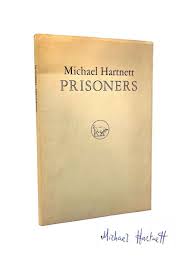


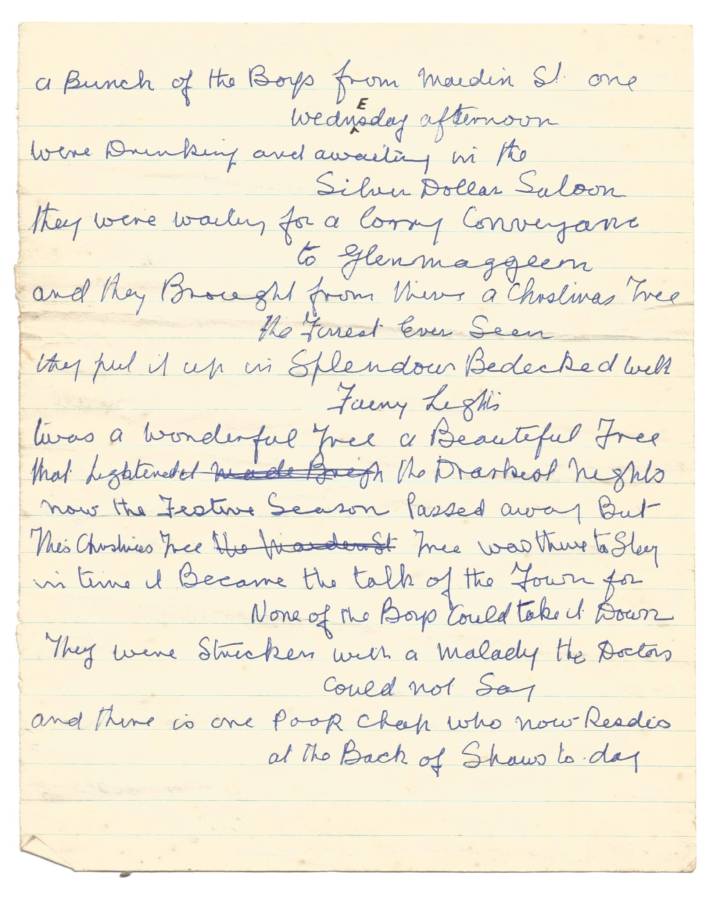
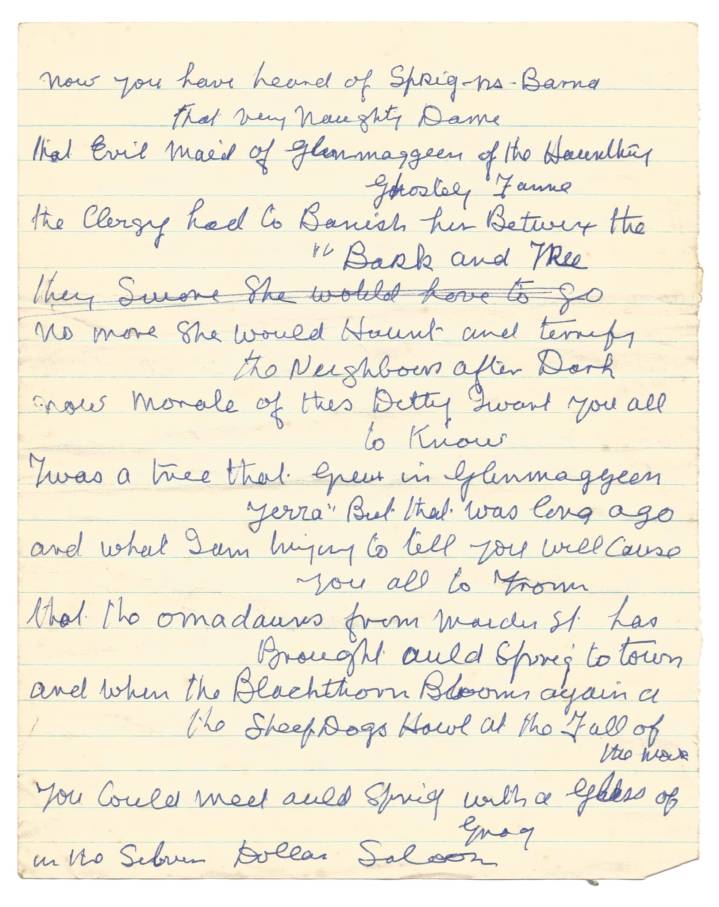
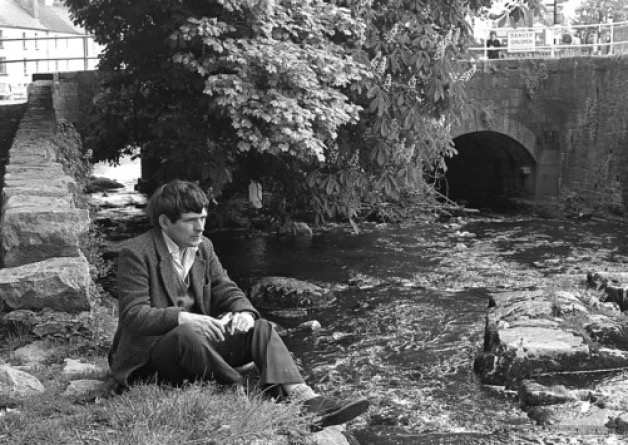


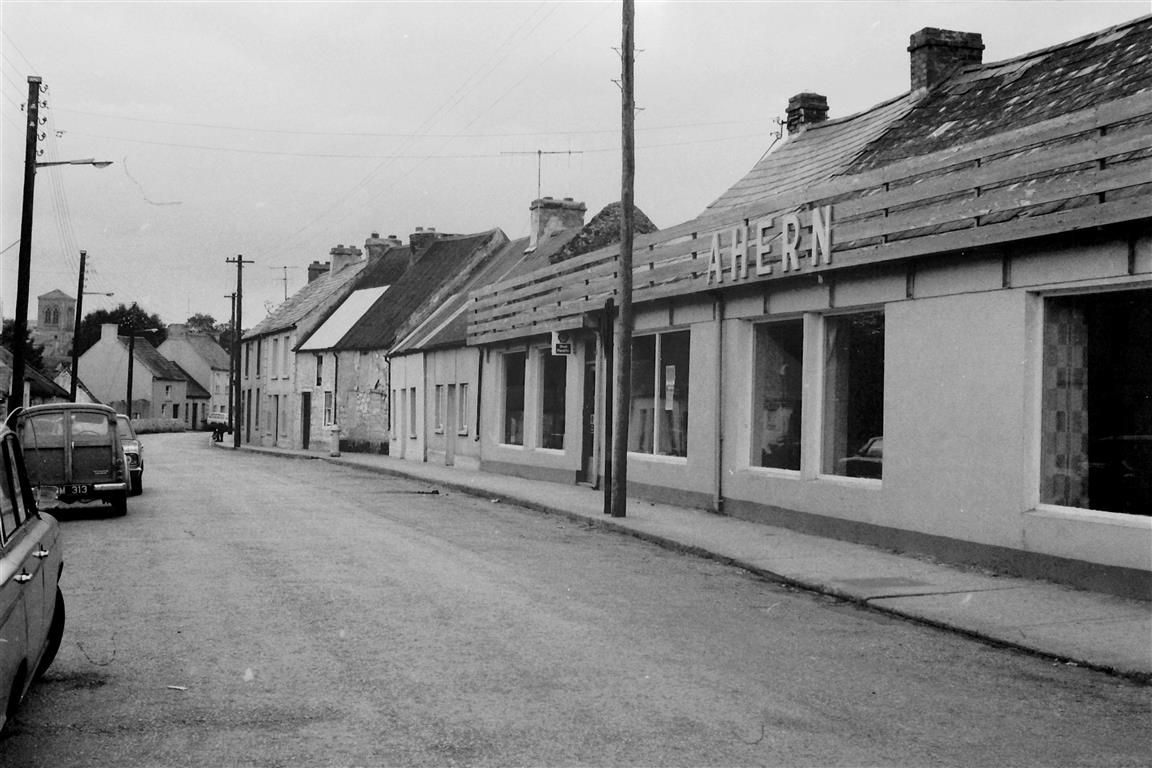


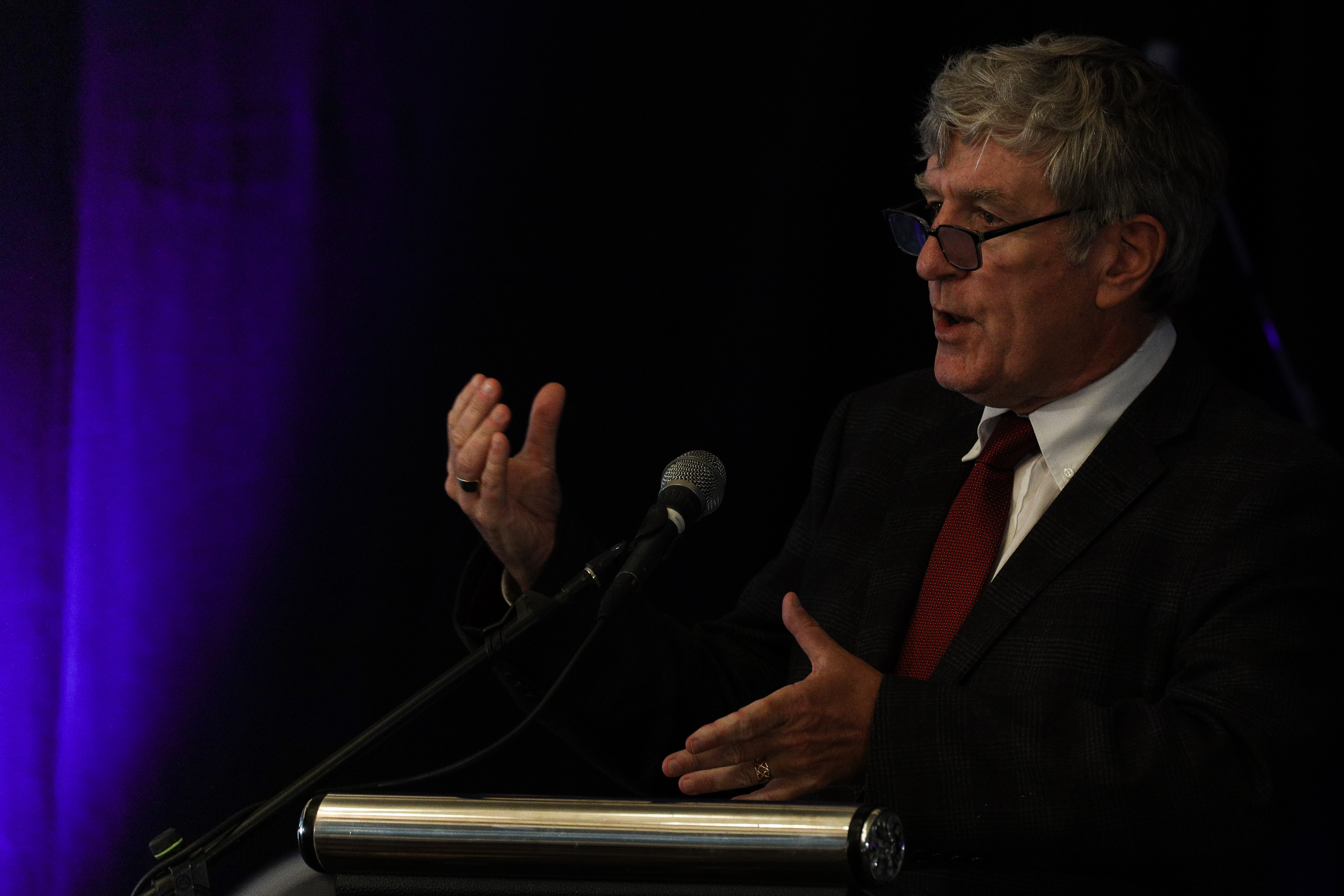


 Reviews Rants and Rambles
You must be logged in to post a comment.