Analysis
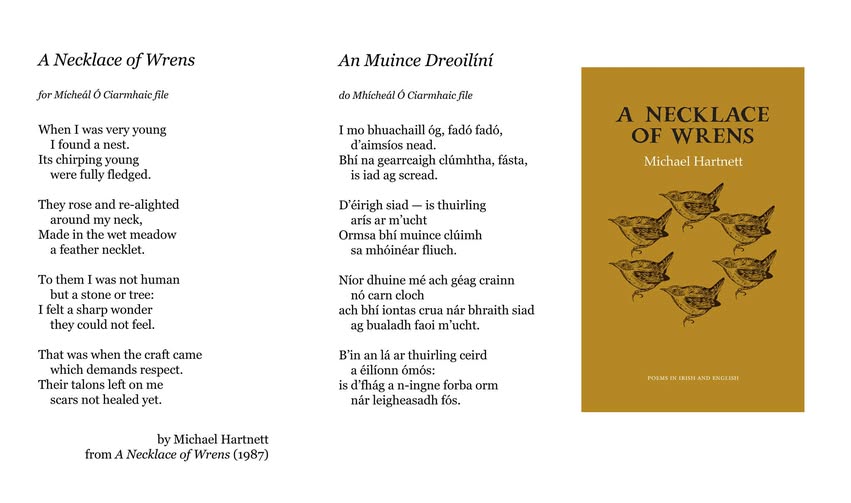
The Irish (and probably original) version of this poem first appeared in Adharca Broic (1978), Hartnett’s first collection in Irish. Thirteen poems from this collection later appeared in the 1987 collection A Necklace of Wrens, along with English versions/translations by the poet himself. Both collections were published by the Gallery Press.
This is probably one of the very few poems in which a poet pinpoints the epiphany moment when he knew he would be a poet. It is a memory poem, an early childhood memory from his time spent with his grandmother, Bridget Halpin, on her small farm in Camas, situated near the village of Raheenagh in the parish of Kileedy in West Limerick. In a poignant documentary made by Pat Collins shortly before the poet’s untimely passing, he says that when he told Bridget Halpin the story of the wrens, she replied, ‘Aha, you’re going to be a poet’.
The language is simple and childlike, and it is one of several poems that feature his grandmother and her influence on the very young Hartnett. We know that Hartnett spent some time with Bridget Halpin and her son, Dinny, his uncle, in the early 1940s, the war years, during what we Irish euphemistically called ‘the Emergency’, and before he started school in Newcastle West.
This poem (and its English translation by the poet himself) should be read alongside other memory poems featuring Camas, such as A Small Farm and the iconic Death of an Irishwoman. Indeed, if we come to this poem by reading it in the 1987 collection, A Necklace of Wrens, we begin to notice the nuances, the subtle whispers, which the poet reveals to us through his mastery of two languages. The original version, in Irish, was written while he lived in Glendarragh, Templeglantine, in the mid-seventies. The English version/translation was produced for the 1987 collection, ten years later, and like the wrens in the title poem, here Hartnett’s words ‘re-alight’ into English. He does not merely translate his poems; he refashions them again.
The memorable woodcut by Michael Kane on the book jacket of A Necklace of Wrens depicts a circle of six stylised wrens in profile. The disconcerting symmetry and packed sharpness of the images prepare us for the poem’s mysterious paradox. We need to remember that the poet wrote the poem in his mid-thirties, describing a memory of an event that took place when he was four or five years old. Do not be fooled by the simplicity of the poem – in two languages! The poet subtly suggests multiple layers of meaning. For example, the image of the ‘muince’, or torc in Irish and Viking culture, or the canque used in China and other Asian societies, is quite ambivalent. A necklace can be a decoration, a fashionable ornament, but throughout history some societies have also used it as a method of torture and subjugation, of punishment and humiliation. Down through history, to the present day, we come across very extreme examples such as the garrote used during the Spanish Inquisition or the very brutal necklacing used in South Africa by the ANC in the 70s and 80s.
The simplicity of the storyline and its brevity are astonishing. The poet is embarking on a new road, a brave adventure. This is one of his early efforts to write in Irish, and the results are astonishing. The story has a childlike simplicity. The Irish version uses classic fairy-tale elements such as ‘fadó, fadó’, or ‘Once upon a time’. The English version is more prosaic: a young child walking in the meadow finds a wren’s nest. The fairy-tale motif soon fades, however, and this story does not have a happy ending. At the poem’s end, the poet is left with ‘scars not healed yet’. The Irish version simply expresses wonderment that the young wrens could not feel the beating of the poet’s heart. The English version doubles down on this inference, referring not only to the sensory world but to the poet’s internal emotions: the very feeling that inspires the poetic utterance is denied to the wrens, thus privileging human subjectivity. One could claim that both versions of the poem begin with a lie. He tells us he ‘found a nest’, ‘d’aimsíos nead’. In fact, the young, mischievous, inquisitive Hartnett finds and disturbs the wren’s nest, and the fledged chicks and their mother explode from the nest in full survival mode.
The verse structure in both versions of the poem is very similar. The end-line rhyme is very controlled in the Irish version: ‘Fadó/fásta’, ‘nead/scread’. The English version is not as tightly controlled, apart from ‘young/young’ in stanza one. The loss of its rhyming scheme in the English translation adds to its plaintiveness. The language in both the Irish and English versions is spare, countering any tendency towards disbelief. Each compact quatrain is clipped and regular, made to resemble the birds it describes. The poet has returned to writing in English after his ten-year sojourn in West Limerick ends, and he shows his craft in subtle ways: ‘fully fledged’.
The verb ‘re-alighted’ in stanza two suggests that the birds settled around his neck and shoulders in the same formation in which they’d perched in the nest. It hints at another meaning of ‘alight’ – to alight upon something, to discover it suddenly. ‘Feather necklet’ beautifully encapsulates the near-weightless delicacy of the tiny birds. The poem points to Hartnett’s ecocentric credentials as a nature poet. Nature, in the form of the young wrens, has bestowed the gift; he has been anointed and ordained. And ‘the craft’ is further qualified: it’s the craft ‘which demands respect’. So the poet places himself, and the poet to whom he dedicated the poem, Mícheál Ó Ciarmhaic, as direct inheritors of the bardic tradition. Hartnett fully accepts the weight of responsibility this anointing brings: his anointing as a poet will entail a public role and accountability.
‘That was when the craft came’ implies that the wren’s gift was the gift of poetry. The poem is dedicated to Mícheál Ó Ciarmhaic (Michael Kirby), who was a fellow poet, painter, farmer, and fisherman from Ballinskelligs, County Kerry. Ó Ciarmhaic spent most of his life working the land and sea on the Iveragh Peninsula, looking out on Skellig Michael. He didn’t begin publishing his literary work until late in life, releasing his first book, Cliathán na Sceilge, in 1984 at the age of 78. When Hartnett returned to West Limerick in 1975, after announcing his intention to bid farewell to English and focus instead on the Irish language, he began a process of total immersion in Irish. One of his favourite places was the Ballinskelligs Gaeltacht (or what was left of it). There, Mícheál Ó Ciarmhaic, Mícheál Ó Siochrú, and others who understood what Hartnett was undertaking welcomed, befriended, and mentored him. Unlike Hartnett, who died at the age of 58 on the 13th October 1999, Ó Ciarmhaic passed away in April 2005 at the ripe old age of 98.
The wren (like Hartnett himself) is diminutive but has a huge voice; it combines vulnerability and power. It figures importantly as the traitor-bird in Irish folklore and is still persecuted in a yearly ritual by the ‘wranboys’ on St. Stephen’s Day. The ‘wranboys’ journey from house to house in rural Ireland, singing, ‘The wren, the wren, the king of all birds’. They sing and play music, expecting money to ‘bury the wren’. The word’s etymology also suggests that the wren is the druid-bird in Irish folklore, and that, for Hartnett, is its deeper symbolism.
The ‘sharp wonder’ felt earlier connects later to the quality of the clinging talons. A sometimes overdone and cliched idea of ‘the suffering poet’ gains a naturalistic thrust from this metaphor. The talons of the gift are sharp and cut deep. But we see no blood, hear no cries: we are simply told about the unhealed scars. The tone is bereft of self-pity. It is the craft that ‘demands respect’ – not the side-effect, the scarring. However, those who knew Hartnett in Newcastle West, in Glendarragh, and later in Inchicore will vouch for his tortured psyche. He did suffer for his ‘craft’; marital breakdown, family turmoil, dislocation, and alcoholism being the public ones we know of.
The acclaimed documentary by Pat Collins, also aptly named A Necklace of Wrens (1999), ends with a very poignant, philosophical reverie by the then-ailing Hartnett as to whether he considered his ‘craft‘ a gift or a curse:
It’s very difficult to describe where poetry comes from. It certainly was given to me, but so were my brown eyes and my big ears. They are just part of what I am, to coin a phrase. I believe it’s a gift, certainly, and I’m lucky to have it. But also it’s a curse, so I’m in two moods about it, really. I could say I did it all myself, which would be a total lie because there’s an entire three or four thousand years of tradition behind me in many languages. But whether it was given or not, I can’t answer that question. It just turned up, and I turned up to meet it, and we met at the crossroads and got married, and we’re still married.
‘Muince Dreolíní’/‘A Necklace of Wrens’ sees Hartnett create an origin myth which relates to his beginnings as a poet. The Irish version begins with the phrase ‘fadó, fadó’, traditionally used to recount an old myth or legend, prefiguring the fantastic details that follow. Hartnett situates his poetic birth at a moment of immediate interaction between man and the natural world. The poem is redolent of ritual as the natural world confers upon the poet a sacrament which makes real the ‘gift of poetry’. The sacrament is not one of communion, however. This interaction with nature leaves Hartnett damaged; the ecocentric space wherein the poet realises his poetic self is marked not by affirmation but by solemnity and a counting of the cost of this transgressive experience:
That was when the craft came
which demands respect.
Their talons left on me
Scars not healed yet.
**********
Hartnett’s just reward came six years after this beautiful poem was first published in Adharca Broic (1978). Because of his dedication to his ‘craft’ and his growing reputation, along with the critical acclaim surrounding his bilingual poetry and historical translations of the works of Ó Bruadair, Ó Rathaille and Haicéad in the mid-80s, Michael Hartnett was elected and co-opted by his peers as a member of Aosdána, Ireland’s prestigious academy of artists, in 1984.
References:
Collins, Pat. (Director). (1999). A Necklace of Wrens [Film]. Harvest Films.
Hartnett, Michael. Adharca Broic, The Gallery Press, Oldcastle, County Meath, 1978
Hartnett, Michael. A Necklace of Wrens, The Gallery Press, Oldcastle, County Meath. 1987.
Hartnett, Michael, Collected Poems, The Gallery Press, Oldcastle, County Meath, 2001. (A Small Farm, p. 15, Death of an Irishwoman, p. 139).


You must be logged in to post a comment.