Some Personal Thoughts on ‘The Road not Taken’ by Robert Frost

two_roads_in_a_yellow_wood_-robert-frost

The Road Not Taken


by Robert Frost

Two roads diverged in a yellow wood,
And sorry I could not travel both
And be one traveler, long I stood
And looked down one as far as I could
To where it bent in the undergrowth;

Then took the other, as just as fair,
And having perhaps the better claim,
Because it was grassy and wanted wear;
Though as for that the passing there
Had worn them really about the same,

And both that morning equally lay
In leaves no step had trodden black.
Oh, I kept the first for another day!
Yet knowing how way leads on to way,
I doubted if I should ever come back.

I shall be telling this with a sigh
Somewhere ages and ages hence:
Two roads diverged in a wood, and I—
I took the one less traveled by,
And that has made all the difference.

‘The Road not Taken’ has always been a very popular poem and despite 21st Century developments such as Google Maps and iPhones and Sat Navs it still bears a relevance for the modern reader.  Then again not all journeys are easily mapped and some take place off-road!  This lyric poem, a first-person narrative tale, describes  a key moment in the poet’s life.  In the poem, the speaker, whom we can assume is Robert Frost himself, is faced with a choice that appears quite suddenly as he walks along a forest track.  Imagine walking through beautiful woodland in upstate New York or Vermont as the Fall takes hold and imagine at this moment, the route on which you travel diverges into two separate paths.  This mirrors the poet’s dilemma in the poem and he faces a difficult decision that has to be made for the moment, yet may have repercussions that last a lifetime.  This is what makes the decision so difficult.

If you consider, briefly, some decisions you make in your own life, you know that you might make hundreds of choices in any one day, most without even noticing!  Deciding where to go for lunch is usually not too difficult; however, a much more difficult decision is the career to follow after your Leaving Cert or A Levels.  Your choice may affect your life for many years and so you tend to take time and effort in arriving at that decision.

So, Frost comes to a fork in the road.  If taken on a literal level, the choice is simply the path along which to continue.  However, if these paths are seen in a symbolic or allegoric way, then the choice is more challenging.  Great poetry and literature have always given us many examples where life is seen in terms of a journey on which we will meet many twists and turns.  So, therefore, the moment described so beautifully in the poem could be such a moment in anyone’s life.

The poet considers his options carefully.  He looks down both paths, ‘as far as I could’ in an attempt to see what they might offer.  But his view is limited by the bend as the track veers into the undergrowth.  It is, in other words, impossible to foresee what future may lie ahead – and Frost did not seem to have the luxury of a Change-of-Mind slip!  At first, each alternative is equally appealing or ‘just as fair’.  Similarly, both roads diverge into ‘a yellow wood’ – Vermont in all its Autumnal glory!  The first path, however, is a more popular route, while the other less-traveled path is overgrown and ‘wanted wear’.  The choice is clear but not at all simple: the common, easy path or the unusual, more challenging path?  The first road might prove more reliable, even reassuring, for others have gone that way.  The more difficult road, however, may produce a less predictable outcome yet perhaps a more fulfilling and individual one.

The poet is aware that the minor difference between the paths at this time will become major differences as the paths diverge further into the woods and into the future.  Each path is attractive and alluring in its own way, but he cannot travel both.  You can’t have your cake and eat it!  This he regrets.  Nonetheless, he decides.

Even as he travels his chosen path he still wonders about the path he has rejected and hopes to keep ‘the first for another day’.  Yet, he knows in his heart that ‘way leads on to way, / I doubted if I should ever come back’.  The poem, in this way, suggests that we can only hope to explore a very limited number of life’s possibilities.  Finally, the poet ‘sighs’, happy with his choice, yet wondering what if…..?  What experiences might have occurred along the other path?  Certainly, his choice has ‘made all the difference’.  That is gratifying; the decision has had a positive effect on his life and he is thankful for that and overall seems pleased with the road he has chosen.

This poem reminds us that important decisions in life are not exact predictions.  We base our choice on reflection of what might be encountered along the way.  Like Frost, we all hope that our major decisions will make ‘all the difference’ in our lives.  We need to believe they will.

Frost believed that each poem was a ‘little voyage of discovery’; a path to something else, rather than an end in itself.  Perhaps, the road not taken is just such a voyage?

 FROST (7)

Analysis of ‘The Harvest Bow’ by Seamus Heaney

DSC_0023                             

The Harvest Bow

       by Seamus Heaney


As you plaited the harvest bow
You implicated the mellowed silence in you
In wheat that does not rust
But brightens as it tightens twist by twist
Into a knowable corona,
A throwaway love-knot of straw.

Hands that aged round ashplants and cane sticks
And lapped the spurs on a lifetime of game cocks
Harked to their gift and worked with fine intent
Until your fingers moved somnambulant:
I tell and finger it like braille,
Gleaning the unsaid off the palpable,

And if I spy into its golden loops
I see us walk between the railway slopes
Into an evening of long grass and midges,
Blue smoke straight up, old beds and ploughs in hedges,
An auction notice on an outhouse wall—
You with a harvest bow in your lapel,

Me with the fishing rod, already homesick
For the big lift of these evenings, as your stick
Whacking the tips off weeds and bushes
Beats out of time, and beats, but flushes
Nothing: that original townland
Still tongue-tied in the straw tied by your hand.

The end of art is peace
Could be the motto of this frail device
That I have pinned up on our deal dresser—
Like a drawn snare
Slipped lately by the spirit of the corn
Yet burnished by its passage, and still warm.

Commmentary:  This beautiful tender poem is taken from Heaney’s collection Field Work (1979).  In a way it is fitting that I’m publishing this blog post on Father’s Day because this poem explores the close relationship between Seamus Heaney the poet and Patrick Heaney his father.  Heaney’s Mossbawn poems contain numerous references to family members; his mother, his Aunt Mary, his grandfather, his brother and his father who is mentioned most notably in the poem ‘Digging’ but also in ‘Follower’ and other poems.

Heaney’s poetry contains many references to dying rural crafts and traditions and the harvest bow in one such tradition.  The bow was fashioned from freshly cut straw and often given by the maker as a token of love.  Here it is silently fashioned by the father and given to his son, ‘a throwaway love-knot of straw’.

Patrick Heaney emerges as a strong, no-nonsense, unsentimental country man who strides through his fields ‘whacking the tips off weeds and bushes’.  He is a man of few words, a man ‘tongue-tied’ who prefers to express himself in actions rather than words.  Like Barney Devlin in ‘The Forge’ or the ploughman in ‘Follower’ or his grandfather in ‘Digging’, who ‘cut more turf in a day/ than any other man on Toner’s bog’,  Heaney sees his father as a craftsman teaching the young poet-to-be that the artist expresses himself through his work.  Heaney sees in his father’s attention to detail the attitude he wishes to bring to his own work as a poet.

The poem is a tender exploration of the father/son relationship and it is clear that an unspoken understanding grows between them and is expressed through the gift of the harvest bow, which is being fashioned by the father as they both stroll together through the fields of stubble on an Autumn evening.  The poet fingers the harvest bow and reads it ‘like braille … gleaning the unsaid off the palpable’.  He then translates what he has read for us and puts it into words which he fashions and plaits and weaves into a poem.  This is reminiscent of the poet’s conclusions in ‘Digging’ – he wants to follow in his father’s footsteps but instead of digging with a spade he will use his pen.

This poem was published in 1979 at the height of the Northern ‘Troubles’ and it sees Heaney retreating again to a happy childhood memory to erase the pain of the daily catalogue of shootings and bombings.  The motto used at the beginning of the final stanza, ‘The end of art is peace’, therefore, is rich in meaning and open to many interpretations.  The obvious one is that father and son have achieved a moment of peace and harmony via their respective crafts and of course it has wider political implications also in the context of the continuing conflict in Northern Ireland.  Many commentators at the time accused Heaney of not taking sides, of not highlighting the atrocities of those dark days.  Maybe they have not delved deeply enough into his Mossbawn poems and elsewhere?  (There’s a thesis there for some enterprising young scholar!)

The harvest bow is a symbol of the love and understanding that has developed between the father and son, it is a ‘love-knot’ which joins them together.  The poet remembers those evening rambles with his father through the cornfields and we are struck by the juxtaposition offered us: the young eager poet striding towards his future while the father clings to the traditions and ways of the past:

And if I spy into its golden loops
I see us walk between the railway slopes
Into an evening of long grass and midges,
Blue smoke straight up, old beds and ploughs in hedges,
An auction notice on an outhouse wall—

The harvest bow can also be seen as an emblem of rural life and agricultural labour.  As I’ve mentioned earlier this poem was written during the ‘Troubles’ in his home place and this has a deep, disturbing effect on the poet.  Time and time again he retreats to the safety and womb-like comfort of his Aunt Mary’s kitchen in Mossbawn in an effort to seek some solace and comfort.  There is something deeply psychological and human about this regression of the poet.  He leaves us with this sharp contrast.  The harvest bow is an endearing and enduring symbol of love, a vestige of a long tradition that has been handed down through the generations, yet the poet is forced to live in a society riven with sectarianism and divisions and the annual ‘harvest’ of the dreaded Marching Season, year in year out.

In ‘Sunlight’ he returns to his Aunt Mary’s warm kitchen for consolation while here he looks to his father and the love  and understanding that has grown between them as a source of comfort at a time of personal and public upheaval and distress.

The end of art is peace
Could be the motto of this frail device

OLYMPUS DIGITAL CAMARA
A traditionally crafted Harvest Bow

Words of Encouragement to Those who Work Alone on Ledges

FullSizeRender (2)

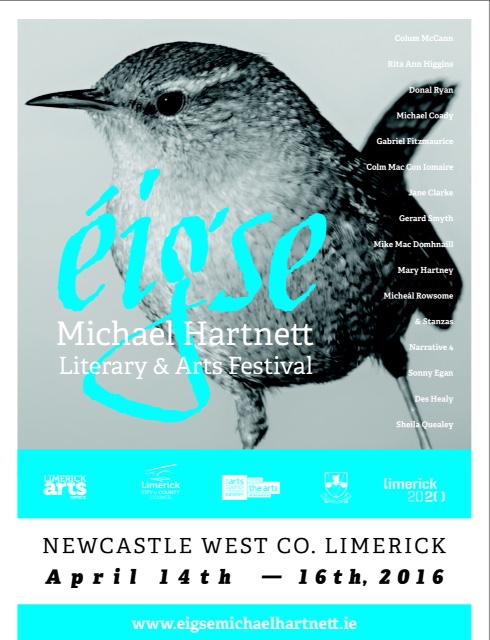
John McAuliffe, joint winner with Doireann Ní Ghriofa of the 2016 Michael Hartnett Poetry Prize says in The Clare Herald, “In  his poem ‘Struts’, Michael Hartnett describes creatures who abide alone, each on their own ‘ledge, / seldom seeing each other — / hearing an occasional shout / above or below / and sometimes and most welcome / seeing fires like silver spirals / jump along the crevices‘. The poem could be describing poets (or academics?), who work alone (on their own ledges) and, every so often, hear good news and celebrate it at events like Éigse in Newcastle West every April.”

“This award is like one of those spiral-like fires. It’s both a confirmation and a great encouragement to receive the award, especially since I’ve been reading and thinking and talking about Michael Hartnett’s poems — the lyrics, the narratives, the ballads — for as long as I’ve been writing,” John said.

This year’s Éigse takes place in Newcastle West with the Official Opening and prize presentation on Thursday 14th April with the keynote address by poet, Rita Ann Higgins, one of this year’s judges along with Gerard Smyth.

Éigse continues throughout the town, in the schools, Library, Red Door Gallery, hospital and pubs until Saturday April 16th – culminating with Colum McCann (in the company of  Colm Mac Con Iomaire who will provide musical accompaniment) reading from his work on Saturday evening at 8pm.

The breadth and diversity of the programme creates an ambience of warmth and conviviality that lends itself to lively gatherings, easy conversation and spirited debate.  In other words……..

Epitaph for John Kelly, Blacksmith

FullSizeRender - John Kelly's forge
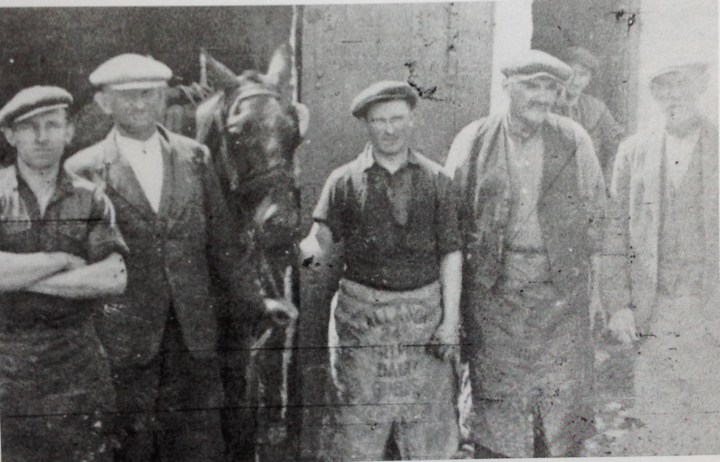
Kelly’s Forge in the 1940’s. L to R: J. O’Kelly, D. Nash, C. McAuliffe, S. O’Kelly. C. Fitzgerald (Information credit Newcastle West in Close Up – Snapshots of an Irish Provincial Town published by Newcastle West Historical Society, 2017)

Epitaph for John Kelly, Blacksmith

By Michael Hartnett

Black clothes do not make mourners:

                                      the cries come out of the heart.

And local men at street corners,

                                      who have stood

                                      and watched grained wood

in horse-hearse and motor-hearse,

                                      white plumes of feathers, blue plumes

of smoke, to the dead man’s part

                                      of  town, to the rain-dumbed tombs,

go, talk his life, chapter and verse,

and of the dead say nothing but good.

In Maiden Street

what man will

forget his iron anvil,

in early Monday morning, sweet

as money falling on the footpath flags?

Author’s Note: 
I am grateful to Maighread Medbh for the following keen observation from her blog: “The 1985 edition of Michael Hartnett: Collected Poems, Volume 1, (Dublin: Raven Arts Press, Manchester: Carcanet) printed “to” instead of “go” here (… to the rain-dumbed tombs, / to, talk his life …), which I’ve taken as a typographical error. The original printing, in A Farewell to English (Dublin: Gallery Press, 1978), had “go”.

Commentary:  This poem was written as a tribute to John Kelly, one of the ‘old stock’[1], one of the characters of Maiden Street and the Coole.  The Coole was an area in Newcastle West, which Michael Hartnett referred to as ‘The Claddagh of the town’.  It encompassed an area running parallel to Lower Maiden Street, a lane behind what we now know as The Silver Dollar Bar.

Eigse Michael Hartnett - Sean Kelly
Sean Kelly former teacher and local historian and also the last blacksmith in Maiden Street and son of John Kelly the subject of Michae Hartnett’s Epitaph.

In bygone days, Sean Kelly, John Kelly’s son tells us that there were three forges in Maiden Street – Big Sean Kelly’s forge was located in The Coole on the site of the present St. Vincent de Paul Charity Shop and his son, John Kelly, the subject of this epitaph, had a forge which was located in what Sean Kelly calls, ‘middle Maiden Street’. The third forge was O’Dwyer’s Forge and this was owned and worked by Bill O’Dwyer, father of the late Ned O’Dwyer. These forges were a focal point for the street and for the town, they were places where town and country met, where stories and news and gossip were exchanged, and where tall stories grew legs.  During a fascinating walkabout during Éigse Michael Hartnett this year (2017),  Sean Kelly and John Cussen gave a very interesting history of Maiden Street.  Sean told his listeners that another source of industry in the street during the 19th century and early 20th century were the four natural sandpits which were located along the street – the street being fortuitously located at the end of an ice-age moraine.  Forges were, however, an essential part of Irish rural life and farmers, in particular, used the services of the blacksmith to shoe their horses and make and repair their ploughs and iron gates and other farm utensils.  Indeed in harsher, more troubled times the forge also doubled as an ‘armaments factory’ where ancient pikes, and rudimentary spears and swords were forged and tempered in a clandestine way and often ‘hidden in the thatch’.  In a way, not only is Hartnett lamenting the death of a man here but also, like Heaney in many of his poems, he is lamenting the loss of an ancient craft which, with the progress of time, has become redundant.

In the Annual Observer, the journal of the Newcastle West Historical Society, published in July 1979, Lizzie Sullivan, a long time resident of the Coole, referred to John Kelly’s father and his importance to the area:

“I can’t forget our blacksmith, Big Shaun Kelly.  He had his forge in a part of the Coole.  He was a fine type of a man, big and brave and he had a voice to go with it.  Many a day the youths of the Coole spent in his forge.  They used to love when they were asked to blow the bellows and Shaun would be singing or telling them stories as they made the sparks fly from the anvil.  He used to have them shivering telling them all about Sprid na Bearna and the dead people he met going home on a Winter’s night.  They believed every word he used to tell them”.

This epitaph, however, is composed to honour Big Shaun Kelly’s son, John, and like all epitaphs, this poem is short and sweet.  In the opening stanza, death and funerals are generalised.  Hartnett doesn’t seem to be talking about any particular death but remembers numerous funerals down the years and he refers to the funeral customs observed in the town.  Quiet men standing at ‘street corners’ looked on the ‘grained wood’ of the coffin as it passed, either in ‘horse-hearse’ or ‘motor-hearse’, on its way to the old graveyard in Churchtown.  There amid ‘the rain-dumbed tombs’ it was customary to speak well of the dead:

          go, talk his life, chapter and verse,

and of the dead say nothing but good.

The second stanza presents us with the real epitaph.  It is short, personalised and very well crafted.  Everyone in Maiden Street will remember the ring of the anvil on a ‘Monday morning’ and Hartnett uses a lovely simile to remember his friend: Heaney uses the image of an ‘unpredictable fantail of sparks’ coming from the anvil in his poem, ‘The Forge’, and here those sparks from John Kelly’s anvil are compared to money falling on the ‘footpath flags’.  His exquisite use of assonance and alliteration in these short lines emphasises his poetic craft.  The poem is also noted for its use of compound words such as ‘horse-hearse’, ‘motor-hearse’,  and ‘rain-dumbed tombs’, which hopefully, in time, will be used as an excellent example of alliterative assonantal onomatopoeia!

In ‘Maiden Street Ballad’, Hartnett similarly remembers with fondness the work of John Kelly:

XXXVIII

I awoke one fine morning down in Maiden Street

to John Kelly’s forge-music ringing so sweet,

saw the sparks flying out like thick golden sleet

from the force of his hammer and anvil:

and the red horse-shoes spat in their bucket of steam

and the big horses bucked and their white eyes did gleam

nineteen forty-nine I remember the year –

the first time I got my new sandals.


There is a strong ‘local’ element to Hartnett’s writing – he tells us in Maiden Street Ballad that,

A poet’s not a poet until the day he

                             can write a few songs for his people.

This loyalty to his native place and space and the people who live there is admirable and is acknowledged with gratitude by those same locals to this day.  Seamus Heaney, in his introduction to John McDonagh and Stephen Newman’s collection of essays on Hartnett, entitled Remembering Michael Hartnett, says that,

Solidarity with the local community and a shoulder to shoulder, eye to eye relationship with local people distinguish Hartnett and make him the authentic heir to the poets of the Maigue.

These local people, John Kelly and his father before him included, had a great influence on the young Hartnett as Heaney also points out in that same introduction:

The young Hartnett rang the bell, and images from the world of the smithy would turn up in some of his most haunting work, as when a rib of grey in a woman’s hair is compared to a fine steel, ‘filing on a forge floor’ (‘The Retreat of Ita Cagney’).

But I’ll leave the last word to Lizzie Sullivan remembering Big Shaun Kelly and his contribution to life in Maiden Street and The Coole :

“When the circus was coming to town, Shaun the Smith would be talking for days before it came… It was lovely to see all the fine horses and ponies.  There would be thirty or forty going up to Kelly’s Forge.  Then, when the circus was gone away he would be still talking about it for days.  He would let Sprid na Bearna rest, and all the other ghosts he used to see.  He made many a one happy, especially the young lads listening to him….. God be with the Coole and all the fine people that are gone!

FullSizeRender (12) Big Shaun Kelly
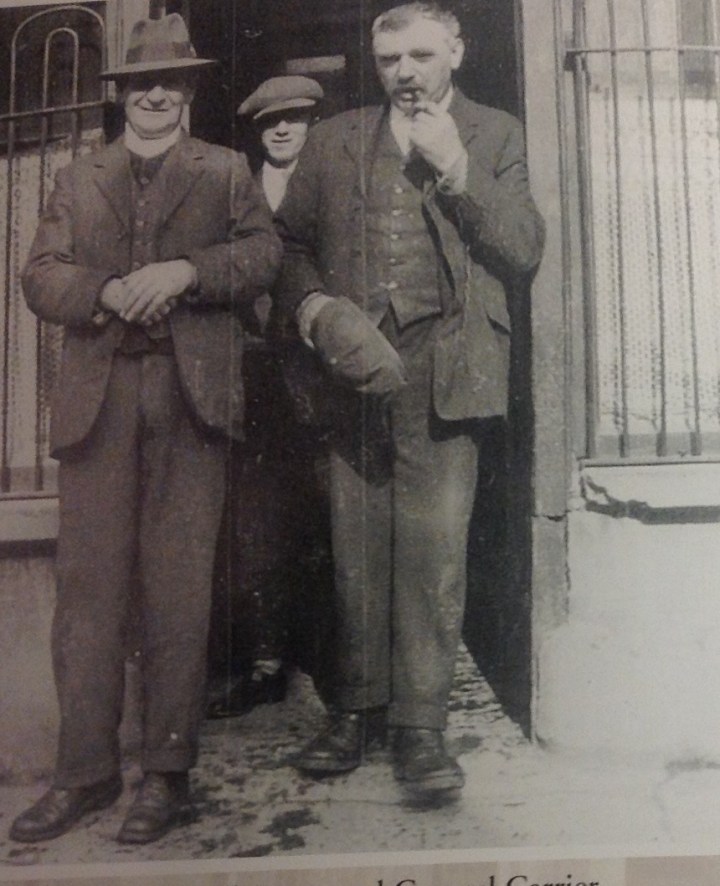
Town Crier Bill Poster and General Carrier John Lenihan pictured at the left of the door of big Sean Kelly’s house in Maiden Street. Sean Kelly is seen smoking his pipe. Information gleaned from Newcastle West in Close Up – Snapshots of an Irish Provincial Town  published by Newcastle West Historical Society (2017).

[1] Hartnett assures us in a footnote to ‘Maiden Street Ballad’ that to qualify as ‘old stock’ a family had to be established in the town for at least three generations.  He goes on to say that the phrase can also be very useful if you meet someone in the street and you can’t remember their name!

Works Cited

McDonagh, John and Newman, Stephen eds. Remembering Michael Hartnett, Four Courts Press: Dublin, 2006

Newcastle West Historical Society publishers of ‘Newcastle West in Close Up – Snapshots of an Irish Provincial Town’ (2017).

The Poetry of Dylan Thomas

Dylan-thomas
Dylan Thomas, oil on canvas, by Augustus John, 1938.

THE POETRY OF DYLAN THOMAS

(with particular focus on ‘Fern Hill’ and ‘A Refusal to Mourn’)

Dylan Thomas’s poetry has always attracted diverging views, attracting some readers and repelling others.  In certain ways he is the last of the Romantic poets, and like most poets in that tradition he liked to experiment with words.  He was perhaps the only modern poet to experiment persistently, hence the bewilderment of his audience when his early poems were published in the mid-1930’s.

The poetry of the twentieth century can be divided roughly into two main categories.  There is, first of all, the tradition established by Yeats and Eliot which attempted to comment on and influence major social issues in an effort to bring about reforms.  Yeats’ ‘September 1913’ and Eliot’s ‘The Waste Land’ (1922), are two good examples of this tradition.  Both poets express similar attitudes, namely disgust at the degeneracy of modern life, and both poets advocate a return to past virtues as a means of displacing society’s unpleasant aspects.  For Eliot and Yeats therefore, a significant aspect of a poet’s role was that of social commentator, and with them a tradition was established which continued to be a dominant one throughout the first half of the twentieth century.

The poetry of Dylan Thomas, however, diverges sharply from this tradition and to a large extent he remains outside it.  His poems had so little of the realism of Eliot and Yeats that they took the contemporary literary scene by storm.  Being at heart a Romantic poet, Dylan Thomas preferred to write poems that were completely devoid of social issues and unlike Yeats and Eliot he did not feel the urge to reform the world.  Modern poets in general had come through the Great War with a new sense of function and responsibility.  This sense of conviction, of important work to do in a political or social context, is completely lacking in the works of Dylan Thomas.  Indeed, this lack of an urgent poetic content seemed naive to many early readers, particularly at a time when Europe had emerged tragically from one World War, and seemed likely to get entangled in another.  In ‘Fern Hill’, for example, Dylan Thomas describes his memories of childhood in Wales in the years after the Great War.  The picture he creates, however, is so beautiful and idyllic as to be almost unreal.  The real Wales of the time, many early critics suggested, was in sharp contrast to that described in the poem.

Similarly in ‘A Refusal to Mourn’, a poem which describes the death of a child killed in an air-raid, no reference is made to the terrible atrocities of war.  ‘Fern Hill’ was also criticised in other respects.  Besides its lack of serious content there was the more serious charge of a complete lack of meaning.  Indeed, like much of his poetry, ‘Fern Hill’ was strongly criticised as being almost totally obscure.  Thomas himself realised the problem his poetry in general, and ‘Fern Hill’ in particular, presented to readers.  He remarked how his poems were always rigorously compressed, being ‘as tight packed as a mad doctor’s bag’.  The poet and critic Geoffrey Grigson, who published Thomas’s early work in his influential magazine, New Verse, (where he also published W.H. Auden and Louis McNeice), and who recognised Thomas’s promise was one of the first to comment on its obscurity.  He attacked Thomas for his neglect of a continuous line of meaning, for his use of ‘towering phrases’ which imply so much but say very little, and for his tendency to be ‘over-fantastic’ and obscure.

To understand the poetry of Dylan Thomas one must consider him as a modern exponent of the Romantic tradition.  Indeed, it is only in the context of this tradition that one can really characterise his particular method and identify his major themes.  Throughout the first half of the twentieth century Romantic poetry was steadily in decline.  Eliot, in particular, had dismissed all poetry in the Romantic tradition as obsolete and unacceptable in a modern context.  In its stead he substituted a new urban poetry which is so often full of depression, anger and despair (e.g. ‘The Love song of J. Alfred Prufrock’).  Dylan Thomas, however, completely rejected the modern mode of expression, and returned instead to the Romantic poets for his principal themes and his characteristic method.  Whereas Eliot and Yeats describe a world which is often dark and depressing, Dylan Thomas reaffirms a personal faith in life.  His poetry is subsequently filled with a sense of joy and optimism.

Dylan Thomas’s working life as a poet lasted a little over twenty years but the most extraordinary thing about it was how much of the foundations were laid down in a very short period towards the beginning.  He was writing profusely in his early teens and when he was seventeen he began work on some of the poems for which he is still remembered.  Between the years 1931 and 1935 he drafted, and in many cases actually completed, most of his best poems.  In other words he had already created the most important parts of his work by the age of twenty-one.  Despite his basic differences with T.S. Eliot, he adopted Eliot’s habit of rejecting nothing, and lines or sections that were unsustainable or unsuitable for one poem often found their way into another.  Years later he still continued to draw on material from his adolescent notebooks.  Indeed, out of these notebooks and casual jottings grew the most famous poems he published in his lifetime and those for which he is remembered after his untimely death.  He composed by selecting the best expressions from his notebooks, reordering and perfecting them until he was satisfied with their sequence.

‘Fern Hill’ and ‘A Refusal to Mourn’ are typical examples of Dylan Thomas’s poetic method.  Both poems depend on a common Romantic assumption that the natural world is self-explanatory: things die and are born again in a constant process of death and renewal.  We notice, therefore, how nature is often strongly incorporated into his poems.  In a letter dated March 1935 he speaks of how his, ‘pre-conceived symbolism derived from the cosmic significance of nature’.  Thus, both ‘Fern Hill’ and ‘A Refusal to Mourn’ are overlaid with a strong natural imagery.  He is particularly attracted to natural images, which suggest youth and vitality, but we also find him returning constantly to ideas of transience and death.  Indeed, throughout his poetic career he remained haunted by the reality of death, and perhaps his chief contribution to English poetry was his sustained vision that life and death form part of a great process shared by all created things.  Both ‘Fern Hill’ and ‘A Refusal to Mourn’ begin with the assumption that we start to die from the moment we are born, even indeed from the moment we are conceived.  This continuous process of dying extends to all living things.  The entire thought of ‘Fern Hill’ is based on this idea, though it does not become explicit until the final stanza:

                   Oh as I was young and easy in the mercy of his means,

                   Time held me green and dying

                   Though I sang in my chains like the sea.

In ‘A Refusal to Mourn’ the theme of death is seen in a slightly different context as the poet surmises on the probability of another existence.  Here he suggests that the world into which we are born and in which we die is not the final world; that there is another existence on the other side of things.  Again he expresses his ideas through use of comparisons with natural things.  Nature ‘dies’ each year and renews itself with the return of every spring; but for man there is only one death, ‘After the first death there is no other’.  Yet this realisation of the eternal presence of death does not allow the poet to grieve over the dead child, or to encourage false sentiments by a vain display of tears.  This poem is not so much a discussion of the child’s death, as a presentation of Thomas’s attitude to the idea of death in general.  He thinks of death as a slow, relentless process, rather than as a sudden pathetic end to life.  This process of destruction extends to all living things and he sees no reason to mourn when the process is finally completed.

The poem begins with a great statement as befits some good, cosmic occasion.  The first two stanzas, and the first line of the third, are one sentence with the skeleton grammar: ‘Till doomsday I will not mourn for the dead child’.  Darkness is described as making mankind, ‘fathering’ birds etc.. and ‘humbling’ all.  As such it is more than a personification of death: it is unknown, undeveloped nature from which all life comes and to which it will eventually return.  One critic suggests that darkness might also refer to God the Father who is described in the Book of Genesis as making the world out of nothing.  Water is always used in Thomas’s poetry as a fundamental life-giver.  Here it is joined with the reference to corn and behind each is the idea of change and transformation.  Corn was said by St. Paul to die in the ground before it receives the rain whereby it sprouts again.  In this manner it is transformed into a more perfect element.  The general theme of the poem is clear: all people, no less than this young girl, are transformed by death into more perfect states, and the whole process of dying is a natural precondition for this transformation.  Throughout the poem ordinary words are used to suggest mystic processes: ‘The majesty and burning of the child’s death’; ‘The grains beyond age, the dark veins of her mother’.  Behind this poem is the biblical idea of death as a change of life rather than as an end of it.  In the final stanza, therefore, we are given a great image of the relentless continuance of life as the Thames, bearing the young girl’s spirit, flows away to the sea.

In ‘Fern Hill’ the emphasis is on life rather than on death, yet we see how the pervasive presence of nature is a dominant feature of this poem also.  From the beginning of the poem the boy’s experiences are described in terms of natural images and his simple vitality is seen as a gift of nature soon to be withdrawn.  Phrases like ‘all the sun long, all the moon long’, show how the child measured time by nature , not by the clock, and how each day seems a long savouring of experience.  As the poem progresses, however, the facts of time become more insistent and the pathos of transience can no longer be ignored, ‘The children green and golden / Follow him out of grace’; ‘And wake to the farm forever fled from the childless land’.  The lack of grammar in these stanzas makes them appear, as in Chapter 1 of James Joyce’s, Portrait of the Artist, as if part of a dream-like reflection.  This nostalgic emphasis on childhood is yet another dominant feature of Romantic poetry.  In one of his most famous poems Wordsworth wrote that, ‘Heaven lies about us in our infancy’, an idea to which Dylan Thomas also subscribed.

Wonderfully rich in visual imagery, the words of ‘Fern Hill’ combine together in highly original ways to picture the joyful exhilaration of a child.  This can be the cause of some confusion for readers.  Striking phrases like , ‘happy as the grass was green’, ‘prince of the apple-towns’, or ‘at my sky-blue trades’, are surprising by their novelty and at first it is difficult to be sure what effects are intended.  These unusual images are evocative rather than precise: their purpose is to create a strong emotional atmosphere.  Dylan Thomas deliberately uses all his poetic powers to combine in one image a wider range of associations.  Being essentially a Romantic poet, he is trying to communicate an experience, which is almost beyond expression.  In the repetitions, ‘it is lovely’, ‘it is air / And playing lovely, and watery…’, he seems to be straining after an ecstasy which can never be completely expressed in words.  He is celebrating the divine innocence of childhood which, for him, is a mystery almost beyond analysis.

The second stanza reminds us how for a child roaming the countryside, time moves slowly through long mornings of pleasure.  But much more than this is implied.  The noise of water passing over the pebbles is like Church bells calling the boy to worship.  Dylan Thomas is aware of the power of time but instead of becoming melancholy he sees the joy of his childhood as something for which to be thankful, being itself part of the wonder of creation.  Instead of giving way to regrets he rejoices in what has been.  Thus, the boy’s emotions transform every object he sees: ‘the lilting house’, ‘happy yard’, ‘gay house’.  He is, ‘honoured among foxes and pheasants’, an integral part of all natural things.  But he also achieves an exalted state: he is a ‘prince’, ‘honoured’ and ‘lordly’.  Lines such as ‘the big fields high as a house’ evoke a sense of abundance, of a world of plenty, of which the boy’s youthful joy is but a part.

These expressions of mystery and wonder reach a climax in stanza four.  When he awakes in the morning, the farm appears like the Garden of Eden, a revelation of earthly innocence.  It is typical of Thomas that this awareness is expressed in religious terms:

                   And then to awake, and the farm, like a wanderer white

                   With the dew, come back, the cock on his shoulder: it was all

                   Shining, it was Adam and maiden,

                   The sky gathered again

                   And the sun grew round that very day.

From the beginning of the poem the boy’s simple vitality is seen as a gift of time to be withdrawn.  The final image of the sea repeats the previous evocations of energy and abundance; but like the child it too is confined and restricted in its range by natural forces.

An important characteristic of ‘Fern Hill’ is the manner in which Dylan Thomas develops his ideas through imagery, verbal repetition, and other stylistic devices.  The prose meaning of his poems – their paraphrasable content – is usually simple.  What is difficult, however, is their verbal texture.  In his prose writings he has stressed the importance of metaphor in his poetry, which often causes difficulties of interpretation to arise.  In one of his few statements on his own poems he describes his peculiar method of composition with particular regard to his use of imagery:

‘A poem by itself needs a host of images.  I make sure – though ‘make’ is not the word; I let, perhaps an image be ‘made’ emotionally in me and then apply to it what intellectual and critical forces I possess; I let it breed another, let that image contradict the first; make of the third image bred out of the other two together, a fourth contradictory image and let them all conflict within my imposed formal limits.  The life of any poem of mine cannot move out of the centre; an image must be born and die in another; and any sequence of my images must be a sequence of creations, recreations, destructions, contradictions…’

This concept of the image determines the construction of ‘Fern Hill’.  Sequences of images are linked together without the relationship imposed by ordinary syntax, so as to provide a uniquely original form of poetry.  Words are arranged in terms of their musical effects, and individual stanzas abound with references to music.  In ‘Fern Hill’ these references are numerous, ‘the lilting house’, ‘singing as the farm was home’, ‘the Sabbath rang slowly’, ‘the tunes from chimneys’, ‘it was air / and playing’, ‘all his tuneful turning’, ‘I sang in my chains like the sea’.  The opening stanza expresses the poet’s experiences clearly.  Music, as conceived by the Romantics, is identified with nature.  Words are listed for their sound properties and are densely woven into poetic rhythms.  To these, also, are added colours suggestive of youth and vitality, ‘green’, ‘golden’, ‘white’, ‘blue’.

One of the secrets of Dylan Thomas’s strongly personal style then was his discovery of unsuspected variables in English – again like James Joyce in Ulysses.  Thus, he would write ‘all the sun long’ instead of ‘all day’, ‘once below a time’ instead of ‘once upon a time’, ‘all the moon long’ instead of ‘all night’.  The change to ‘Adam and maiden’ instead of ‘Adam and Eve’ is particularly significant with the connotation of innocence and purity that the first phrase brings.  This gift for revitalising common, general statement was to remain with Thomas all his life.  Indeed, only the great Gerard Manley Hopkins shows a comparable talent for finding similar rich possibilities in worn-out words and phrases.

Dylan thomas (2)


Maiden Street

image
Photograph courtesy of Niall Hartnett

Maiden Street

By Michael Hartnett

Full of stolen autumn apples

we watched the tinkers fight it out,

the cause, a woman or a horse.

Games came in their seasons,

horseshoes, bowling, cracking nuts,

Sceilg, marbles – frozen knuckled,

Bonfire Night, the skipping-rope

And small voices on the golden road

At this infant incantation:

        ‘There’s a lady from the mountains

Who she is i cannot tell,

All she wants is gold and silver

And a fine young gentleman’.


We could make epics with our coloured chalks

traced in simple rainbows on the road,

or hunt the dreaded crawfish in the weeds

sunk in galleons of glass and rust,

or make unknown incursions on a walk

killing tribes of ragworth that were yellow-browed:

we were such golden children, never to be dust

singing in the street alive and loud:

        ‘There’s a lady from the mountains

Who she is I cannot tell,

All she wants is gold and silver

And a fine young gentleman’.      


Commentary:  In the preface to the beautiful, bitter sweet ‘Maiden Street Ballad’, which Hartnett wrote as a Christmas present for his father, Denis Hartnett, in December 1980, he writes:

Everyone has a Maiden Street.  It is the street of strange characters, wits, odd old women and eccentrics; in short the street of youth.

This earlier poem published in 1967 is one of Michael Hartnett’s most romantic, sentimental and nostalgic poems about the street where he was reared as a child in the 1940’s.  It is a poem brimming with childhood games and activities – all outdoors by the way!  The games ‘came in their seasons’, throwing horseshoes, bowling, cracking chestnuts, playing sceilg and then there was street entertainment as they watched ‘the tinkers fight it out’.

Hartnett himself in an article in The Irish Times in the 1970’s explains the games that were played in Maiden Street in his early years:

Old customs survived for a long time.  I played ‘Skeilg’ once a year, chasing unmarried girls with ropes through the street, threatening to take them to Skeilg Mhicíl; I lit bonfires along the street on Bonfire Night; I put pebbles in a toisín (a twisted cone of paper in which shopkeepers sold sweets) and threw it on the road.  If anyone picked it up and opened it, you lost your warts, a pebble for each one in the paper, and the person who picked up the paper took the warts from me of his own free will.

Each stanza comes to an end with a lyrical, lilting skipping-rope incantation.  The poet looks back with nostalgia to a time of childhood innocence and the grinding poverty experienced by all in Lower Maiden Street during the ‘40’s is set aside for a time at least.

While the games and activities mentioned in the first stanza are mainly autumnal, those of the second stanza take place in high summer – similar to Kavanagh’s Canal Bank poems.  Here the children play in the road drawing with coloured chalks on the footpath or fishing for minnows or crayfish in the Arra as it flows down North Quay and continues on parallel to Maiden Street.  They fished using jam-jars or tin cans and they imagined them to be Spanish ‘galleons’ bobbing in the stream.  The imagination of the young children is again highlighted as the young urchins from the ‘golden road’ carry out military-like incursions into the surrounding countryside, with sticks for swords, as they kill ‘tribes of ragworth’, the yellow  perennial weeds which were the bane of every farmer’s life in the country.  The stanza then ends with the beautiful, poignant phrase:

            ‘We were such golden children, never to be dust’

Many poets, such as Seamus Heaney and Dylan Thomas, have also romanticised their childhood and maybe its just that human nature has decreed that we look back on our childhood through rose-tinted glasses.  However, our memory is never a good witness: Hartnett’s mood here resembles Dylan Thomas in Fern Hill; childhood is forever remembered as high summer and ‘it was all shining, it was Adam and maiden’.   There is a fairytale, Garden of Eden, ‘Mossbawn kitchen’ element to this poem also with its lilting chorus and his references to the ‘golden road’ in stanza one and the ‘golden children’ in stanza two.

The object of this poem, and also the much longer ‘Maiden Street Ballad’, is to evoke and preserve ‘times past’ and to do so without being too sentimental and maudlin.  Hartnett has said elsewhere that, ‘Maiden Street was no Tír na nÓg’, and he admonishes us that:

Too many of our songs (and poems) gloss over the hardships of the ‘good old  days’ and omit the facts of hunger, bad sanitation and child-neglect.

It is quite obvious that he hasn’t taken his own advice when writing this poem!  He has written eloquently about the hardship and poverty experienced during those early years, particularly in his prose writing where he shows a great aptitude as an incisive and insightful social commentator.  However here in this poem, the poet, now in his twenties, recalls a happy childhood, living in his own imaginative world playing on ‘the golden road’ or along the banks of the Arra River.

image

  ‘Such golden children never to be dust….’

Further Reading:

Check out my take on the etymology of the street name here

The Early Poetry of Thomas Kinsella

thomas-kinsella (2)

The Early Poetry of Thomas Kinsella

(with particular focus on ‘Another September’ and ‘Mirror in February’)

In the years after Yeats there was a general change in the direction of Anglo-Irish poetry.  In his desire to establish an Irish poetic tradition, Yeats had confined himself, for the most part, to subjects of Irish interest, and poets who directly succeeded him were very influenced by his poetry and the underlying philosophy of cultural nationalism which he espoused.  Thus, an older poet like Austin Clarke is very obviously an imitator of Yeats both in his subject choice and in his treatment of it.  Indeed, Clarke’s subject matter is principally confined to three main areas and may be summarised as follows: his judgements on the old heroic Ireland of the past (‘The Blackbird of Derrycairn’), his response to the general contemporary issue of Ireland itself (‘The Lost Heifer’), and his perceptive, lyrical treatment of the theme of love (‘The Planter’s Daughter’).

In the 1950’s, however, a new generation of Irish poets began to emerge.  Born in 1928, Thomas Kinsella belongs to this generation of writers; unlike Clarke, his main concern as a poet was not to limit himself to Irish topics but to explore a wider range of ideas and themes.  In 1892 Yeats had called for the creation of a national literature which would be distinct from all other literatures written in the English language.  Consequently, poets who succeeded Yeats found a constant need to express themselves as being fundamentally Irish, and the nature of their relationship with Ireland was one of their dominant concerns.  By 1950, however, Anglo-Irish poetry had found a permanent place for itself in modern English literature.  The new generation of writers were therefore not restricted to the old stances.  They did not feel it necessary to constantly assert allegiance to subjects of Irish interest, nor were they emotionally involved with dead leaders and causes as Yeats and Clarke had been.  Indeed, their most vivid memories were not of Wolfe Tone or the Fenian, John O’Leary, but of the contemporary holocaust in Europe, and the futile hero-worship of the modern world.  With Thomas Kinsella, therefore, we have one of the first to move into this different area of awareness and exploration.

Kinsella’s considerable talent as a poet has been well documented in many recent studies (e.g. Andrew Fitzsimons, The Sea of Disappointment: Thomas Kinsella’s Pursuit of the Real. UCD Press, 2008). His early work shows his skill at exploring states of feeling, especially feelings that are painful or acute.  His early poems also contain some moment of illumination, or epiphany, as he increases his awareness of some thought, idea, or reality he has previously overlooked.  This emphasis on reflection gives his poems many of the qualities of meditations: they are often, as he called them himself, ‘detailed explorations of private miseries’.  In these poems he usually begins with some simple situation which he advances towards complexity and which he attempts to incorporate into a coherent personal philosophy.

In both ‘Another September’ and ‘Mirror in February’ the speaker is presented as a solitary, humble figure who is confronted with an overwhelming significance in some simple aspect of life.  Though many of Kinsella’s poems deal explicitly with members of his own family he is essentially a poet of abstract ideas and concepts.  Also, throughout his early works nature always figures prominently.  He is conscious of the passing of time and of the seasons, the birth, death and decay of all life, even his own.

In ‘Mirror in February’ he connects his realisation of the decay inherent in modern man with his personal understanding of nature, while in ‘Another September’ he expresses his work as a poet in simple rural terms, ‘this … consciousness that plants its grammar in her yielding weather’.  Both these poems reveal certain similarities; each shares a common effort to find meaning and direction, and both are portraits of a defeated personality.  In ‘Another September’ the speaker is plunged into the bizarre, disorientated and isolated world of his wife’s past.  He is concerned with her immediate rural background, with the ways and customs of the people who still live there, with the culture they have formed from which he is excluded.  But beyond these reflections lie considerations about truth and justice, especially in the idea of a spectral woman who haunts him throughout the poem.  In ‘Mirror in February’ the poet’s self-portrait is made up of naturalistic and personal details through which he contemplates his muted, tragic story.  He experiences a sudden crisis of identity; there is a sense of loss in the feeling that his hold on youth is frail and tenuous.  In the end there is a gallant expression of hope as a faint optimism hesitantly breaks through.  Both poems succeed through a close attention to detail and through the use of natural images to expose the unpleasant and pitiful details of the poet’s life.

The material of each poem is different but the method is the same.  A theme is projected through the narrator, who alternates between apprehension of his immediate surroundings and memories or ideas that impinge upon his mind.  His recurring theme is the gulf between appearance and reality.  In ‘Mirror in February’ he regrets the loss of his youth: but the loss he is even more painfully aware of involves what he appears to be and what he actually is, ‘For they are not made whole that reach the age of Christ’.  The poem moves towards the acceptance of his condition even though his relationship with the world is one of steady and unavoidable decay.  Similarly, ‘Another September’ attempts to find some meaning in chaos.  This poem is also a projection of a state of feeling: the chaos is trivial in a wider sense, but is endowed with significance within the context of the poem.  The theme has possibly a wider application than ‘Mirror in February’, which deals with the poet’s immediate awareness of time.  In ‘Another September’, on the other hand, the initial meditation on his wife’s past gives rise to a meditation on women in general, and then to a consideration of the serious moral concepts that are usually represented as women, ‘Down the lampless darkness they came, moving like women: Justice, Truth, such figures’.  No firm conclusions are made in this poem: it is not ‘rounded off’ with a simple assertion as ‘Mirror in February’ is.  Indeed, the poem ends not with conclusions but with images, the meaning of which are not completely understood by the poet.  The theme of ‘Mirror in February’ is clear enough.  In ‘Another September’, however, the poet is presented with half-formed, shadowy ideas which trouble his consciousness and on which no firm judgements can be pronounced.

‘Another September’ describes an incident of particular importance in Kinsella’s life.  He has returned with his wife to the country house in which she grew up, and the opening stanza gives the poem a particular rural setting: ‘Dreams fled away, this country bedroom…’.  The time is early morning, just after dawn on a damp autumn day, and the poet wakes up in unfamiliar surroundings.  He first becomes conscious of the coldness (‘raw with the touch of dawn’), then of the silence (‘Nearer the river sleeps St. John’s’).  Nature, too, is still sleeping: the garden draws, ‘long pitch black breaths’, and the orchard exhales ‘rough sweetness’.  The poem is set in autumn, a time of ‘minor peace’; for the hard-working country people when the chores of summer are over and the fruits of their labour can be enjoyed.  The harvest is strongly suggested in this opening stanza, and the images provide a sense of simple rural abundance.  The trees are ripe with pears and apples, the rough soil is ‘windfall-sweetened’, the people are momentarily free from labour and secure from all intruders, ‘Locked fast inside a dream with iron gates’.  Being a Dubliner, it is as though Kinsella is experiencing these things for the first time.  This country scene is completely new to him, and he tends to see it in poetic terms.

The presence of autumn is strongly suggested in the images of the first stanza: in the second, it is personified as a domestic animal which, ‘rubs her kind hide against the bedroom wall’.  This sort of imagery is very common in modern poetry.  T.S. Eliot, in particular, specialised in far-fetched, arresting images, which have much of the impact of extended metaphysical conceits.  There is indeed a strong comparison between Kinsella’s description of autumn in this poem and Eliot’s description of the fog in the second section of ‘The Love Song of J. Alfred Prufrock’, ‘The yellow fog that rubs its back upon the window-pane’.  In Kinsella’s poem the image is meant to suggest friendliness and familiarity.  Country people live close to nature; they measure time not by the clock but by the seasons.  As such, autumn represents another aspect of their lives and is ‘long used to handling’ by them.  For Kinsella on the other hand – a city dweller for whom the seasons have no real significance – autumn is seen, prosaically, as ‘weather’.

The main topic of the poem is introduced here. The farm-house and the surrounding countryside are familiar features of his wife’s past; the life they represent belongs to his wife, not to him.  In the first stanza the farm is quiet and peaceful, safe from all intruders.  Here, however, Kinsella begins to realise that he himself is an intruder; he feels isolated and estranged in these new surroundings.  He is only ‘half-tolerated’ by the autumn morning, personified here as a friendly domestic animal which only ‘half-tolerates’ the caresses of a stranger.  The comparisons suggested here are difficult but comprehensible: it is as though a large domestic animal has entered the room sensing that an old forgotten friend has returned after many years’ absence.  Immediately, it is confronted by a stranger who tries to win favour by a vain display of friendship.  However, the poet’s overtures of friendship are ignored: it is not for his sake but for his wife’s, ‘this unspeaking daughter’ that the morning dawns so beautifully.  This use of personification in the poem is meant to suggest a sense of drama.  Indeed, what is difficult in the second stanza is not so much what the poet has to express, but the manner in which he expresses it.  He could just as easily have said that he felt out of place in the small rural community where his wife grew up, but this unremarkable statement would lack the strong sense of urgency that Kinsella wishes to suggest.  Also, by introducing characters in the second stanza Kinsella not only makes us see his personal situation in terms of drama – almost like a short scene from a play – but he also prepares for the important characterisations at the end of the poem.  He continues for the moment with simple poetic description:

                   Wakeful moth-wings blunder near a chair,

                   Toss their light shell at the glass, and go

                   To inhabit the living starlight.

At this point his attention is suddenly directed back to his wife who seems remote and unfamiliar in these strange surroundings.  Almost at once his image of her fades, ‘wanes’, and is replaced by other threatening images, ‘bearing daggers and balances’.

The ending to the poem presents some difficulty of interpretation but its meaning is usually explained as follows: Kinsella’s visit to the house where his wife grew up makes him conscious of those aspects of her life that had previously been ignored.  The poem represents, as it were, a moment of insight into her past which he had never before considered.  Following this epiphany he realises how women’s achievements in general, and their contribution to history, have also frequently been ignored.  Throughout the poem his wife is presented in quiet, placid descriptions: ‘a fragrant child’, ‘unspeaking daughter’, ‘stranded hair stirs on the still linen’.  The final feminine images, however, suggest vigour and movement, representing that part of womanhood which is characterised by energy and endurance.  Down through history, ‘down the lampless darkness’, the deeds of women have been unknown and unrecognised.  Kinsella therefore sees the images as threatening him with retribution, ‘bearing daggers and balances’, and seeking recognition for their personal deeds and achievements.

The situation described at the start of ‘Mirror in February’ is somewhat similar to that of ‘Another September’.  Indeed, both poems are composed of certain personal details and are in some sense autobiographical.  Again Kinsella relies on simple rural description in an effort to create a sense of atmosphere.  It is a damp spring morning; outside the upturned soil is ready for the seed; the trees are dark and still leafless.  The poet is going about the familiar morning chore of dressing and shaving, his mind occupied ‘by some compulsive fantasy’, when suddenly he notices his reflection in the mirror.  In the cold light of morning he is brought back to reality and he considers his advancing years.  His features reveal the relentless progress of time: his eyes are dark and exhausted; his mouth is dry and down-turned.

This moment of revelation, this epiphany, is extended into the second stanza.  The poem is set in springtime, the start of another year.  It is time to look to the future, to take stock, a time to ‘learn’.  In the second line of this stanza the cyclical nature of life is represented in an interesting paradox, ‘this untiring, crumbling place of growth’.  Life and death, he realises, are part of the great system of creation.  Things mature and die in an endless process of death and destruction.  Within the context of the poem, however, this realisation is the cause of some concern for the poet.  The slow, relentless progress of time has not brought him to perfection as it has in the case of Christ.  Instead he has achieved little, apart from a comfortable mediocrity.  The phrase ‘and little more’ is deliberately ambiguous.  The obvious meaning is that he is a ‘little more’ than the age of Christ, and the poem describes a moment of painful revelation for a person who suddenly realises that the best years of his life have slipped away and middle-age is approaching.  Another possible meaning to the phrase is suggested by Maurice Harmon.  What this critic suggests is not so much the idea of time passing, but of time lost: the poet laments that he has merely ‘looked’ his last on youth, almost like an observer, and done ‘little more’ to accomplish anything of importance.  This interpretation certainly fits in with the general tone of the second and third stanzas where the idea of worthwhile achievement is suggested in the extreme comparison with Christ’s life.  In contrast to Christ’s supreme achievements the poet has accomplished little, and he strays into the middle years of his life with little hope of attaining anything of note.  At this point he generalises about life: ‘they are not made whole / That reach the age of Christ’.  In the second stanza life is visualised in terms of sacrifice, and the idea implied is that it only becomes meaningful when seen in goal-directed terms.

In the third stanza this idea is repeated and is made more explicit in the striking references to nature.  Looking through the window the poet sees that the fruit trees have been severely pruned.  He uses this simple observation from nature as the occasion for an important comment on life.  The trees in the garden have withstood these brutal attacks upon them so that they may bear more and better fruit.  The basic idea expressed here is that nothing worthwhile is accomplished  without sacrifice, and that suffering contributes in a mysterious way to the perfection of a person’s character.  Just as Christ attained his destiny through suffering, and just as trees are pruned to make them more productive, so men too must suffer ‘mutilations’ if they wish their lives to be meaningful and enriched.  Unlike Christ, however, man does not submit to suffering willingly: he avoids hardships at each opportunity and cowers, ‘quails’, under every blow of fortune.

One aspect of the kind of suffering Kinsella imagines is described in this poem.  In his moment of anguish he tries to make light of the serious thoughts that weigh upon his mind.  He folds his towel with as much grace as he can manage.  He is no longer young, and unlike the trees he is not ‘renewable’, but he takes comfort in the fact that everybody shares in the same fate.  Life is continuous and irreversible: in the last line, therefore, he attempts to face up to his predicament with courage and conviction.

Kinsella (1)

Exploring the Poetry of Adrienne Rich (1929 – 2012)

 Adrienne Rich (1)

THIS IS A PERSONAL REVIEW OF SOME THEMES AND ISSUES WHICH FEATURE IN THE POETRY OF ADRIENNE RICH. YOU SHOULD CONSIDER THESE IDEAS, THEN RE-EXAMINE THE POEMS MENTIONED FOR EVIDENCE TO SUBSTANTIATE OR CONTRADICT THESE INTERPRETATIONS.  IN OTHER WORDS MAKE YOUR OWN OF THESE NOTES, ADD TO THEM OR DELETE FROM THEM AS YOU SEE FIT.

THE FOLLOWING SELECTION IS SUGGESTED BECAUSE THEY DEAL WITH THE MAJOR THEMES WHICH RECUR IN RICH’S POETRY:

  • Storm Warnings,
  • The Uncle Speaks in the Drawing Room,
  • Living in Sin,
  • The Roofwalker,
  • Trying to Talk to a Man,
  • Diving into the Wreck,
  • From a Survivor.

YEATS SAID OF HIS POETRY THAT IT WAS ‘BUT THE CONSTANT STITCHING AND RESTITCHING OF OLD THEMES’.  CHECK THIS OUT FOR YOURSELF IN RELATION TO ADRIENNE RICH!  

YOUR AIM SHOULD BE TO PICK YOUR OWN FAVOURITES (THREE OR FOUR) FROM THIS SELECTION AND GET TO KNOW THEM VERY WELL. 



Adrienne Rich (2)

_______________ o __________________


MAJOR THEMES IN RICH’S POETRY


Relationships

Rich is best known as a feminist writer and many of her poems deal with the oppression of women by men.  Marriage, in particular, is seen as a tool by which women are kept under the thumb of men.  ‘From a Survivor’ emphasises how women can be mastered or controlled by their husbands.  The speaker suggests that her husband’s body was ‘the body of a God’ and that it had ‘power’ over her life.

Similarly, in ‘Trying to Talk to a Man’, the speaker again suggests that her husband might have dominated her life: ‘Your dry heat feels like power / your eyes are stars of a different magnitude’.  ‘Living in Sin’, too, touches on this topic although here the couple are simply living together.  Here it is the woman in the relationship who does all the work (What’s new?), who makes the bed and tidies the apartment: she ‘pulled back the sheets and made the bed and found / a towel to dust the tabletop’.  The man with whom she’s living, meanwhile, seems to contribute little to the upkeep of the household.  This can be taken as yet another instance, therefore, of a woman being dominated or controlled by man.  It is another poem in which Rich emphasises the fundamental inequality of marriage and of relationships between men and women.

‘The Roofwalker’ is another poem that presents marriage in a negative light.  In this poem the speaker realises that her marriage has been a terrible mistake, that she has wasted a great deal of time and energy creating a life that is not suited to her: ‘Was it worthwhile to lay / with infinite exertion / a roof I can’t live under?’  The life she has made for herself, this seemingly comfortable existence that centres on a happy marriage and healthy children, is a life she was pressured into: ‘A life I didn’t choose / chose me’.  Now she is prepared to leave this life behind, to abandon the comfortable structure of her marriage and brave the world beyond this comfortable shell.  She will become, she says, ‘like naked man fleeing / across the roofs’.

It is important to note, however, that Rich can also be positive about marriage and relationships.  There is also room in her poetry for straightforward romance and love.  In ‘From a Survivor’, for instance, she emphasises that her husband’s body is ‘as vivid to me / as it ever was’ suggesting the deep love she felt for this man who is now tragically dead.  ‘Trying to Talk with a Man’ also stresses the deep emotional bond that existed between Rich and her husband with its deeply moving litany of memories and intimate moments that the couple shared; ‘whole LP collections, films we starred in / playing in the neighbourhoods, bakery windows / full of dry, chocolate-filled Jewish cookies/ the language of love-letters……’

The Personal and the Political

One of the best-known aspects of Rich’s poetry is the way it blends political and personal concerns.  Again and again she finds unexpected parallels between her personal traumas and political events that take place in the wider world.  This technique is used in an especially moving way in ‘Trying to Talk with a Man’.  The disintegration of the couple’s relationships is depicted against the backdrop of the violence and fury of a nuclear test in the Nevada desert: ‘Out here in the desert we are testing bombs / that’s why we came here’.  As we read the poem we realise that external violence of the nuclear test is a metaphor for the internal or emotional violence of the couple’s break-up: ‘talking of the danger / as if it were not ourselves / as if we were testing anything else’.

Women in a Patriarchal Society

The poetry of Adrienne Rich (like the poetry of Boland and Plath) documents the struggles and difficulties that women endure in the modern world.  Many of these difficulties are the result of the nature of the society in which we live.  Rich suggests fairly forcefully that we live in a man’s world.  The consequence of this for women is that they are never given the opportunities to achieve and optimise their potential or even communicate their true feelings and desires.  In ‘Diving into the Wreck’, Rich uses the dive into the dark depths of the sea to symbolise her efforts to penetrate the murky waters of history in order to see what lies at the bottom.  She has read about what might be there in a ‘book of myths’ but she wants to find out for herself.  What she finds is a ‘wreck’, an old ship that is battered and broken, but ‘whose silver, copper, vermeil cargo lies / obscurely inside barrels’.  It seems that this ship is a symbol of the origins of who we are and how we understand ourselves.  Down here with the wreck the speaker of the poem seems to lose all solid notions of what it means to be a woman.  Her gender becomes ambiguous and gender definitions become fluid and vague.  (Could you tell if a diver in a wet suit is male or female from a distance under water?)  The suggestion seems to be that the roles of men and women in society have a history, they are not established in fact, are not absolutely intrinsic to who we are.  If we can get back to the origins, to the beginning, when these definitions were first established we might be able to re-define and re-determine roles.  Why, the poet asks, should we live our lives according to definitions that we had no role in creating, that were established way back before we were even born.  ‘Diving into the Wreck’ suggests that there may be possibilities of rediscovering and re-learning who we are, if we are willing to try:

                               We are, I am, you are

by cowardice or courage

the one who find our way

back to this scene

carrying a knife, a camera

a book of myths

in which

our names do not appear

Forces for Change

The idea of an outside force, something that is potentially dangerous and capable of affecting our lives, is present in a number of Rich’s poems.  In many of her earlier poems Rich gives the impression that she is at the mercy of elements that she can’t quite control.  In ‘Storm Warnings’, for example, Rich portrays the weather as a powerful force for change that threatens her fragile home.  All she can do is close the windows and lock the doors against the storm that is brewing outside.  As the poem points our, even with our fancy new-fangled technologies and our weather reports, we are unable to control the weather.  We might be able to predict what is going to happen, but we are powerless to prevent it happening.  Time and darkness are two other forces that we are unable to control.  She also seems to suggest that there are elements of our own lives that we are powerless to change also.  As Rich points out: ‘Weather abroad / And weather in the heart alike come on / Regardless of prediction’.  By this she seems to be talking about the depression and other moods that we suffer from throughout our lives.

The notion of an external force is also at play in ‘The Uncle Speaks in the Drawing Room’ which contains the speech of a rich man whose lifestyle is put under threat by the presence of an angry mob at his gate.  We are not aware of the mob’s grievance but its presence remains a potent and ominous force in the poem.  Again there is a suggestion that the world contains elements that are beyond our control, no matter how wealthy and powerful we might be.  As I have said on many occasions, change is a fact of life, and the only people who welcome change are babies with wet nappies.  The speaker in this poem, the uncle seems oblivious to the reality of the growing social unrest that is taking place around him.  One could say that he’s in denial – and as I often say the Nile is not just a river in Egypt!!!!!

Roofwalker - Adrienne Rich (3)

Sample Answer:

‘The poetry of Adrienne Rich shows us the relationship between men and women in all their glory and despair’.

With reference to the above statement say whether the poetry of Rich appealed to you.


Adrienne Rich was the poet on the Leaving Cert course whose work most appealed to me.  There were several reasons for this.  For me the most important aspect of Rich’s work was her depiction of relationships in a way that seemed very real.  Her poems take account of the fact that love so often goes wrong yet they also offer hope that the anguish of a failed relationship can be overcome.  I also enjoyed the feminist aspect of Rich’s work.  Her depiction of women being dominated by the men in their lives is as relevant today as it was when Rich first presented it.

In my opinion, too many poems and pop songs present an idealistic or overly romantic view of love.  Rich, however, is having none of this.  She is fully aware that all too often relationships don’t work out the way we want them to.  As she puts it in ‘From a Survivor’, every couple believes they are ‘special’: ‘Like everybody else we thought of ourselves as special’.  Yet no couple is immune to the ‘failure of the race’.  Every relationship will experience turbulence and difficulty.  In ‘The Roofwalker’ for instance, the speaker invests a great deal of time and energy in a relationship only to realise that she does not really belong with this man.  The life they have created together is not for her.  ‘Was it worth while’, she asks to ‘lay – / with infinite exertion – / a roof I can’t live under?’  This tragic waste of time and effort in the  cause of a failed relationship was something I could really relate to.

I could also identify somewhat with the situation depicted in ‘Living in Sin’.  This poem also shows us a woman whose relationship has not worked out as she expected.  This young woman believed she would have a perfect life with her lover in their studio apartment.  She imagined there would be ‘no dust upon the furniture of love’.  However, life in the studio has turned out to be quite miserable.  The apartment is dirty and unpleasant; ‘Half-heresy, to wish the taps less vocal, / the panes relieved of grime’.  Her lover appears distant and uncaring, and hardly speaks to her each morning before going ‘out for cigarettes’.  It is hardly unsurprising, therefore, that this young woman is filled with mental anguish, is haunted by the ‘minor demons’ of sorrow and disappointment.

Yet Rich’s most moving account of a relationship in crisis is surely ‘Trying to Talk with a Man’.  What impresses me most about this poem is the way it captures just how difficult it can be to communicate at the end of a relationship, with Rich brilliantly describing the lovers ‘surrounded by a silence … that came with us /and is familiar’.  This silence expands like a cancer at the heart of the couple’s relationship, forcing them to ‘give up’ the things they shared, such as  ‘the language of love-letters’ and ‘afternoons on the riverbank / pretending to be children’.

A strong belief in women’s liberation is also central to Rich’s poetry as she developed as a writer.  Many of her poems, including ‘Living in Sin’, focus on the inequality between women and men that exists at the heart of so many relationships.  The young woman in this poem seems to do all the housework while her boyfriend lounges about the place uselessly.  Though he is allegedly an artist of some kind he appears to do little artistic work, only sounding a ‘dozen notes upon the keyboard’ before heading ‘out for cigarettes’

However, Rich’s poetry also offers a lot of hope.  In both ‘The Roofwalker’ and ‘From a Survivor’ she shows that it is possible for a woman to reverse bad decisions and escape a relationship or way of life that is unsuitable to her.  In ‘From a Survivor’ the speaker has ‘made the leap’ and escaped her failing marriage.  Now her husband is no longer like a god to her and her new life is like a ‘succession of brief, amazing moments’.  ‘The Roofwalker’ also deals with this possibility of escape and shows the speaker desiring to leave behind a life she ‘didn’t choose’.  Yet this poem stresses how unnerving and intimidating it can be to leave a stable relationship behind.  To do so is to be exposed and vulnerable as ‘a naked man /fleeing across the roofs’.  I thought this was one of Rich’s finest images, brilliantly capturing feelings of vulnerability and isolation in an image that is both moving and amusing.

While Rich’s philosophy is important, it is her use of images, in my opinion, that makes her truly great as a poet.  Her use of metaphors is very eye-catching and there is a lovely example of this in ‘Living in Sin’ where a beetle is described as ‘an envoy from the moldings’.  There is also another excellent metaphor in this poem where the morning is compared to a ‘relentless milkman coming up the stairs’.  I found both of these images amusing but they also filled me with a certain unease and discomfort.  There is also a startling set of metaphors in ‘The Roofwalker’ that really appealed to me, where builders on a roof are described as sailors on a deck; the sky is depicted as ‘a torn sail’, and the night as a black wave about to descend.

To sum up, then, my admiration for Rich’s poems stems from the fact that she is not afraid to confront unpleasant realities such as the heartbreak that accompanies the failure of a relationship and the oppression of women.  Yet she is not a poet who is content to simply dwell on the negative.  Her work also offers hope, hope that the anguish of failed love can be overcome, that women can escape the traps in life they set for themselves and that they can gain power all of their own.

image

Sample Answer:

‘Adrienne Rich’s poetry is interesting both for its themes and its language’.  Discuss.

 I am in complete agreement with this statement.  Rich is one of the most important and provocative voices in modern day literature.  Her themes are always relevant and she often challenges us with her ideas on, for example,  male-female relationships and the role of women in society.  While her feminist perspective means that her work has an obvious attraction for a female audience, her appeal is not confined to one gender.  Her language is generally clear and direct and her images striking and memorable.

An idea that she often explores is the complex reality of male-female relationships.  ‘Living in Sin’ is interesting primarily because of its realistic depiction of male-female relationships.  Most people could relate to the experience of the woman who finds that the reality of living with her partner in a small studio apartment falls short of the romantic dream.  In her naivety, the woman had given no thought to the mundane realities of day-to-day life with her partner.  This idea is expressed in everyday language, ‘She had thought the studio would keep itself’.  Inevitably, harsh reality reveals the unglamorous truth: noisy dripping taps, grimy windows, scraps of leftover food and empty bottles.  Worst of all, she encounters a beetle among the saucers – the beetle is described in a memorably humorous image as an ‘Envoy from a village in the moldings’.  Aside from the grim physical environment, the woman has to cope with her partner’s lethargy and general indifference.  He seems to be a musician or composer, but lacks the motivation to practice his music, ‘sounded a dozen notes upon the keyboard, / declared it out of tune, shrugged at the mirror, /rubbed at his beard, went out for cigarettes’.  The shrugging image perfectly captures her partner’s apathetic attitude.  This poem provides us with an insight into sexual stereotyping – the man makes no attempt to tackle any domestic tasks and it is the woman who cleans the apartment.  Despite her disillusionment, the woman does not leave her indifferent boyfriend and the depressing apartment, ‘By evening she was back in love again’.  However, the next phrase (‘though not as wholly’) qualifies this statement, reminding us that her initial optimism about the relationship is beginning to fade away gradually.

Anyone of us who have found ourselves in a relationship, which is falling apart, will easily relate to ‘Trying to Talk with a Man’.  In this poem the speaker and her partner have gone into the desert ostensibly to witness (and protest about) the detonation of a nuclear bomb – however, we get the impression that the underlying purpose of this journey is to take stock of their relationship.  An excellent visual image suggests how the woman is growing in insight, ‘Sometimes I feel an underground river / forcing its way between deformed cliffs / an acute angle of understanding’.

This poem also highlights Rich’s effective use of metaphor and imagery to convey her themes.  The images of a ghost town and the desert effectively suggest the silent, barren nature of the couple’s relationship.  While the troubled lovers are ‘surrounded by a silence’ that sounds like the silence of the deserted town, the poet realises that the silence has come with them – it is ‘a familiar’ silence. The speaker acknowledges the extent of their problems in language that is admirably simple and direct, ‘Out here I feel more helpless / with you than without you’.    What I found interesting about this poem was the man’s unwillingness to discuss the problems at the heart of the relationship.  He talks only of external events such as the danger of nuclear testing, making no attempt to address the danger surrounding the relationship, ‘Talking of the danger / as if it were not ourselves’.  This poem stands out in my mind because it underlines an almost universal truth – women are more emotionally aware and more emotionally honest than men.

‘From a Survivor’ is a deeply personal poem describing the poet’s failed marriage.  What I found interesting – and indeed uplifting – about this poem was the affectionate nature of the poet’s reflection on her late husband and the fact that her brave ‘leap’ away from her marriage enabled her to find true joy.  The conversational language employed by Rich gives this poem a wonderful sense of immediacy, ‘I don’t know who we thought we were / that our personalities / could resist the failures of our race’.  The poet reminds us of the optimism that attends the early stages of romantic relationships, ‘Like everybody else, we thought of ourselves as special’.  She never anticipated that their marriage, like so many others, would not stand the test of time.  Despite the tensions of their marriage, the poet’s affection for her late husband endures, ‘Your body is as vivid to me / as it ever was’.  It was also encouraging to learn that, having come through a difficult period, the poet retains the capacity to find joy in life – she speaks of having experienced ‘a succession of brief amazing moments’.  Another aspect of this poem that I found interesting was the insight it provided into the changing nature of male-female relationships.  Social and cultural changes brought about largely by the active feminist movement mean that the poet now has a clearer perspective on her marriage.  When she married, marriage was an intrinsically unequal institution (and who wants to live in an institution….!), with the woman expected to be obedient to her husband.  In the past the poet had seen her husband as ‘a god / …with power over my life’.  As Rich grew as a person and as a poet, she ‘no longer’ viewed her husband as god-like.

In conclusion, Rich’s poetry is interesting both for its ideas and the way in which these ideas are expressed.  She explores issues that are relevant to the modern reader in language that is generally clear and accessible, making very effective use of imagery to express her themes.
 

 adrienne-rich-(4)


The End and the Beginning – Wislawa Szyborska

us-to-clean-herbicide-from-vietnam-37-years-after-war-20120809

The End and

The Beginning


After every war

someone must do the cleaning-up.

Because the minimum of order

cannot be done without someone.

Someone must clear back the rubble

from the sides of roadways

so that the cars full of corpses

are able to pass.

Someone must go down into

the wet earth and the ash

into the sofa springs

into the shattered glass

and the bloodstained linen.

Someone must drag over the beam

that is going to prop up the wall,

set the pane in the window

and the door on its hinges.

It’s not photogenic

and it takes years.

All the cameras have already left

for another war.

It needs – new bridges

and railway stations.

Sleeves will soon be in tatters

From rolling them up.

Someone, a broom in hand,

still remembers how it was.

Someone listening

Nods his head that was not ripped off.

Somewhere in the vicinity

people are beginning to protest already

that this work is going to bore.

Someone from time to time

unearths from under a bush

arguments eaten away by rust

and sets them on a pile of debris.

Those who knew

what happened here

Have to leave room for those

who know very little.

Then for those who know even less.

Finally for those who know nothing.

In the grass that grew over

the causes and the consequences

someone must daydream

a wheat stem between their teeth

watching the clouds pass.


                                       Wislawa Szyborska

About the Poet…………

w_szymborska (2)

Maria Wisława Anna Szymborska (1923 – 2012) was a Polish poet, essayist, translator and recipient of the 1996 Nobel Prize in Literature. Born in Prowent, which has since become part of Kórnik, she later resided in Kraków until the end of her life. Wikipedia


Stony Grey Soil by Patrick Kavanagh

Patrick Kavanagh - Stony Grey Soil (1)

Stony Grey Soil

by Patrick Kavanagh

O stony grey soil of Monaghan
The laugh from my love you thieved;
You took the gay child of my passion
And gave me your clod-conceived.

You clogged the feet of my boyhood
And I believed that my stumble
Had the poise and stride of Apollo
And his voice my thick tongued mumble.

You told me the plough was immortal!
O green-life conquering plough!
The mandril stained, your coulter blunted
In the smooth lea-field of my brow.

You sang on steaming dunghills
A song of cowards’ brood,
You perfumed my clothes with weasel itch,
You fed me on swinish food

You flung a ditch on my vision
Of beauty, love and truth.
O stony grey soil of Monaghan
You burgled my bank of youth!

Lost the long hours of pleasure
All the women that love young men.
O can I stilll stroke the monster’s back
Or write with unpoisoned pen.

His name in these lonely verses
Or mention the dark fields where
The first gay flight of my lyric
Got caught in a peasant’s prayer.

Mullahinsa, Drummeril, Black Shanco-
Wherever I turn I see
In the stony grey soil of Monaghan
Dead loves that were born for me.

Kavanagh spent the first half of his life farming ‘the stony grey soil’ of his native Monaghan.  In Ireland in the 1930’s and ‘40’s this usually meant a life of dull, hard work.   He recalls the hardship, misery and austerity in this poem and also, of course, in his major opus, ‘The Great Hunger’.  In ‘Stony Grey Soil’ Kavanagh regrets having wasted his youth in a barbarous, bleak place.  The very title, ‘Stony Grey Soil’ suggests a hard, harsh, dull, unimaginative world – not an ideal environment for a poet.

In this poem, Kavanagh sees himself as a victim who was deprived, deceived, lied to, cheated and robbed by his homeplace and the way of life it imposed on him.  The poem is an outpouring of anger and accusations against Monaghan for what it did to the poet.  The soil of Monaghan is personified in the poem in very unflattering terms.  Because he is personifying Monaghan, he has to use metaphor extensively.  The soil is represented as a thief, a cheat, a depriver, a liar, a burglar; it is seen as one who ‘flung a ditch’ on his vision; as one who weighed down his feet to prevent his flight into the world of poetic imagination.

In harsh metaphor after harsh metaphor, he pours out a sustained and strident angry tirade against the place where he feels his youth was wasted and his potential inhibited and stunted.  Monaghan and the farming way of life is a thief, ‘the laugh from my love you thieved’.  It is a cheat, it dealt falsely with him, ‘you took the gay child of my passion and gave me your clod conceived’.  It gave him poison for perfume, ‘you perfumed my clothes with weasel-itch’.  It is a liar, ‘you told me the plough was immortal’.  The soil and the rural way of life are seen as a robber, ‘you burgled my bank of youth’.  It tried to blind his vision and limit his potential, ‘you flung a ditch on my vision of beauty love and truth’.

To summarise, Kavanagh is bitterly attacking and blaming Monaghan and the drudgery of farm life.  It stole the fun and humour of his youth and gave him instead the ‘clod-conceived’, which suggests perhaps, practical, pragmatic ideas about crops and cattle.  His ambition and self-belief were ruined.  He was aware of his own potential; he believed that he had ‘the stride of Apollo’ but Monaghan dragged him down and ‘clogged the feet of my boyhood’.

Monaghan flung a ditch on his vision.  It limited and confined him, instead of providing inspiration it fed him ‘on swinish food’.  This is a particularly harsh metaphor, suggesting that the whole atmosphere of farming life was totally without any aesthetic dimension.  The people among whom he lived his life are represented as ‘cowards’ brood’.  This seems to suggest that they were slave-minded and without the courage to break out of their dull, drab routine.  Hardly fit company for a poet!

We have seen how Kavanagh’s bitterness is shown in the harsh metaphors which he uses to describe his victimisation.  The tone of the poem – in particular the first five stanzas – is extremely bitter.  Perhaps it could best be described as accusatory.  Notice the recurring accusations in the repeated ‘you’: ‘you thieved’, ‘you took’, ‘you clogged’, ‘you told’, ‘you fed’, ‘you perfumed’, ‘you flung’, ‘you burgled’.  We all know that if you want to start an argument the best word to use to begin it is ‘you’!

However, the poet is unable to sustain this tirade to the bitter end and in the final three stanzas he relents and his great love for his native place surfaces at last.  The accusatory ‘you’ occurs no more and now he is sadly reflective, almost nostalgic (which suggests that the poem is written from a distance in both time and place).  He mentions the hallowed place names of his native place with reverence, almost as if in a religious litany: ‘Mullahinsha, Drummeril, Black Shanco’.  He is, after all, mourning what might have been.  At a very human level he is regretting the romances that never formed part of his young manhood.  Wherever he looks in Monaghan he sees ‘dead loves’ that were born for him.  These represent not only the romantic loves that never happened in that barren place but also all his unfulfilled potential as a poet.

‘Oh, can I still stroke the monster’s back or write with unpoisoned pen…’