The Theme of Escape in ‘Philadelphia Here I Come!’


1411150193-philly_tickets

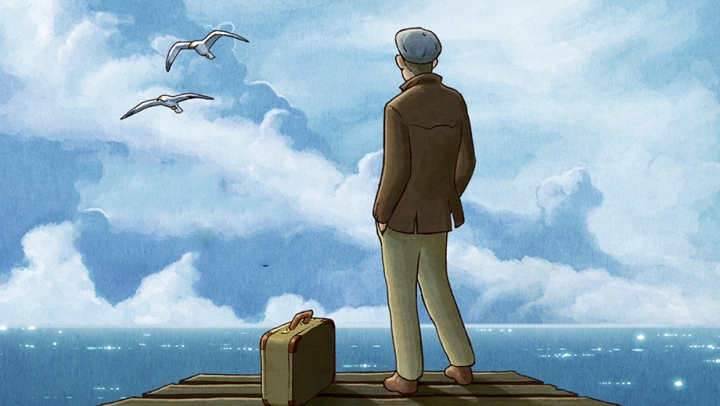
One of the most frequently recurring themes in Anglo-Irish literature is the flight or escape from a harsh environment.  The linked themes of escape, exile and emigration are frequently found in drama, prose and poetry.  One of its well-known representations is Stephen Dedalus in Joyce’s,  A Portrait of the Artist as a Young Man, who chooses exile from his native land because he cannot come to terms with the authorities that hold its people in their grip.  So, Stephen sets out, ‘to encounter for the millionth time the reality of experience and to forge in the smithy of my soul the uncreated conscience of my race.’  In Philadelphia Here I Come!, Friel also explores the nature of Irish society fifty years after Joyce’s novel was written.  This society is still governed by the church, the politician and the schoolmaster.  The society that Gar is leaving has failed him and his generation.  The question is will things be any better for Gar when he moves to Philadelphia?

Similarly, in an article in The Irish Times in the 1970’s local poet Michael Hartnett turns his hand to social commentary when he stated that Newcastle West in County Limerick,

‘is an Irish town that is not dying.  It has kept its economic stability at a terrible price, the constant exportation of human beings.  It is the example of a town that is alive because the young leave, a town that would certainly be ruined if those people born in the 30’s and 40’s had stayed at home en masse.

In Philadelphia Here I Come!, Brian Friel gives another particular instance of the ‘flight from the land’ theme in the story of Gar O’Donnell’s proposed emigration to America.  Here, Friel shows his awareness of an older, oral tradition.  Emigration is the subject of a vast number of Irish songs and ballads.  It is particularly close to the Irish spirit, having been forced on us by the circumstances of our history.  In this oral tradition, emigration is always viewed ambiguously. On the one hand, it offers escape from a hopeless environment, promising new opportunities that were unavailable at home.  But on the other hand, it is also viewed with nostalgia and sadness, as the emigrant says his last farewell to his home, his family and his friends.  It is this double aspect that makes emigration a suitable subject for drama and which Friel exploits with such effect in Philadelphia Here I Come!

However, Friel is also making a political point here.  Many see the play as a covert criticism of De Valera’s vision of a self-sufficient Ireland of cosy homesteads and comely maidens dancing at the crossroads.  S.B and Máire marry on New Year’s Day 1937, the very day that De Valera’s new Irish Constitution comes into effect.  Twenty-five years or so later and the product of that marriage, Gar O’Donnell, is packing his suitcase to head for Philadelphia in the morning.

The escape theme is emphatically present in the play right from the start.  The first Episode begins in an optimistic mood as Gar considers his departure on the next morning.  Life in Ballybeg is monotonous and offers little scope for his ambitions.  America is considered to be the land of opportunity, where ambitions are fulfilled and fortunes are made.  The thrust of this opening Episode is entirely towards release, freedom, escape: ‘Think ….up in that big bugger of a jet, with its snout belching smoke over Ireland…’ (p. 17).  S. B. makes a brief entrance at this point in the play, and through him Friel expresses the type of life Gar wishes to escape from.  S. B. is elderly and somewhat out of place in the modern world.  So too is the business he owns.  Gar emphatically rejects S.B.’s old-fashioned world.  He speaks on numerous occasions of the weariness and boredom of weighing up sacks of flour and sugar, cleaning and salting fish, unloading barbed wire and sacks of spuds.  To all of these unpleasant chores, he contrasts the broader horizons offered by American life.  Initially, at least, he is in no doubt about the wisdom of his decision to emigrate.

Other events in the play serve to strengthen this decision even further.  The characters of the play are seen by Gar as a somewhat pathetic group.  As he sees it, they are all the victims of the restrictions imposed on them by their lives in Ballybeg.  Gar wishes to escape to America before he too becomes like them.  This emerges quite clearly in his conversation with Katie Doogan in Episode Two.  Indeed in this conversation, the escape theme is most pronounced.  Earlier in the play, Gar rejects Ireland in his reference to it as, ‘the land of the curlews and the snipe, the Aran sweater and the Irish Sweepstakes’ (p. 18-19).  In his conversation with Katie his rejection is more emphatic, ‘I hate the place, and every stone, and every rock, and every piece of heather around it…’ (p. 81).  (This is reminiscent of Kavanagh’s outburst in ‘Inniskeen Road: July Evening’, ‘I am king of banks and stones and every blooming thing’).  On this occasion, it is principally the people of Ballybeg who lead him to this outburst.  For example, Gar is impressed with Master Boyle’s visit; he is also impressed by the visit of ‘the boys’ later in the play.  But on both these occasions, there is a common element to Gar’s reaction.  He is not blinded to the failings of ‘the boys’ or of Master Boyle.  The latter in particular has sacrificed his ideals for a life of quiet boredom in Ballybeg.  Like Gar, he once had the opportunity to emigrate, but unlike Gar, he was unwilling to take it.  There is a marked feeling of regret in Boyle’s conversation with Gar, a sense of having let life’s possibilities slip by.  Boyle’s character is pathetically drawn.  He is an isolated figure, unhappy with his situation, a lonesome bachelor, and a secret drinker.  He is determined to escape from the environment that produces such characters as Master Boyle.

Indeed, it must be said that the escape theme is inextricably linked to the theme of escapist fantasy used by Friel in this and other plays in his oeuvre.  At the root of this escapist fantasy lies a deep-seated dissatisfaction within every character with themselves and their environment.  Gar has not attained a sufficient identity for himself in Ballybeg. Pulled towards the future and yet drawn backwards towards a sentimental vision of the past, he seeks to escape by running away to Philadelphia, which represents the solution to all his problems.

Ironically, as the play unfolds and we begin to glean insights into his character, we realise that escape will only intensify rather than solve any of his problems. He condemns Ballybeg for the very things which will solve his problems, love, affection, identity and warmth. Gar is no better at the conclusion of the play. Escape to Philadelphia, as Madge tells us, will solve nothing.

Master Boyle also compensates for his failure as a schoolteacher by dreaming up challenging professional situations in Boston. He tells Gar he has been offered a ‘big post’ in a ‘reputable university’ in Boston. Unable to face the reality of his own alcoholism he hides behind imaginative dreams of another world and unrealistic achievements.

The boys also indulge in this escapist fantasy. They come to say farewell to Gar on the night before he departs yet they spend their time indulging in monologues about themselves and their imagined exploits. Life in Ballybeg is more bearable when it is relieved by fantasy and escapism. Rather than admit their own inadequacies they hide behind bravado and loud talk.  The visit of ‘the boys’ also confirms Gar in his decision to escape from Ballybeg.  Superficially at least, ‘the boys’ and Master Boyle have little in common.  They make a noisy entrance, speak loudly and with arrogance, whereas Master Boyle is quiet and soft-spoken.  But Gar is aware of the characteristics shared by each of them.  They are all ‘lost souls’.  The future, which faces ‘the boys’, is as dim as that which has faced Master Boyle.  They speak enthusiastically about themselves and their situation, but to Gar these words sound hollow.  In the end he is forced to admit that they are ‘ignorant bloody louts’ who cover the meaninglessness of their situation with pretence and lies.  Significantly, in his speech with Katie, Gar groups ‘the boys’ with Master Boyle, S.B., and Canon O’Byrne: they are all pathetic figures.  They all confirm his decision to emigrate.

The escape theme in Philadelphia Here I Come! is not a simple one, however.  To create a sense of drama Friel explores the theme from a contrary point of view.  Friel uses the same technique as Kavanagh in ‘Stony Grey Soil’, a poem in which the escape theme is also evident.  Kavanagh enumerates the aspects of his life in Monaghan, which led to his decision to leave.  But he also provides a contrary statement at the end of the poem.  In spite of all the hardships, which have been inflicted on him, he still feels some affection for Monaghan.  The same feeling of affection is evident in Philadelphia Here I Come!, in spite even of Gar’s emphatic statements of rejection.  As the play opens Gar is confirmed in his decision.  But as the action progresses he is subjected to numerous situations, which remind him of the more pleasant aspects of Ballybeg and its people.  As these situations continue to arise in the play, the desire to escape is made more complicated, and even meaningless.  In the play, a definite bond of affection unites the characters, which is all the more touching because it is left unspoken.  Gar’s relationship with Master Boyle, ‘the boys’, and S.B. is characterised by rejection.  They have all, in part, contributed to his desire to escape.  But his relationship with them also contains traces of affection.  He is moved by the visits of Master Boyle and ‘the boys’ and is in a distressed state when they leave.  His affection for S.B. is secretly expressed by Private throughout the play and is openly articulated to Madge at the end (p. 109).  But in particular, his relationship with Katie Doogan represents a part of his life he is sorry to leave behind.  As is usual with Gar, he speaks casually and with forced nonchalance.  But his decision to emigrate, to become ‘100 per cent American’ (p. 82), is complicated by the affection he still feels for the ordinary mundane life of Ballybeg.  In this way the escape theme is fully dramatised by Friel.  Gar’s need to escape, coupled with the affection he feels for the people he is leaving, constitutes one of the effective conflicts of the play. Indeed, the ending is very inconclusive and we are left to wonder as we leave the theatre: well, did he ever leave or did he continue to live a life of futility fuelled by fantasy?

Private: God, Boy, why do you have to leave? Why? Why?

Public: I don’t know. I – I – I don’t know.

There is also a double-dimension to all Friel’s work. He tends to illustrate the same theme from different points of view – Gar leaving for Philadelphia and Lizzie who has come home.  Like other characters in the play, Lizzie is garrulous and she is also the centre of her own conversation.  She wanders through her story about her past life, speaking incoherently, and often losing her train of thought.  She is also irritated when someone interrupts her, and even casual interjections cause her annoyance.  While she speaks, the other characters sit quietly.  Eventually, she breaks down, starts to cry, and stumbles into silence giving us a perfect cameo of the reality behind many a ‘returned Yank’. and a rather stark reality check for Gar as he prepares to leave.  Friel returned to this theme later in The Loves of Cass McGuire which explores the psychology of Cass as she returns from her emigration and exile.   Gripping, often humorous, but steeped in compassion, Friel scripts a rich and complex portrait of a marginalised emigrant returning home.   We can all easily empathise with Cass’s dilemma.  She has returned to a world she cannot recognise and the play explores the difficulties she has in coming to terms with a life not as she imagined and the exclusions society now imposes upon her.  Whereas, Philadelphia Here I Come! dealt with Gar’s physical act of emigration, The Loves of Cass McGuire deals with the psychology of returning and this  marks it out as a very relevant work – indeed, it can be said of Cass, like many a returning exile, she comes back to a home that does not exist except in her fantasy.

So, we can see that the linked themes of escape, exile and emigration (and eventual return) are as relevant today as ever.  Friel’s plays are at times caustic commentary on successive governments for their failures to provide for the people in their care.  As Michael Hartnett also suggested in the 70’s we have been able to maintain our economic stability at a terrible price: ‘the constant exportation of human beings’.

Philadelphia Here I Come!, therefore, contains considerable political and psychological insights. Gar is a kind of ‘split-personality’ and we sense that he will have great difficulty coping with this schizophrenia wherever he ends up. He can escape from Ballybeg, from the small-town people who annoy him, but he can never be free from his own inner voice, constantly exploring, questioning,  and rebuking.

Author’s Note: My favourite production of this play was by the Ardagh Drama Group in County Limerick, which was staged some time in the 1990’s.  It featured a superb tour de force of a performance by Jim Liston as Gar Private.  He was ably supported by sterling performances from Garry McMahon as SB, Margaret Enright as Madge, Senator Doogan was played by Sonny Crowley (RIP), Rory O’Donnell (RIP) was Lizzie’s browbeaten husband, Master Boyle was played by Tom Madigan and ‘the boys’ were superbly marshalled by Mike O’Flynn.

You might also like to read ‘The Theme of Communication in Philadelphia Here I Come!’   here

You might also like to read “Characters and Relationships in Philadelphia Here I Come!” here

 philadelphia-here-i-come-by-brien-friel

A great love poem for the day that’s in it!

from Anatomy of a Cliché


by Michael Hartnett

I want you to stand with me

as a birch tree beside a thorn tree,

I want you as a gold-green moss

close to the bark

when the winds toss

my limbs to tragedy and dark.

You are to be the loveliness

in my cold days,

the live colour in my barrenness,

the fingers that demonstrate my ways.

I can anticipate no days

unless your graceful sway of hands

arrange my awkward life.

…………………………………

‘Water Baby’ by Michael Hartnett

download-1

Water Baby


By Michael Hartnett

Already the chestnuts, each a small green mace,

fall in the rusted chainmail leaves.  The swifts,

like black harpoons, fail against the whaleskin sky.

Wasps in this skyless summer have no place,

small quarrels swell to great and flooded rifts;

lime trees, prematurely old, decide to die.

The heavy steel-wool curtain never lifts.

Many cling to rafts of music but I,

I am not happy with the human race

aching for its sun-god – he kills as well –

I skip dripping in the shining rain

and feel the minute fingers tap my face

and breathing in St. Bartholomew’s bell

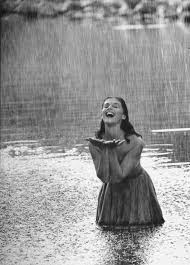
I look up to the sky and kiss the rain.

Commentary:

Some day I hope to write a fitting analysis of this beautiful sonnet – a commentary that will do it justice.  In the meantime, I have to agree with my son Don who has suggested that this is Michael Hartnett’s best sonnet and a poem for which Hartnett deserves acclaim and greater recognition.  Leaving Cert English Poetry course developers please note!

Finally got round to doing an analysis of ‘Water Baby’!  You can read it here.


The Troubled History of The Crooked Tree

The Crooked Tree as it is today in 2026 – unfortunately, like many other ash trees, it has succumbed to the dreaded Ash Dieback  disease, and its days as an iconic landmark are numbered.  You can see the remnants of the old Limerick – Newcastle West road on the left of the photograph and the new road layout on the right.

The Crooked Tree is a very well-known landmark on the main Limerick-Newcastle West road, about two kilometres out on the Limerick side of the town.  The tree is situated in the townland of Gortroe and is, in fact, situated in the parish of Knockaderry. The Crooked Tree also holds the unenviable distinction of being one of the few trees in Ireland to have moved from one side of the road to the other!  In 1965 the tree stood on the right-hand side as one approached the town from Limerick as can be seen in the photograph above.  Then, the County Council carried out extensive renovations and upgrading to the roadway, following which the Crooked Tree now stands sentinel on your left-hand side as you approach the town from Limerick!

Rightly or wrongly, the tree has been the subject of many gruesome stories down the years, the most common of these being that it was used to hang people in the dim and distant past.  According to Bill Flynn, then a student in St. Ita’s Secondary School, who wrote a very interesting article in the 1983 edition of the Knockaderry Clouncagh Community News:

The most persistent of these stories was that which claimed that the assassins that murdered the ‘agent’s son’ paid with their lives for the foul deed on this natural scaffold.  There were, too, stories of other hangings – sheep stealers and other minor criminals, according to local lore, breathed their last as they swung from the peculiarly shaped branch of this ugly black ash.

Another local resident, Michael Cregan, R.I.P., who lived for many years within a stone’s throw of The Crooked Tree seems to corroborate these stories, providing us with further detail.  Writing in the Knockaderry Clouncagh Journal in 1999-2000 he states:

The story goes that people were hanged from the tree up until the early 1900s for committing the most minor of offences.  According to Liam Ó Danachair, the historian, Patrick Moylan and his son Seamus, who lived in Ballyallinan in 1732 were returning from Newcastle West after getting a spade made at the forge.  They were stopped by drunken English soldiers.  The soldiers began to jab the father with their bayonets and he defended himself with the spade and he killed one of the soldiers.  He shouted to his son to run home.  They killed the father and hanged his hacked and tattered body from The Crooked Tree where it was left as a warning.  Under the cover of darkness, some neighbours cut down the body and buried it in consecrated ground.

The Moylan homestead in Ballyallinan. The house was demolished in the early 70s.

The Moylan homestead in Ballyallinan South corresponds today to the land farmed by James O’Connor and his wife Colette and family and was formerly owned by James’s parents, Colm and Nellie O’Connor.  Mrs Moylan was one of the last native Irish speakers in the area and the house was famous for its gatherings where Irish was spoken.  Sean Ó’Faoláin, when he visited his relations, the Hough family in Loughill East, was a frequent visitor.

The evidence above doesn’t point to a hanging taking place, rather that the body was hung from the tree as a warning, Patrick Moylan having been earlier killed by the drunken soldiers.  Michael Cregan also has a plausible explanation concerning the mystery surrounding the tree:

Many people were doubtful that hangings took place because when excavations took place no remains were found.  The simple explanation is that the next of kin always removed the body and gave it a proper burial.

Bill Flynn tries in his article to dispel the notion that the tree was ever used as a gallows by detailing the excavations which took place around 1965:

When the County Council excavated along by the west side of the tree, preparatory to the construction of a new section of road, deep interest was taken in the operation.  The excavators tore down to a depth of five feet into the tough yellow mud but no sign of soil disturbance was revealed and no remains were found.

He further states that a local man, Toss Enright, who lived out his eighty-odd years virtually in the shade of the tree claimed that the present tree developed from a ‘sucker’ that grew out of the stump of the original tree which was felled in the early 1900’s.  He also told of a local woman who died in 1903 at the age of ninety years who claimed that nobody had ever, in her memory, been hanged from the tree.  However, she did say that her mother had told her of two men who had been hanged from a scaffold erected in the field beside The Crooked Tree and she had never heard of any other executions.  Bill Flynn ends his enthralling piece of research by concluding:

For lack of evidence to the contrary, we are forced to assume that the ‘history’ of the tree was born out of fanciful thought.

However, another plausible explanation as to why the legend persists may have something to do with the etymology of the name given to the tree.  We know from just a cursory examination that Irish place names give up a rich harvest of information concerning topography, battles, famous saints, etc., etc.  For example, Gortroe, the townland in which The Crooked Tree stands was originally called An Gort Rua in Irish, which means ‘the red garden’ (probably a place where potatoes were grown in the past), and another nearby townland Ballingowan,  was originally Baile an Gabhan, the townland of the blacksmith.  In Ireland, in the 1830s the English were busy converting many such place names from the Irish language into the now legally required English.  Sometimes they were very diligent and sometimes they were very lazy!  The Irish phrase for a Hanging Tree would have been Crann Crochadh and on a Friday evening, after a long week translating place names into English, it might have been very tempting to translate this Crann Crochadh into what we know today as The Crooked Tree.

Talking of place names in the locality, however, tends to disprove my theory.  Not too far away from the townlands of Gortroe and Ballingowan, as one exits Newcastle West heading for Dromcolliher, is the townland of Ardnacrohy.  Now, this must have definitely been translated in somewhat of a hurry because the original would have been Árd na Croiche which should be translated directly as ‘The Hill of the Gallows’, or ‘Gallows Hill’ maybe, or ‘The Hill of the Hanging’ or somesuch gruesome alternative.  My point is that if  Ardnacrohy was the location for local hangings then The Crooked Tree was not needed – except maybe in an emergency!

(It is interesting, even fascinating, that in Cork City there was also an Árd na Croiche, at the top of Barrack Street in the city, Cork’s Tyburn if you will, but the earnest and diligent Corkman, who carried out the translation for his English masters, must have been very conscious of the future tourism potential of the place so he translated Árd na Croiche into the far more innocuous and inviting placename, calling it Greenmount)!

So, there you have it, ‘fanciful thought’ or long-embedded local lore no one is sure – the jury is still out – or maybe they didn’t have much use for juries in the ‘good old days’ long, long, ago!

Bibliography

Knockaderry Clouncagh Community News – Christmas Annual 1983

Knockaderry Clouncagh Journal – Millennium Edition, 1999-2000

fullsizerender-3

Shakespearean Tragedy Defined

7cf365c2a31fffe5aad2e6cbce5f3fda

Modern definitions of the word tragedy don’t help when trying to explain the niceties of Shakespearean tragedy.  Our sensationalist news channels such as Sky and CNN are very quick to bring us the latest tragedy; a passenger jet crashes with the loss of all on board; a bridge collapses causing mayhem for home-bound commuters; a school is in lock-down after a young student kills his teacher and many of his fellow students before turning his gun on himself.   Our modern definition of ‘tragedy’, therefore, is usually synonymous with the word ‘disaster’;  or an event causing great suffering, destruction, and distress, such as a serious accident, crime, or natural catastrophe.

These modern definitions do not help us greatly when trying to describe the action in one of Shakespeare’s tragedies.  The good news is that Shakespeare is clearly following a template, one laid down centuries earlier by Aristotle and others – in fact, it can be said that he invented the sequel!  So, therefore, if you have studied one tragedy well,  you have a huge advantage when you come to study the next one!  However, the sad news for all you aspiring young actors is that all Shakespeare’s tragic heroes are men and secondly, if you happen to be playing the title role in one of these tragedies, then universally you will meet a rather gruesome end.

Shakespeare, the consummate businessman, tended to rotate his dramas, so he knew the audience could only take so much comedy, or history or tragedy in any one season.  As opposed to his Comedies or Histories, his Tragedies always dealt with tragic events and always had an unhappy ending i.e. the tragic hero dies.

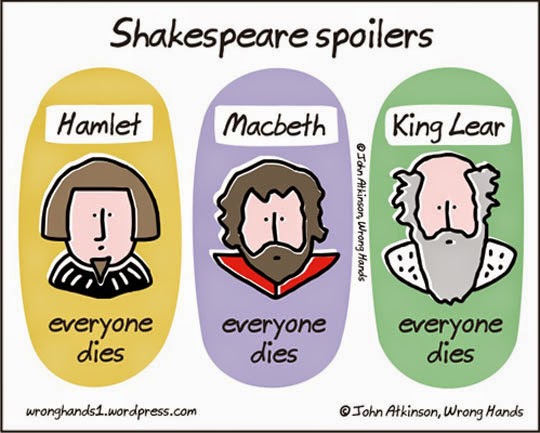
Spoiler Alert!  Sometimes, however, Shakespeare’s genius is evident as in Macbeth when the tragic hero suffers a gruesome beheading at the end (sad ending!) but the audience leave the theatre with the knowledge that order has been restored in the kingdom and so Scotland has been rescued from a murderous tyrant (happy ending!).

So, to summarise, no one tragedy fits perfectly any one definition, but the conventions of tragedy require certain tragic elements.  Aristotle considered tragedy to be ‘the fall of princes’.  Macbeth falls into this category: he is a thane and he becomes king.  Generally, in Shakespearean Tragedy, the tragic hero sets out on a course of action but because of a flaw in his character evil enters and is the cause of the catastrophe.  Shakespeare believed that his tragedies, including Macbeth, depicted the struggle between good and evil in the world.

The notion of the tragic hero is also problematic.  It seems, at face value, to be a paradoxical term, an oxymoron like Groucho Marx’s famous ‘military intelligence’.  Our dramas today, in our cinemas, in particular, give us loads of suited heroes from Spiderman, to Superman, to Batman and these modern heroes always win.  Tragic heroes, on the other hand, always die!

Shakespeare’s tragic heroes all possess definite characteristics and hopefully, the extreme sexism of the following statements will be understood by members of my female audience!  After all, we have to realise that Shakespeare was writing in the late 1500’s and early 1600’s so, inevitably, his tragic hero is always a man of exceptional nature, a great man such as a King or a great General or a Prince, with a more powerful consciousness, deeper emotions and a more splendid imagination than mere ordinary mortals.  He is a sensitive being with a spiritual bias.  He has a divided soul, he is torn by an internal struggle.  However, this tragic hero has some weakness, some fatal flaw that contributes to his downfall.  Aristotle called this internal weakness of the hero the ‘hamartia’, the tragic flaw, an essential element in tragedy.  Macbeth’s tragic flaw is his ambition.  He succumbs to this powerful failing in his nature and is destroyed by it.  His ambition pushes him into a sequence of action which inevitably leads to his death.  Macbeth attempts the impossible, to usurp the lawful king, and because the means he employs are evil and against the natural law, the inevitable consequences of his actions work themselves out and the result is tragedy.

Aristotle’s criterion for good tragedy was that the members of the audience should experience ‘catharsis’, that is, pity and terror for the tragic hero.  The sensitive, conscience-stricken, tortured Macbeth inspires pity, and the tyrannical Macbeth, ‘in blood stepp’d in so far’ inspires terror.

Therefore, Shakespeare, in Macbeth, does a wonderful balancing act between the audience having sympathy for Macbeth while also recognising the reality that evil must be destroyed and good must triumph in the end and order must be restored to the kingdom.


funny-Shakespeare-spoilers-Hamlet-Macbeth-King-Lear

“A sense of loss pervades much of Patrick Kavanagh’s poetry” – Discuss

kav2
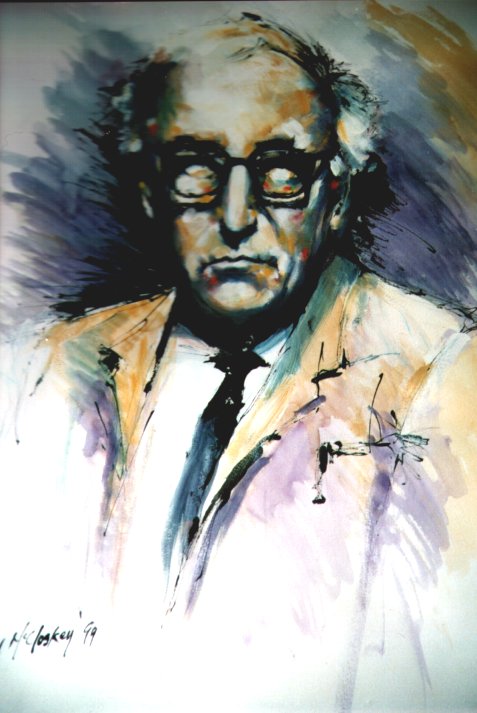
Patrick Kavanagh by Paul McCloskey. Visit his website http://www.paulmccloskey.ie

Kavanagh is very adept at reflecting the common, everyday occurrences in the rural area of Monaghan in which he grew up.  He writes in a direct way about his own experience with the land.  He celebrates the beauty of nature’s commonplace things.  And yet, a sense of loss also pervades much of his poetry.

In one of Kavanagh’s earlier poems, ‘Inniskeen Road: July Evening’, he stands on his mile of kingdom, insisting with pride, or perhaps defiance, that he is king of ‘banks and stones and every blooming thing’.  The poem explores the nature of being a poet and in this regard,  Kavanagh acknowledges the reality of his ‘plight’, in spite of the grandiose notion of poetic ‘contemplation’.  The poet shares with us his deep sense of loss.  It is a loss of companionship as others rush past him in ‘Twos and threes’.  Other young men and women make no attempt to communicate with the poet who stands alone on the roadside.  At the dance, he imagines their own coded communications, from which, once again, he is excluded.  The hurt is felt as the poet stands in solitude, isolated from his community, with ‘no shadow thrown / That might turn out a man or woman’.  Kavanagh has been reduced to being a spectator and he sees that this is the high price he must pay for his poetic gift.  The bustle of the dance is in stark contrast to the silence of the mile of road where not even a ‘footfall’ can be expected.

The exploration of the loss of companionship is further developed in ‘The Great Hunger’.  In this poem, Kavanagh explores and also explodes many of the romantic images of the simple, contented rural peasant in Ireland.  He exposes the inadequacies of a social system which stifles the emotional and sexual needs of Patrick Maguire, who becomes entrapped by his clay bride, the land.  Similar to the poet in ‘Inniskeen Road’, Maguire is unable to communicate his needs to others; his only reason for shouting at his farm labourers is to extend his orders for the day.  He is bogged down in empty promises: ‘Who was it promised marriage to himself / Before apples were hung from the ceilings for Halloween’.  He attempts to console himself for his loss of fertility, without wife, without children, pretending to his soul ‘That children are tedious in hurrying fields of April’.

In this society, the lie that ‘Clay is the word’ is perpetuated and so Maguire ‘lives that his little fields may stay fertile’.  In moments of frustration and despair he cries out ‘if I had been wiser!’ but he knows he can never escape ‘the grip of irregular fields’.  Tragically, Maguire’s cries are unheard and unheeded.

A further exploration of loss is evident in ‘Advent’.  In this poem, the concern is with the loss of innocence and wonder.  Kavanagh employs religious association to suggest his yearning to return to a state of innocence in which the ordinary and the commonplace are ‘spirit-shocking’.  It is a poem that declares the poet’s regret at having been corrupted by experience – ‘we have tested and tasted too much’.  Although the poem details the poet’s loss, it does not plummet into despair.  The loss is balanced by the uplifting mood of hope in the third stanza that after Christmas the poet will once again take possession of that ‘luxury’ he had previously lost, ‘And Christ comes with a January flower’.

Kavanagh’s verse is usually self-revealing.  In ‘On Raglan Road’ yet another aspect of loss is related to us.  Once more Kavanagh opens his mind and heart with honesty, cautioning in the first line of the lyric that his love’s ‘dark hair would weave a snare’.  Despite his awareness of the ‘danger’, the poet begins his courtship and enthusiastically woos his friend with gifts ‘of the mind’ such as poems.  A major concern of the poem, however, is lost love, and so despite the poet’s attempts to win his friend’s trust and love, the courtship fails.  Loss of faith in women is replaced with loss of faith in the land in the poem ‘Shancoduff’.  Hills which are looked upon with affection and some pride, are re-evaluated in light of the cattle-drovers’ denouncement that they are ‘hungry’ and ‘forsaken’.

It is abundantly clear, therefore, that in his poetry Kavanagh speaks his mind in praise and in condemnation.  In his subjective verse, his feelings run very deep.  Certainly, he may share with us his celebrations but he does not ignore his sense of loss and isolation.  He records his resentment at being an outcast in his own community in ‘Inniskeen Road’. He denounces the privation of opportunity and fulfilment in ‘The Great Hunger’. He yearns for his lost innocence and wonder in ‘Advent’ and he agonises over his lost love and lost faith in ‘On Raglan Road’ and in ‘Shancoduff’.

Stony Grey soil (2)
‘Oh, can I still stroke the monster’s back or write with unpoisoned pen…’

“Patrick Kavanagh is a very Religious Poet” – Discuss

Patrick Kavanagh 1
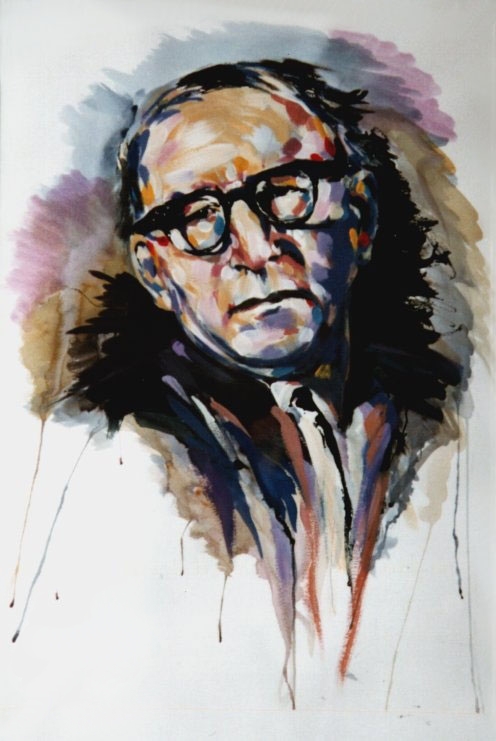
A portrait of Kavanagh by Paul McCloskey. http://www.paulmccloskey.ie

There is a major religious element to Kavanagh’s poetry.  Kavanagh is clearly deeply influenced by his early Catholic upbringing and all that this entails.  He finds inspiration in the liturgical seasons such as Advent.  His poems contain references to Genesis in the Old Testament and to the sacrament of Baptism.  Examples of this orthodox Catholic theology is clearly evident in such poems as ‘Advent’ and ‘Canal Bank Walk’, ‘A Christmas Childhood’ and many more.

In the poem ‘Advent’, Kavanagh feels that he has been corrupted by the whole process of living.  He has ‘tested and tasted too much’.  By ‘testing’ and ‘tasting’, of course, he means that he has indulged in pleasure for the mind and pleasure for the body.  Kavanagh feels too that he has lost the wonder of things, ‘through a chink too wide there comes in no wonder’.

In order to purify himself, Kavanagh is going to use traditional religious methods: ’the dry black bread and the sugarless tea of penance’.  He wants to win back lost innocence, to ‘charm back the luxury of a child’s soul’.  He is going to make a new spiritual beginning; he is going to leave the apple of sin back on the tree and start again in innocence: ‘We’ll return to Doom the knowledge we stole but could not use’.

In this poem, Kavanagh feels that the world has grown sour and stale.  He wants to reawaken the newness that was once in the world for him before he lost wonder and innocence.  This newness and spiritual renewal is to be achieved through penance and self-denial.

Once he has been purified and spiritually regenerated, the ordinary world around him will be new.  It will be new because he will have been spiritually renewed.  He will now find newness and wonder in the ordinary ‘banal’ things – in something as common as the sound of a churning, in the very ordinary almost clichéd sight of the village boys ‘lurching’ at the street corner or in the sight of decent men ‘barrowing dung in gardens under trees’.

Now Kavanagh will be rich – spiritually rich: ‘Won’t we be rich, my love and I’.  And he vows that he will not destroy his new-found wonder and innocence by analysis, by questioning, by intellectualising.  He will not ask for ‘reason’s payment’.  He will not ask the ‘why’ of things.  He will be content to wonder.  As he says in another poem, ‘to look on is enough in the business of love’.

Kavanagh has now discarded his old self – the self that ‘tested’ and ‘tasted’, the self that was obsessed with the worthless pursuit of pleasure and knowledge: ‘We have thrown into the dust-bin the clay-minted wages of pleasure, knowledge and the conscious hour’.  There is going to be a new beginning: ‘And Christ comes with the January flower’.

The poem, ‘Canal Bank Walk’ is equally religious.  The year is 1955 and Kavanagh has recently emerged from hospital having undergone a sort of religious experience or spiritual renewal.  The natural world around him is wonderful.  The canal banks are ‘leafy with love’ and the canal water has taken on a religious significance.  It is now Baptismal; water, baptising the poet’s new-born soul.

From now on Kavanagh is going to do the will of God and God’s will is that he steep himself in the ordinary world, ‘wallow in the habitual, the banal’.  God’s will is that he go back to that state of oneness with nature which he had in the innocence of childhood.  He must ‘grow with nature’ again.  For Kavanagh the very breeze takes on a personal dimension: it is adding a third party to the couple kissing on an old seat; it is making up a threesome.

In this poem, Kavanagh’s view is deeply religious.  A bird preparing to build a nest is no longer just a bird building a nest.  It has taken on a religious dimension.  The bird is, in a spiritual sense, preparing a place for the Word to be made flesh.  In Kavanagh’s new-found spiritual view of the world, all new life is a manifestation of God.  It is God Himself visible in physical terms.  The bird is ‘gathering materials for the nest for the Word’.

Kavanagh now wants to live in total oneness with God’s creation, with nature.  He will live life at the level of the senses.  There will be no more intellectualising.  He wants to be trapped forever in the world of sight and sound: ‘enrapture me in a web of fabulous grass and eternal voices by a beech’.  He seems to feel that he has lived too long and too much in the world of questioning, testing and analysis.  He has neglected the world of sensual contact with nature; ‘feed the gaping need of my senses’.

Finally, in this poem, Kavanagh wants to return to the innocence and simplicity of childhood where he could pray without inhibition: ‘Give me ad lib to pray unselfconsciously with overflowing speech’.  He wants his new-born soul to be dressed in green and blue things.  This is the green of the earth and the blue of the sky, the totality of nature, of God’s creation.  There will be no searching for answers. He will settle for ‘arguments that cannot be proven’.

Kavanagh then, in the poems ‘Advent’ and ‘Canal Bank Walk’, is deeply religious.  He is religious in two ways; he is spiritually renewed personally and nature itself takes on a very religious significance.  He wants, as it were, to begin again in innocence – to be, in effect, the very first Born-Again-Christian in 1950’s Catholic Ireland! 

Patrick Kavanagh
Patrick Kavanagh’s bronze commemorative seat near Baggott Street Bridge in Dublin

“Patrick Kavanagh’s Poetry is full of Honesty, Integrity and Simplicity” – Discuss


53967f30ccfe99cad03d5c2ee3223197
Patrick Kavanagh by Barnie Maguire on ArtClick.ie

An important element in Kavanagh’s poetry is his obvious honesty, integrity and simplicity.  According to Kavanagh, simplicity is the ability to be content and satisfied with oneself no matter how ridiculous or silly or commonplace one may appear to others.  A simple man is not a poser; he has no need to look over his shoulder to see what others think; there is no desire to seek the approval of the experts or of one’s peers.  To have simplicity is to have what Kavanagh called ‘the philosophy of not caring’.

Kavanagh manifests simplicity in his poetry in three ways:

  • First, we have the simplicity of subject matter or theme.
  • Secondly, he writes about things and experiences that other poets might be ashamed to write about.
  • Thirdly, there is simplicity of language and technique, in his rhymes and in his rhythms.

The simplicity in his subject matter and themes is easily seen.  He writes unashamedly about the ordinary, commonplace world around him; he does not search for lofty, intellectual themes.  He writes about ‘whins’, ‘bogholes’, ‘cart-tracks’, barn dances, farming, ‘men.. who barrow dung in gardens under trees’.  He draws from the ordinary but authentic world of his own experience.  He tells us of the awful loneliness of being a poet in a peasant community, about being ‘king of banks and stones and every blooming thing’.  He recalls bitterly how he, as a poet, had been ‘soul destroyed’ by an uninspiring environment, how Monaghan ‘burgled his bank of youth’, how it ‘flung a ditch on my vision’.  He tells too of his deep human need for love and romance, ‘lost the long hours of pleasure, all the women that loved young men’.  This is all the ‘stuff’ of reality and ordinary reality at that. It may not be a great heroic world, it’s not earth-shattering, but it is the world of authentic experience and he is content with it.  That’s simplicity.

In his poetry, Kavanagh writes about things and experiences that other poets might be ashamed to write about.  He finds wonder in a barge coming up the canal, in a swan going by ‘head low with many apologies’, in ’the bright stick trapped’, in the light which comes ‘through the eye of bridges’.  Everywhere he is satisfied with his world, he does not need to go searching for a theme, they are all around him.  He finds a message in ‘the whispered argument of a churning’ or in the street ‘where the village boys are lurching’.  He finds his God being revealed in incidents as ordinary as a bird building a nest or in decent men ‘who barrow dung in gardens under trees’.

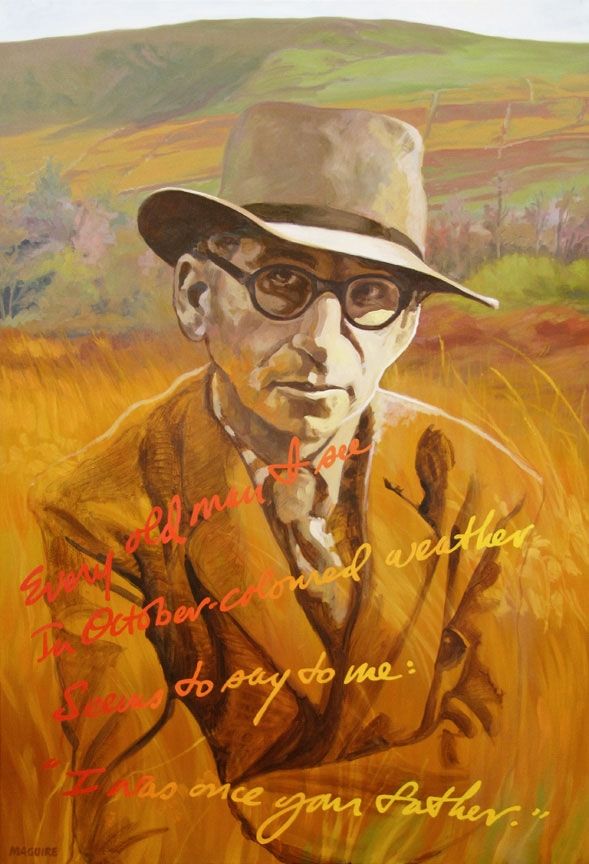
This same simplicity is to be found in his language and diction.  He has little time for poetic diction or flowery pompous language.  He uses ordinary everyday colloquial language, ‘the bicycles go by in twos and threes, there’s a dance in Billy Brennan’s barn tonight.’  There’s nothing very poetic about that!  Other examples of his ordinary language are numerous: ‘Every old man I see reminds me of my father’, ‘Commemorate me where there is water, canal water preferably’. Etc. etc. etc.  There is nothing pretentious about this poetic voice, rather it is honest.  He is content with his own language, however ordinary, and doesn’t care how he is perceived by the literary ‘purists’.

We can also see examples of his simplicity in his rhythms and rhymes – his technique.  His rhymes are often imperfect.  For example he rhymes ‘water’ with ‘brother’, ‘roars’ with ‘prose’, ‘silence’ with ‘islands’, ‘bridges’ with ‘courageous’, ‘lover’ with ‘wonder’, ‘weather’ with ‘father’, ‘musician’ with ‘London’, and ‘web’ with ‘lib’.  These rhymes would not, I’m sure, meet with the approval of the ‘experts’.  But Kavanagh is not concerned.  He is content with himself, he is not trying to be polished.  After all, he is simply an honest peasant poet writing about ordinary, unsophisticated, personal things.  Over-polished rhyming would surely be out of place here, it would be seen as less authentic

His rhythms are often, too, coarse and rugged.  This is only to be expected since, as I have already stated, he is not using poetic diction but ordinary, colloquial language which is not always musical.  Listen to a few examples: ‘O commemorate me where there is water..’, ‘I have what every poet hates, in spite of all this solemn talk of contemplation’, ‘that man I saw on Gardner Street was one’.  All these lines have the ruggedness of ordinary speech.  Kavanagh is, however, content with them.  He has discovered in his life the ability to be satisfied with himself no matter how others may come to regard him.  That’s honesty.  That’s integrity.  That’s simplicity.

grand_canal_dublin_2006
The Grand Canal in Dublin. Image by Kaihsu Tai via Wikimedia Commons.

“Patrick Kavanagh is a poet of the Ordinary” – Discuss

Inniskeen road (1)
Bikes on the Road to Billy Brennan’s Barn, Inniskeen – courtesy of http://www.fisherbelfast.wordpress.com

Kavanagh writes about the ordinary world around him; about a world of ‘whins’ and ‘bogholes’ and ‘cart-tracks’ and ‘old stables’. He has learnt anew to look at the ordinary in an extraordinary way.   This is part of Kavanagh’s greatness as a poet: he is content with his own world, his own reality.  It may not be a sophisticated world, but no matter.  This willingness and ability to be faithful to himself and his world is part of his simplicity.  Simplicity, after all, is just the ability to be satisfied with oneself, no matter how ridiculous one may seem to others.

All through his poetry, Kavanagh has a respect for the commonplace, the ordinary.  He wants to ‘wallow in the habitual’.  In ‘Inniskeen Road: July Evening’  he tells us what it was like to be a poet in a peasant community where he was an outsider.  It’s a July evening and all the locals are celebrating at the local barn dance.  Kavanagh is alone on the road.  He knows now the price that is to be paid for his gift of poetry; the price is isolation and loneliness.  Poet or no, he has human needs, the need for human contact, the need for romance.  He dismisses the pretentiousness of the intellectuals, ‘I have what every poet hates in spite of all the solemn talk of contemplation’.  This is the ordinary, it is the authentic voice of the outsider who yearns to be loved.

In his poem ‘Advent’, he feels that he may perhaps have lost some of the wonder that lies in the ordinary.  He may be beginning to lose respect for the everyday world because of over-familiarity, ‘we have tested and tasted too much…..’  he sets out to recapture that fascination that he once found in the ordinary.  He is going to renew himself through suffering during the penitential season of Advent by eating only ‘the dry black bread and the sugarless tea of penance’.   He has decided to regain his state of childish innocence and then he will once again revel in the ordinary, in ‘the whins, the bogholes, the cart-tracks, old stables …’  the ordinary will once again be wonderful, a ‘black slanting Ulster hill’ will be spirit shocking’; it will touch his soul.  The boring chat of an old fool will no longer be tedious.  It will again have a newness; it will contain ‘prophetic astonishment’.  The common everyday world will fascinate him; there will be wonder in the ‘whispered argument of a churning’.  From now on his interest will be ‘wherever life pours ordinary plenty’.  He is going to settle for the ordinary, ‘the banal’.  Instead, he will now no longer over-analyse the world of the senses, ‘please God we shall not ask for reason’s payment’.  He won’t ask the ‘why’ of things, ‘nor analyse God’s breath in common statement’.

There is nothing pompous or pretentious about Kavanagh.  He respects the commonplace, whether it is in the Monaghan of his youth or in the canal area around Baggot Street of later years.  He enthuses about the swan going by ‘head low’ or the fantastic light ‘that looks through the eyes of bridges’, or again the common sight (in Kavanagh’s day) of a barge on the canal. When he dies he wants no ‘hero courageous tomb’.  He’ll settle for something much more humble, ‘just a canal bank seat for the passer-by’ – for the ordinary man in the street.

There is more to be said about Kavanagh’s treatment of the ordinary: he often takes the ordinary and elevates it to a new level; he gives it a heroic dimension.  The little waterfall on the canal becomes Niagara Falls.  Even the little patch of grass at Baggot Street Bridge becomes his Mount Parnassus, his place of inspiration.  The barge on the canal is also given legendary status.  It is bringing ‘mythologies’ from afar like Jason’s Argos no doubt.  The barge men, too, will have yarns to tell in Dublin pubs, these yarns may be just well-made lies about strange sights they claim to have seen in that world beyond Sallins!  Kavanagh elevates these events and now they become ‘mythologies’.  Athy may be a not-very-important little town some forty miles from Dublin but it is elevated by Kavanagh to the status of heroic places like Athens and Rome.  Athy becomes a ‘far-flung’ place.

Elsewhere in his poems, we have the same elevation of the ordinary.  His own humble plight as a lonely soul becomes equated with that of Alexander Selkirk.  A bird building a nest is an ordinary sight but in his poem ‘Canal Bank Walk’ it takes on a greater significance.  In that nest, new life will be born and through that new life God will reveal himself; in that nest, the Word will be made Flesh.  In this poem we also see that the canal water is no longer mere canal water; it is now elevated to the Jordan (where Christ is baptised by John), ‘the green waters of the canal pouring redemption for me’.  In ‘Advent’ he can see Christ in a January flower and the ‘decent men who barrow dung to gardens under trees’ are engaged in great work, they are helping God to continue the work of ongoing creation.  They are, he proposes, co-creators with the Almighty.

Finally, we come to Kavanagh’s language and diction.  His language is not strictly poetical, not pompous, not sophisticated.  It is the language of every day, it is colloquial.  We don’t find Kavanagh resorting to poetic diction.  He uses the phrasing and rhythms of ordinary speech.  The result, of course, is that his poetry has often been adversely criticised for its rugged rhythms.  Kavanagh would not be over-concerned about this.  He had, he said, developed ‘the philosophy of not caring’.  ‘The bicycles go by in twos and threes, there’s a dance in Billy Brennan’s barn tonight’ – that’s a perfect example of ordinary, colloquial language. Examples like these occur everywhere in Kavanagh’s poetry.  This ordinary diction conveys the simplicity, integrity and total lack of pretension in Kavanagh.  He is, indeed, a poet of the ordinary.

Patrick Kavanagh
Patrick Kavanagh’s bronze commemorative seat near Baggott Street Bridge in Dublin

‘Death of an Irishwoman’ by Michael Hartnett

brigid-halpins-cottage-today
Bridget Halpin’s cottage in Camas as it is today. Photograph is by Dermot Lynch.

Death of an Irishwoman

Ignorant, in the sense
she ate monotonous food

and thought the world was flat,
and pagan, in the sense
she knew the things that moved
at night were neither dogs nor cats
but púcas and darkfaced men,
she nevertheless had fierce pride.
But sentenced in the end
to eat thin diminishing porridge
in a stone-cold kitchen
she clenched her brittle hands
around a world
she could not understand.
I loved her from the day she died.
She was a summer dance at the crossroads.
She was a card game where a nose was broken.
She was a song that nobody sings.
She was a house ransacked by soldiers.
She was a language seldom spoken.
She was a child’s purse, full of useless things.

© 1975, The Estate of Michael Hartnett
From: Collected Poems.Publisher: The Gallery Press, Oldcastle, 2001.

Author’s Notes: 

Púcas: This was the Irish (Gaelic) term for pookas, hobgoblins, fairies.  In the Irish language a man of African descent is described as a fear ghoirm, a “blue man”.  In Irish, “an fear dubh” (“the black man”) exclusively denotes the devil, therefore, the reference to “darkfaced men” in this poem does not have any racial connotations!  

A wake was a social gathering associated with death, usually held before a funeral.   Traditionally, a wake took place in the house of the deceased with the body present.

In 1965 Michael Hartnett was in Morocco when his grandmother, Bridget Halpin, died at the age of 80.  Hartnett had spent his formative years in Halpin’s simple, meagre cottage in Camas soaking up the stories and folklore of the area as she entertained her cronies in the mid to late 1940’s. She had a great array of Irish words in her vocabulary, many related to the animals of the countryside and life on the farm, although she and the family didn’t use Irish in everyday conversation. Nevertheless, her knowledge of Irish had an immense influence on the young Hartnett, who would go on to became as fluent in Irish as he was in English.

Camas is a hugely important place for Hartnett. It was there that his poetic gift was first recognised and cultivated, particularly by his grandmother.  His first ever published poem was called ‘Camas Road’ and was published in The Limerick Weekly Echo on 18th June 1955.  Hartnett was thirteen.  This present poem, ‘Death of an Irishwoman’, is his effort at an apology for not being there at her funeral – ‘I loved her from the day she died’.

Hartnett, probably the finest poet of his generation in the Republic, returned to his West Limerick roots in the mid-1970’s having made his famous declaration from the stage of the Peacock Theatre at an event organised by Goldsmith Press on June 4th, 1974. At that event, Michael Hartnett informed the audience of his resolution to cease writing and publishing in English, stating that his “road towards Gaelic” had “been long and haphazard” and until then “a road travelled without purpose”. He reassured his audience that he had realised and come to terms with his identity while acknowledging that his “going into Gaelic simplified things” for him and provided answers which some considered to be naive but at least gave him “somewhere to stand”.  Hartnett, similar to what Sean Ó Riada had done in the 1960s, left Dublin and found refuge in rural West Limerick.  (Ó Riada had forsaken Dublin for Baile Bhúirne in West Cork).  According to Fintan O’Toole these flights,

“were driven by a deep pessimism: there was no authentic way of being Irish in the cities, in the English language, in a European modernist tradition.  The only future lay in the past, in a reconnection with the real people, the more rural the better “(O’Toole, 189). 

Rediscovering and reinventing himself and the long forgotten echoes of his Gaelic past was, therefore, a central project during those years in the 1970’s. 

Bridget Halpin and her small farm in Camas were central symbols in Hartnett’s search for authenticity.  In Harnett’s mind, she symbolised all that was lost in the traumatic early years of the Twentieth Century in Ireland.  In Hartnett’s view one of the many precious things which was lost, ignored, and abandoned was the Irish language itself and so the poem can be read as a post-colonial lament.  According to Census returns for Camas in 1911, Bridget Halpin was 26, living with her husband Michael, ten years her elder.  This would mean she was born in 1885, a time of cultural revival, coinciding with the founding of the Gaelic League and the Gaelic Athletic Association.  Hartnett always considered her to be a woman ‘out of her time’.  She never came to terms with the New Ireland of the 1920’s, 1930’s, and though her life spanned two centuries she was, in his eyes, still living in the past, ‘Television, radio, electricity were beyond her ken entirely’ (Walsh 13).  To her, ‘the world was flat / and pagan’, and in the end,

she clenched her brittle hands
around a world
she could not understand.

There is a strong sense of regret for a lost generation in this poem and this is particularly in evidence in the poignancy of the line:

I loved her from the day she died.

What follows is a masterclass of poetic skill, the poet cherishes the memory of his lost muse with an epitaph made up exclusively of metaphors:

She was a summer dance at the crossroads.
She was a card game where a nose was broken.
She was a song that nobody sings.
She was a house ransacked by soldiers.
She was a language seldom spoken.
She was a child’s purse, full of useless things.

These metaphors conjure up an almost forgotten rural idyll: dances at the crossroads on summer evenings, the hustle and bustle of the rambling house with its card games and music sessions, slow airs and sean nós singing, sets and half-sets.  Hartnett also veers into the political sphere with reference to The Black and Tans and the fraught Irish language question, which he sees as having been abandoned and neglected by successive governments since the foundation of the State, ‘Our government’s attitude is hostile and apathetic by turns’ (Walsh 126).  His final metaphor:

She was a child’s purse, full of useless things.

captures the futility and frustration felt both by his grandmother and the poet himself at the relentless pace of change.  Safia Moore, in her excellent blog, Top of the Tent, says of this metaphor that it encapsulates the notion of his grandmother as ‘being out of step with the utilitarian, modern world’.

In effect, Hartnett is not only writing the epitaph for his grandmother but for a unique and precious culture which he sees drifting towards oblivion through neglect.  During these years in Newcastle West and in his cottage in nearby Glendarragh, Templeglantine, Hartnett wrote many such epitaphs for local people and their dying country crafts.  This is a facet of Hartnett’s work which began with his grandmother, Mrs Halpin. (See Epitaph for John Kelly, Blacksmith as one example of this).  Therefore, in a way, not only is Hartnett lamenting the death of Mrs Halpin here but also, like Heaney in many of his poems, he is lamenting the loss of ancient crafts and customs which, with the progress of time, have become redundant.  He has returned home to find things falling apart and that Time has thinned the ranks of the stalwarts of the town.  His local poetry, in particular, takes on a nostalgic retrospection and features poems about those who have died, such as ‘Maiden Street Wake’, where he describes one such wake:

We shuffled round and waited.
Our respects were paid.
And then we ate soft biscuits
and drank lemonade.

This period in his life is, therefore, best depicted as a period of intense creativity and a series of well-documented farewells, best characterised by this poignant line from the ‘Maiden Street Ballad’ where he ruefully declares:

old Maiden Street went to the graveyard.

Author’s Note:  Students of Hartnett and aspiring academics will readily verify that Harnett, whether deliberately or mischievously, was a master of misinformation.  The Youtube clip above is a perfect example of this.  As he begins to introduce the poem, ‘Death of an Irishwoman’ he states that his grandmother, Bridget Halpin was born in 1870 when,  in fact, we know through Census returns for 1911 that she was born in 1885.  He also says that she was 93 when she died when, in fact, if the Census returns are to believed, she was a mere 80! Bridget Halpin, immortalised by her grandson, Michael Hartnett, is buried with her daughter Ita Halpin (Dore) in the grounds of the old abbey in Castlemahon Cemetery. Hartnett declares poignantly in the poem: I loved her from the day she died’.

IMG_3602
Bridget Halpin’s grave in Castlemahon Cemetery. She is buried with her youngest daughter Ita Dore (nee Halpin). Her husband Michael, her son Denis and her sister Mary Kiely (nee Halpin) are also remembered on the headstone.

Further Reading

You might like to have a read of a more detailed exploration of Bridget Halpin’s obvious influence on her grandson, Michael Hartnett,  here.

Bibliography

Collins, Pat. ‘A  Necklace of Wrens’ (Film). Harvest Films. 1999.

O’Toole, Fintan.  We Don’t Know Ourselves: A Personal History of Ireland since 1958, London: Head of Zeus, 2021.

Walsh, Pat. A Rebel Act: Michael Hartnett’s Farewell to English, Cork: Mercier Press, 2012