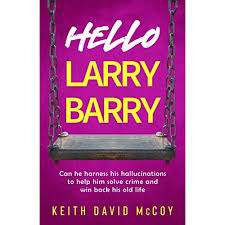
Hello Larry Barry by Keith McCoy

Hello Larry Barry

I have just finished my advance copy of Hello Larry Barry by my former past pupil Keith McCoy. Because of my very close and dear connection to Keith I have to confess that this will not be an objective review. I am biased from the start! However, I was very impressed and you will be too with Keith’s storytelling ability on this his first venture into the murky waters of fiction writing. This is a cracking first novel by this dark horse and true to his personality it is full of his uniquely quirky dark sense of humour.

Larry’s long stay in a mental health unit is at an end, but on discharge, he learns that he has been demoted from his very senior role with the Garda Special Branch in Dublin. Instead, he finds that he has been transferred to a relatively new detective unit in Limerick that appears to house a number of failed, odd and dysfunctional detectives. He wants his old job back and needs to save his marriage, all of which he believes rests on him being a success with this new team. Still very unwell and constantly hallucinating, he is having a go.

Set against a backdrop of police, political and business corruption, can Larry achieve this ultimate challenge. This is a funny, warm and serious story that explores mental health stigma, hope and the drive required to overcome the obstacles thrown at this likeable man. If you enjoyed TV shows such as The Office, Monty Python and Father Ted or any films by the Coen brothers, you will love this.

Keith McCoy was born and raised in Newcastle West, in County Limerick.   After finishing secondary school in St Ita’s Secondary School in 1992 he moved to London to attend university where he trained as a mental health nurse.  In St Ita’s he excelled as the school’s rugby captain and superb Number Eight.  Since then he has achieved even greater accolades, completing his master’s degree in mental health and an MBA. He is hugely interested in film, sport and acting.  He continues to work in mental health, in recent years as a health care director. Today he lives with his wife and young family in Manchester.
IMG_4053
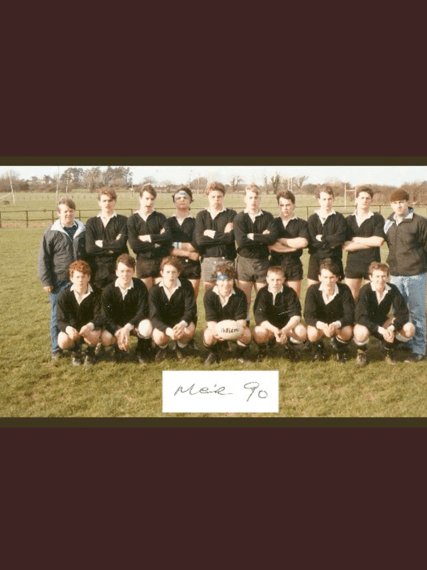
West Munster Junior Cup Winners 1990. Back Row (Left to Right): Ger Normoyle (coach), Rob Moone, Kevin O’Brien, Tom Dooley, Barry Madden, Keith McCoy, Dylan O’Doherty, John Ahern, Eoin Cahill, Micky Lane (coach). Front Row: Seamus Harrold, Maurice Magner, Paul Murphy, Dave Dooley (Capt.), John Flavin, Noel Murphy, Noel Hennessy. (Photo jdtvideo, NCW).


The novel draws on Keith’s extensive experience in the mental health area and fittingly the locations in Newcastle West, Monegea and Limerick are obviously close to his heart.  Keith himself explains: “I was never interested in books, (despite the best efforts of my teachers!), I was very active, and just couldn’t sit still, I found the idea of reading very boring. Then one summer in the late 90s I was working nights as a nurse and was doing suicide watch on one particular male patient, and ended up doing so with him for the whole summer. He was very depressed, would just lie there, and was totally uncommunicative. After about three nights, I was finding the task difficult and decided to buy a book to keep myself stimulated.  I bought a biography of Frank Sinatra, and once I had settled down with this male patient for the night, I opened the book and he spoke to me for the first time, saying,  “You can read that aloud if you want”. That summer I must have read at least a dozen books to him. Over time he recovered from his depressive episode, and by that time I had developed a new and huge interest in books.

“I deliberately used humour in this book. When you are writing about a subject that for many is uncomfortable, writing it in dramatic reality makes it too heavy for most, so what I aimed to do and I hope I have achieved it, was use humour to engage the reader, get them enjoying the read, the fun, and then let everything sink in slowly, and gently provoke them to think about and understand the subject matter differently. I truly hope I have done justice to those who have mental health challenges, and that it is recognised that I am not making light of their journey, just using the comedy to get the audience to think more deeply about mental health.

“When I got the idea for Hello Larry Barry, I was halfway through an MBA and busy, so I promised myself that I would have a bash at writing it when the degree was finished. Then after I had finished it, one day my son was telling me about how he was going to write a book too etc., and he explained some of his characters to me, so I thought to myself, how can I help him? I concluded that the best way would be by being an excellent role model, and therefore I should crack on with trying to write Hello Larry Barry. The following day, I sat down and took on the challenge.

“I got huge enjoyment from writing Hello Larry Barry, the words just flowed. It was hugely exciting and the positivity that came each day from achieving a new part or direction to the story was immense. At the outset, I wasn’t sure if I could write this and just went for it, and then it was done. Since completing it, the personal impact has been interesting, from feelings of incredulity to just being calm and much more content with myself. It’s hard to explain, maybe something to do with a renewed self-acceptance or something in relation to Identity.”

The novel was due its local launch in the Ballintemple Inn in Newcastle West tonight, 21st of March but events elsewhere intervened and the event had to be postponed. However, rest assured there will be and there deserves to be a local launch of this cracking read. It’s not every day that Newcastle West and Monegea form the backdrop to a modern novel. I loved the story and there’s a lovely twist at the end.  It’s also for sale on all Ebook platforms including Kindle, with print versions available from Amazon. Hopefully, ‘hard’ copies will be available locally in Tony Hayes’ and elsewhere in the near future.

In the meantime, from my enforced isolation in Knockaderry, I tell all my callers that I taught Keith McCoy everything he knows and even though he was somewhat slow in developing into the novelist that he has become there always seemed to be other challenges that took precedence over his academic studies and called for his attention first. He was one of the best natural leaders on the rugby field (and unfortunately, also in the classroom) that I have ever seen and even though he has travelled far and wide and now resides in Manchester his heart has never left his native place.

I hope you enjoy the read – spread the word!

GN4_DAT_15852947.jpg--first_time_novelist_keith_to_launch_in_limerick_s_county_town
The author of Hello Larry Barry, Keith McCoy

Free Resources for Leaving Cert English Students 2020

Because of the ongoing school closures and the uncertainty and anxiety which this causes all Leaving Cert students, I have brought together here in one post links to a series of relevant notes which you may consider useful in your English course studies for 2020.  These notes cover Single Text, Comparative and Poetry Sections.

Caveat Emptor!  Leaving Cert Student Beware !!  These are resources which you should use wisely.  They are personal responses to the various texts and you should read and consider them if you find them useful.   IN OTHER WORDS, MAKE YOUR OWN OF THEM, ADD TO THEM OR DELETE FROM THEM AS YOU SEE FIT.  ALSO, YOU MIGHT SPREAD THE WORD, DON’T KEEP THEM ALL TO YOURSELF!

THE SINGLE TEXT

(You know the drill, click on the link!)

Hamlet

Shakespearean Tragedy Defined

Hamlet: An Introduction

Hamlet: The World of the Play

The Problem with Hamlet – is Hamlet

Hamlet’s ‘Antic Disposition’ – That is the Question!

Hamlet’s Delay

Death and Deceit in Hamlet

The Moral Question in Hamlet

The King and Queen in Hamlet

Polonius and his family in Hamlet

Comparisons and Contrasts in Hamlet

Ghosts and the Supernatural in Hamlet

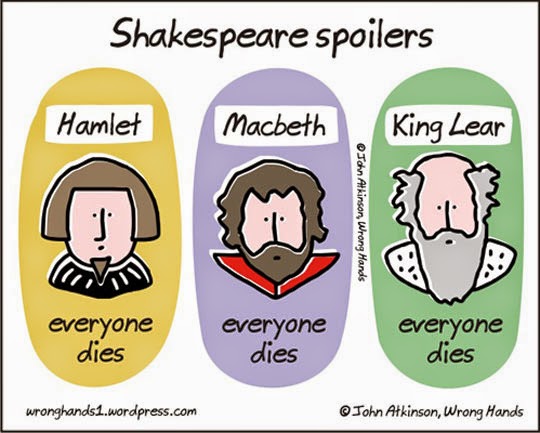
funny-Shakespeare-spoilers-Hamlet-Macbeth-King-Lear

Persuasion

Some Themes in Persuasion by Jane Austen

Characterisation in the novel Persuasion

Fairy-Tale Motifs in Persuasion by Jane Austen

The Playboy of the Western World

An Analysis of the characters of Christy Mahon, Pegeen Mike and the Widow Quin in The Playboy of the Western World by J.M. Synge


THE COMPARATIVE STUDY QUESTION IN 2020

RATIONALE
This section was introduced in order to bring some variety and interest to the manner in which texts are studied at Leaving Cert. level and to give students another perspective on the potential of literature in their lives.

Although literary texts are aesthetic artefacts they can be gainfully approached from a range of other viewpoints, e.g. cultural, historical, social, which can enrich our understanding of the role and significance of literature.

Studying texts comparatively from these perspectives invites students to interact with the different worlds encountered and to make discriminations and evaluations. Such study will hopefully reflect back on the student’s own world and raise her or his awareness of it.

MODES OF COMPARISON

For each Leaving Certificate course, three modes of comparison will be prescribed. This means that the texts chosen for comparative study must be studied under these particular modes (headings).

This year the modes of comparison at Higher Level are as follows:
• Literary Genre
• Theme or Issue
• Cultural Context

Two of these three will be examined in 2020.

Literary Genre
This mode focuses on the ways that texts tell their story. This is also a legitimate basis for comparison: whether it is a tragic play, a detective thriller, a film, a historical novel, an autobiography or a travel book. (The amazing thing is that all these differing genres are available for study on this course!).

The following questions should be asked about the texts being studied by you:
• How is this story told? (Who tells it? Where and when is it told?)
• Why is the story told in this way?
• What effects do all these have?
• Is there just one plot or many plots? How do these relate?
• What are the major tensions in the texts? Are they resolved or not?
• Was this way of telling the story successful and enjoyable?
• How do the texts compare as stories?
• Is the story humorous or tragic, romantic or realistic?
• To what genre does it actually belong?
• Because your three texts are so different you have to be very aware of how different the experience of encountering a novel, a play, and viewing a film is.

Theme or Issue
This involves comparing texts on a prescribed theme(s). These would have to be themes that were pervasive and central to the texts chosen for study e.g.

  • Isolation and Loneliness
  • Relationships
  • Family
  • Childhood
  • Fantasy and reality

These themes/issues will be the messages or concerns that the writer or film director wishes to impart to the audience. In most texts, there will be a number of themes/issues worth considering

Your task, therefore, in this section is to compare and contrast the same theme as it is treated by different authors or film directors.

Cultural Context
Compare the texts focusing on social rituals, values and attitudes. This is not to be seen as a sociological study of the texts alone. It means taking some perspectives, which enable the students to understand the kind of values and structures with which people contend. It amounts to entering into the world of the text and getting some insight and feel for the cultural texture of the world created. This would imply considering such aspects as the rituals of life and the routines of living, the structures of society, familial, social, economic, religious and political: the respective roles of men and women in society, the position of children, the role and nature of work, the sources and structures of power and the significance of race and class.

When you answer a question in the Comparative Section remember that you have to be selective in emphasising the most meaningful similarities and differences between texts. The more similar they appear to be, the more provocative and challenging it is to contrast them and to draw out differences between them. Remember also that when you draw out surprising or disputable similarities or differences, you require detailed support from the texts.

In a Comparative answer, it is vitally important to compare and contrast these different ways of looking at life, or to examine if there is coherence or a lack of coherence between all these differing viewpoints.

THE COMPARITIVE STUDY

EXAM HINTS

• There are three modes of comparison this year – literary genre, themes and issues, and cultural context. Two of these modes will be examined this year.

• Four questions will be offered in this section to cater for the variety of texts that have been studied. (Only one question is to be answered from this section.) You must read each question carefully and in full to see if it suits your own set of texts.

• Some questions will be in the form of a statement to be discussed. Others will be presented in parts with the marking for each part clearly stated following the question.

• It is vitally important that you remember that the questions here will be mode-specific and not text-specific. Remember that you must approach this section with the comparative headings in mind and then you must apply them to your chosen texts.

• You should bear in mind that, as with the single text, e.g. Hamlet, you must avoid the easy option of merely summarising the story. This will fill up pages (and pages!) of foolscap and will give the impression of writing a lot but will not give the examiner the opportunity of awarding marks. Remember, THINK, ANALYSE, PROVE AND SUPPORT your points as you go.

• The most important words to remember in writing answers here in this section is COMPARE and CONTRAST. You should present texts alongside one another and then compare, contrast and think about interesting parallels and divergences as they arise.

• Remember to have your KEY MOMENTS well prepared for this section so that you can make use of them in comparing one text with another.


Links to Notes on Comparative Texts

A Doll’s House

Study Notes on A Doll’s House by Henrik Ibsen

Persuasion

Some Themes in Persuasion by Jane Austen

Characterisation in the novel Persuasion

Fairy-Tale Motifs in Persuasion by Jane Austen

Wuthering Heights

Major Themes in Wuthering Heights

The Depiction of Childhood in Wuthering Heights – Some Observations on Characterisation in the Novel

Grace Notes on Wuthering Heights

Silas Marner

Themes in ‘Silas Marner’

Silas Marner – The Characters

Imagery in ‘Silas Marner’

Fairy-Tale Elements in Silas Marner

Silas Marner by George Eliot is a radically disturbing social document…

The Great Gatsby

Introducing ‘The Great Gatsby’

The Spinning Heart

The Spinning Heart by Donal Ryan


THE POETRY SECTION IN 2020

I include links to FIVE of the eight poets on your course here – simply click on the link.

Eavan Boland

Major Themes in Eavan Boland’s Poetry

The Beauty of Ordinary Things – In the Poetry of Eavan Boland

‘Child of Our Time’ by Eavan Boland

Emily Dickinson

An Overview of the Poetry of Emily Dickinson

Robert Frost

AN ANALYSIS OF THE POETRY OF ROBERT FROST (1874 – 1963)

Some Personal Thoughts on ‘The Road not Taken’ by Robert Frost

Analysis of ‘Spring Pools’ by Robert Frost

Commentary on ‘A Tuft of Flowers’ by Robert Frost

Adrienne Rich

Exploring the Poetry of Adrienne Rich (1929 – 2012)

Hidden Riches in The Poetry of Adrienne Rich

William Wordsworth

William Wordsworth’s Poetry

Tintern Abbey – An Analysis

Analysis of ‘Upon Westminster Bridge’ by William Wordsworth


REMEMBER ALL THIS WILL PASS – STAY SAFE AND KEEP THOSE CLOSE TO YOU SAFE ALSO.  IN ACTUAL FACT, MOST OF THESE SHAKESPEAREAN TRAGEDIES WOULD HAVE BEEN AVERTED IF PEOPLE HAD STAYED HOME…..

IMG_4062 (1)