Some Personal Thoughts on ‘The Road not Taken’ by Robert Frost

two_roads_in_a_yellow_wood_-robert-frost

The Road Not Taken


by Robert Frost

Two roads diverged in a yellow wood,
And sorry I could not travel both
And be one traveler, long I stood
And looked down one as far as I could
To where it bent in the undergrowth;

Then took the other, as just as fair,
And having perhaps the better claim,
Because it was grassy and wanted wear;
Though as for that the passing there
Had worn them really about the same,

And both that morning equally lay
In leaves no step had trodden black.
Oh, I kept the first for another day!
Yet knowing how way leads on to way,
I doubted if I should ever come back.

I shall be telling this with a sigh
Somewhere ages and ages hence:
Two roads diverged in a wood, and I—
I took the one less traveled by,
And that has made all the difference.

‘The Road not Taken’ has always been a very popular poem and despite 21st Century developments such as Google Maps and iPhones and Sat Navs it still bears a relevance for the modern reader.  Then again not all journeys are easily mapped and some take place off-road!  This lyric poem, a first-person narrative tale, describes  a key moment in the poet’s life.  In the poem, the speaker, whom we can assume is Robert Frost himself, is faced with a choice that appears quite suddenly as he walks along a forest track.  Imagine walking through beautiful woodland in upstate New York or Vermont as the Fall takes hold and imagine at this moment, the route on which you travel diverges into two separate paths.  This mirrors the poet’s dilemma in the poem and he faces a difficult decision that has to be made for the moment, yet may have repercussions that last a lifetime.  This is what makes the decision so difficult.

If you consider, briefly, some decisions you make in your own life, you know that you might make hundreds of choices in any one day, most without even noticing!  Deciding where to go for lunch is usually not too difficult; however, a much more difficult decision is the career to follow after your Leaving Cert or A Levels.  Your choice may affect your life for many years and so you tend to take time and effort in arriving at that decision.

So, Frost comes to a fork in the road.  If taken on a literal level, the choice is simply the path along which to continue.  However, if these paths are seen in a symbolic or allegoric way, then the choice is more challenging.  Great poetry and literature have always given us many examples where life is seen in terms of a journey on which we will meet many twists and turns.  So, therefore, the moment described so beautifully in the poem could be such a moment in anyone’s life.

The poet considers his options carefully.  He looks down both paths, ‘as far as I could’ in an attempt to see what they might offer.  But his view is limited by the bend as the track veers into the undergrowth.  It is, in other words, impossible to foresee what future may lie ahead – and Frost did not seem to have the luxury of a Change-of-Mind slip!  At first, each alternative is equally appealing or ‘just as fair’.  Similarly, both roads diverge into ‘a yellow wood’ – Vermont in all its Autumnal glory!  The first path, however, is a more popular route, while the other less-traveled path is overgrown and ‘wanted wear’.  The choice is clear but not at all simple: the common, easy path or the unusual, more challenging path?  The first road might prove more reliable, even reassuring, for others have gone that way.  The more difficult road, however, may produce a less predictable outcome yet perhaps a more fulfilling and individual one.

The poet is aware that the minor difference between the paths at this time will become major differences as the paths diverge further into the woods and into the future.  Each path is attractive and alluring in its own way, but he cannot travel both.  You can’t have your cake and eat it!  This he regrets.  Nonetheless, he decides.

Even as he travels his chosen path he still wonders about the path he has rejected and hopes to keep ‘the first for another day’.  Yet, he knows in his heart that ‘way leads on to way, / I doubted if I should ever come back’.  The poem, in this way, suggests that we can only hope to explore a very limited number of life’s possibilities.  Finally, the poet ‘sighs’, happy with his choice, yet wondering what if…..?  What experiences might have occurred along the other path?  Certainly, his choice has ‘made all the difference’.  That is gratifying; the decision has had a positive effect on his life and he is thankful for that and overall seems pleased with the road he has chosen.

This poem reminds us that important decisions in life are not exact predictions.  We base our choice on reflection of what might be encountered along the way.  Like Frost, we all hope that our major decisions will make ‘all the difference’ in our lives.  We need to believe they will.

Frost believed that each poem was a ‘little voyage of discovery’; a path to something else, rather than an end in itself.  Perhaps, the road not taken is just such a voyage?

 FROST (7)

The Theme of Marriage in ‘Pride and Prejudice’


e8675-pride-and-prejudice-2005-movie-download

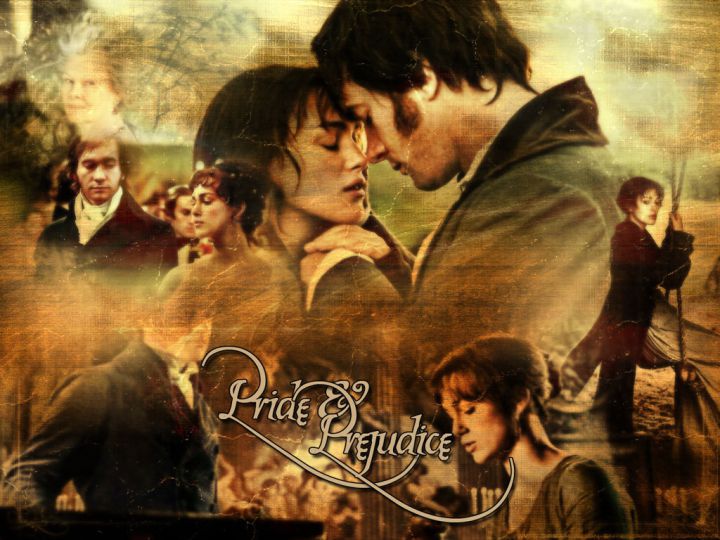
Marriage is the focal point of Pride and Prejudice.  The plot concerns a series of marriages (Four Weddings and a ….. ?), the characters are revealed and developed through marriage and the lessons Jane Austen teaches us are centred around marriage.

Why does Jane Austen choose marriage as her main theme?  In her world, marriage was the ‘only honourable provision’, infinitely preferable to the dependency of spinsterhood or the near slave-labour of being a governess.  Socially, it marked maturity.  When she married and started a family, a woman took her place in society.  So marriage is obviously the focus of interest in Austen’s world.

How does she present her view?  Against a background of conventional contemporary attitudes on the subject, she places a series of actual and possible relationships.  Elizabeth and Darcy, Jane and Bingley, Lydia and Wickham, Mr Collins and Charlotte Lucas all marry.  Some couples, such as the Bennets and the Gardiners, are already married, and there are a variety of potential marriages throughout the novel.  Through all of these Jane Austen shows us, and Elizabeth, what she considers to be worthwhile in marriage and life.  Elizabeth eventually reaches a real understanding of what a good marriage involves, and she finds it with Darcy.

At first, Jane Austen seems to disapprove strongly of such arrangements.  From the opening sentence of the book, she mocks the link between marriage and money made by Mrs Bennet when talking about Bingley.  Wickham’s fortune hunting is condemned by Mrs Gardiner; his eventual marriage, the result of a bribe, is doomed from the start.  Darcy’s awareness of the ‘inferiority of (Elizabeth’s) connections’ is seen as a major flaw in his character.  All those who scheme for arranged marriages are condemned: Mrs Bennet, Lady Catherine, and Caroline Bingley.

From the start, Elizabeth despises those who wed to be ‘well-married’.  She defends before Mrs Gardiner her right to marry without a fortune and implies the same to Mr Collins when he proposes.  She is determined to choose her husband for love, rather than money.  Jane Austen’s influence seems quite clear here.

However, Elizabeth must learn that love is not enough.  Without financial stability, in Jane Austen’s world, people literally starved to death, and the building of a family circle with a sound economic base was therefore highly important.  For example, Mr Collins wishes to marry for his own ‘happiness’, to set an example, to gain Lady Catherine’s approval.  His reasons are selfish, but his intention is sound.  When he meets Charlotte, someone with equal aims, they marry.  Elizabeth is horrified, but the Hunsford visit reveals a marriage that works.  Possessions take the place of affection, but it is a stable social unit and therefore valid.  Charlotte has ‘a degree of contentment’ and by the end of the novel the couple are expecting a child, fulfilling the purpose of this kind of marriage and offering the couple an established place in society.

The success of this marriage helps change Elizabeth’s mind.  After Darcy’s letter and her self-realization, she matures further.  Soon the Wickham she was prepared to marry without money seems ‘mercenary’ for wanting an unequal match.  She still retains her basic belief in marriage based on love rather than practicalities, as when she refuses to agree to Lady Catherine’s marriage arrangements and maintains her right to choose a husband for herself.  But she now also realises how essential practical considerations are, and when she marries Darcy and moves to the comfort and elegance of Pemberley, she has also achieved an adult view of marriage as a practical and necessary financial contract.

It is very obvious to the modern reader, however, that Jane Austen’s view of sexuality seems very old-fashioned.  There is little examination of the feelings and responses sexual attraction can bring.  Sexual attraction comes way down the list of priorities in all but one of the marriages arranged during the course of the novel and then even though we see that Darcy is infatuated with Elizabeth the idea of sex or a sexual relationship seems not to have ever entered her head! (Or am I completely wrong here??). Once respect, regard and love were established and validated by marriage, then sexuality was acceptable and taken for granted.  Outside marriage, sexuality was merely self-indulgent, and therefore a threat to society.

Her views on marriage based on sexual attraction alone changes little through the novel.  She at first responds to Wickham’s ‘beauty… countenance … figure’, but very soon realises that appearance is not everything.  It has to be matched by real worth.  She realises, too, that Darcy’s goodness more than compensates for any lack of ‘appearance’, while he, at first thinking her ‘not handsome enough’, in the end, finds her ‘loveliest Elizabeth’.  Elizabeth continues to question Lydia’s marriage and in the midst of general rejoicing she alone sees the difference between a physically-based marriage and a working relationship.  ‘For this, we are to be thankful?’ she asks.  All this shows what Elizabeth and Darcy eventually learn – that obvious physical attraction may mislead, but once affection brings knowledge of and respect for one’s partner, true love follows.

Jane Austen obviously sees her heroine’s marriage as a model one, the outcome that her readers have been hoping for, and one that rises above the other marriages in the book.  What makes it so ideal?

Their marriage is primarily a sound personal relationship where each person gives something and helps the other to mature.  Secondly, the marriage marks a step to this maturity for each of them.  By learning to put the other first, they have advanced from the self-centeredness of their unmarried lives.  They have learnt to accept responsibility for  each other, and to put their relationship first.  In Elizabeth’s case, this means accepting the importance of marriage as a sound financial and social contract; for both it means realising that infatuation is not the basis for a lifelong commitment.

Chiefly, however, they have matured by casting aside their main faults – pride and prejudice – through their developing relationship.  This maturing of Elizabeth and Darcy culminates in their marriage.  Now the ‘proud’ Darcy and ‘wild’ Elizabeth can take their rightful place in society and form a true family.

matthew-macfadyen-pride-prejudice


The Themes of Pride and Prejudice in ‘Pride and Prejudice’


pride-prejudice-750x290

The Theme of Pride

In Pride and Prejudice, Jane Austen looks at people who are guilty of pride, and the effects it has both on their lives and the lives of others.  Everyone in the book has some degree of pride, but the key characters are often caricatures of proud people: Mr Collins and Lady Catherine de Bourg.  Darcy and Elizabeth develop as characters during the course of the novel and they are also seen to have pride as part of their personality.

Caricatured pride is shown by Austen to be obnoxious.  Lady Catherine is proud because she was born an aristocrat, raised to believe herself to be superior to others.  She is patronising, believes she has a right to know and judge everything and gives petty advice because she needs to feel useful.  She always likes to be the centre of attention, and she expects to be always obeyed.

Lady Catherine is challenged by Elizabeth, who unlike everyone else, is not overawed by her. Lady Catherine is outraged when Elizabeth answers her back at Rosings and later when she barges in to Longbourn.  She tries to bully her at first, ordering her not to marry Darcy and finally insulting her by saying that accepting Darcy will pollute the shades of Pemberley.  She demands instant submission  and when this is not on offer her pride is severely dented.

Mr Collins had long been supplying this need.  He had been raised with ‘humility of manner’, but living at Hunsford has made him a mixture of ‘pride and obsequiousness, self-importance and humility’ and this lapdog servility makes him even more unlikeable in our eyes.  The key scene showing Collins’s pride comes with his proposal to Elizabeth, where he not only assures her he will not despise her for being without a dowry but tells her that she might as well accept him, for he is the best she can expect.

Elizabeth herself, though chiefly signifying prejudice, is guilty of the pride on which this prejudice is based.  Darcy tells her when he proposes, ‘Had not you heart been hurt … (my faults) might have been overlooked’, and in the key chapter that follows, she admits this.  She has been convinced she was right about Bingley’s treatment of Jane, Charlotte’s and Collins’s marriage, Wickham’s goodness and Darcy’s lack of worth.  She learns that her prejudice has been due to her belief in the infallibility of her own judgement.  Also, she realises her vanity has been wounded.

The distinction between pride and vanity is made early in the novel.  Mary comments that ‘pride relates more to our opinion of ourselves, vanity to what we would have others think of us’.  As well as pride, Elizabeth has, therefore, been guilty of vanity.  She has been far too influenced by Wickham’s attention and Darcy’s neglect.  She admits this immediately, making an honest effort from then on to be neither proud nor vain.

The chief representative of pride in the novel is Darcy.  On his introduction in Chapter 3, he is said to be proud.  He seems withdrawn, superior and cynical.  He puts Elizabeth down coldly with a patronising comment about her looks.  Later, despite his infatuation, he feels himself superior to Elizabeth and kindly condescends to ignore her towards the end of her visit to Netherfield so that ‘nothing could elevate her with the hope’ of marrying above herself.  Pride convinces Darcy he is right to interfere in Bingley’s relationship with Jane, and pride keeps him from lowering himself and his family by disclosing Wickham’s bad nature.

By the time he makes his first blighted proposal to Elizabeth, Darcy is firmly established in our minds as the epitome of pride.  The proposal, ‘not more eloquent on the subject of tenderness than of pride’, reveals a Darcy who considers he is doing her a favour.  She is outraged and accuses him of ‘arrogance’ and ‘conceit’.  Were he a lesser character, like Mr Collins, for instance, he would have sulked and moved on to fresher pastures, but Darcy, the hero, ponders Elizabeth’s accusations, realises the truth in them and he resolves to change.  At first, we only see his outward transformation, his gentle behaviour at Pemberley, his assistance to the Bennets after the elopement.  It is only after his second and more successful proposal that we see evidence of his complete change of heart.  Loving Elizabeth has made him realise that people can be good despite their humble origins and that love is not compatible with condescension.

We must remember of course that Darcy was never all bad.  Our view of him as such is largely formed by Elizabeth’s prejudice.  His reputation for being proud largely stems from his being shy and his dislike of socialising.  He may put people down, but he also helps them, as friends and dependants.  Remember his housekeeper’s kindly comments: ‘Some people call him proud; but I am sure I never saw any thing of it’.

By the end of the novel, Darcy still has some pride, but with good reason.  The mature Elizabeth has learnt, as have we, that there is good pride and bad.  ‘Vanity is a weakness’, says Darcy, but with ‘superiority of mind, pride will always be under good regulation’.  Elizabeth, thinking he is guilty of both, smiles.  But Darcy is right.  Vanity, as seen in Lady Catherine, Mr Collins, Elizabeth, and even in Darcy himself, is wrong, but pride, while also being wrong, can be acceptable if properly controlled.  In many ways, Darcy controls his pride.   The Darcy who saves Lydia and marries Elizabeth is a well balanced mature individual.  He is master of Pemberley and Elizabeth sees this in a positive light; he has many good attributes and a capacity to help his family, tenants and friends.  She defends Darcy to her father, telling him that he is proud, but has ‘no improper pride’.

Lady Catherine and Mr Collins don’t change in the course of the novel but Elizabeth and Darcy do. Having learnt a valuable lesson they both are now ready to take up residence at Pemberley and reign supreme at the centre of Austen’s universe!

e8675-pride-and-prejudice-2005-movie-download

THE THEME OF PREJUDICE

In this age of political correctness and media spin the notion of prejudice, as described in the novel, is very pertinent.  In the novel, Jane Austen talks about the idea of ‘universal acknowledgement’, where society in general takes a united (and she infers, a biased) stand, welcoming Bingley because he is an eligible bachelor, rejecting Darcy because he seems proud and favouring Wickham because he flatters and charms.

Against this background of public prejudice, Jane Austen presents several particular illustrations of people who confuse appearance with reality because of their personal bias.

Mrs Bennet is probably the most humorous example of this, seeing the world in terms of the wealth and charm of potential husbands.  Thus, she is blind to Collins’s faults, is deceived by Wickham, and yet cannot see Darcy’s real worth: ‘I hate the very sight of him’.  (Yet, worryingly, she welcomes Wickham as Lydia’s husband even though he nearly ruined her reputation and the reputation of her family).

There are many examples of social prejudice and snobbery dealt with in the novel (and this overlaps with the vice of pride).  Lady Catherine, Collins and the Bingley sisters all fail to see the real Bennets when they judge them early on.  Look at Collins’s proposal and how he constantly reminds Elizabeth of her inferior position in life, echoing the comments of Lady Catherine at Rosings.  The Bingley sisters spend several sessions judging Jane and Elizabeth on their relatives and their wealth.

Darcy, though in the main clear-sighted and intelligent in his approach to life, at first joins in this social snobbery.  His initial opinion of Elizabeth herself was formed by her lack of beauty and then compounded by her lack of connections.  This snobbery led him to influence Bingley away from Jane and to resist his own infatuation for Elizabeth.  It is only when Elizabeth points out his pride, after his first proposal to her, that he realises his mistake and he makes an honest effort to change his behaviour.  By the end of the novel, he respects Elizabeth’s family and sees only the true Elizabeth, not her social standing.

It is Elizabeth who most typifies prejudice for us.  The first time she and Darcy meet he snubs her and this turns her against him.  From then on, instead of attempting to understand him, she reacts only to his proud outer appearance and delights in fuelling her prejudice as much as possible.  At first, she can be pardoned for disliking a man who has insulted her but, as she admits, her reasons were not sound.  She wanted to score points, to seem clever, and to say something witty.

It is not until the first proposal that Elizabeth begins to doubt her judgement.  After all, she has been prejudiced against Darcy because of his insensitive remarks and in the case of Wickham, her judgement has been clouded by sexual attraction and flattery.  In the crucial Chapter 36, Elizabeth considers Darcy’s letter and there follows a careful account of how she overcomes her prejudice.  At first totally biased against Darcy, without ‘any wish of doing him justice’, she then realises that if his account is true, she must have deceived herself.  Notice how by putting the letter away she literally refuses to see the truth.  Almost immediately, however, her strength of character triumphs, she rereads the letter, and Elizabeth now sees the situation clearly.  She admits to being ‘blind, partial, prejudiced’ and achieves insight into the situation and her own character.  She admits her fault to Jane, and by letting Wickham know that she sees the difference between appearance and reality, she makes a public statement of her new self-knowledge.

She sees things in a clearer light from this point on, viewing Pemberley with unbiased eyes and meeting Darcy with an open mind.  She also begins to understand his criticisms of her family, seeing them objectively possibly for the first time in her life.  Finally, she comes to accept Darcy as an acceptable partner and she works hard to overcome her family’s prejudices against him by presenting him in his true light.

Elizabeth has learnt many valuable lessons at the end of this novel: she now knows that ‘first impressions’ are rarely sufficient and she comes to see the reality of true worth, not the appearance of it.  There may be lessons here for us as well.  Our age is obsessed with image, and spin and outward appearances and social snobbery.  Finding our own Elizabeth or Mr Darcy is not going to be easy either!


Character Study of Elizabeth Bennet and Mr Darcy in ‘Pride and Prejudice’

pride-prejudice-750x290 

pride-and-prejudice-2

Elizabeth Bennet

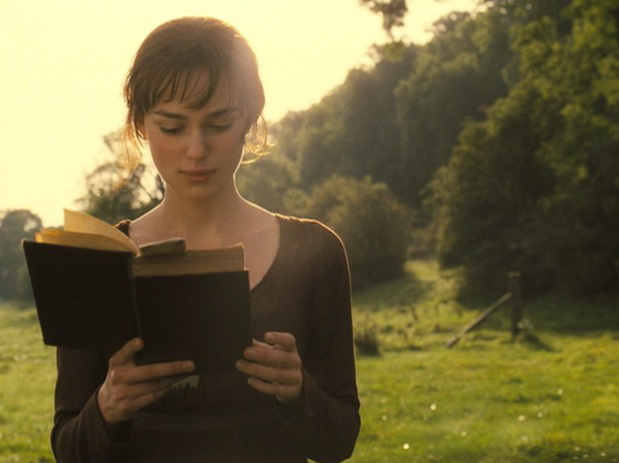
Elizabeth is the central character in Pride and Prejudice – indeed it could be said that Elizabeth is Pride and Prejudice.  She is the main focus of our interest, she is the novel’s heroine, even though she makes mistakes and is not particularly heroic.  Her personality, her attitudes and her development throughout the novel bring together the story and all the other characters.  The novel is concerned with pride and with prejudice and she and Darcy are the main players.  She is Mr Bennet’s favourite daughter and her ‘quickness of mind’ is made evident in her witty and teasing conversations, where she often adopts striking and independent views.  (See Chapters 8,9, and 11, when she is looking after Jane at Netherfield, in her conversations with Bingley, his sisters and Darcy).

She likes to laugh at people, including herself.  She shares her capacity for irony with her father and the narrator.  This allows her to stand back and offer judgements on certain situations.  She often says the opposite of what she really means.  In Chapter 6 (p. 27) she says, ‘Mr. Darcy is all politeness’, as a way of avoiding dancing with him after his rude remarks earlier.

A key passage in reviewing Elizabeth’s growth is Chapter 36 when we see her painfully coming to terms with her mistaken understanding of Wickham and Darcy while reading Darcy’s letter.  She is forced here to confront some of her prejudices and earlier judgements, and in doing so realises that she has not been as sharp a reader of character as she has previously supposed.  She blames herself for not having recognises the smack of ‘impropriety’ in Wickham’s behaviour, but had allowed herself to be deceived by his charm.

Elizabeth’s most appealing characteristic is her independent streak, her ‘self-sufficiency’.  She judges things for herself and she is capable of decisive action as when she calmly, yet firmly, stands up to Mrs Bennet over Mr Collins’s proposal.  She argues later that it is this ‘self-sufficiency’ which made Darcy fall in love with her.

However, though formidable at times, Elizabeth is also emotional.  She feels great affection for Jane  and is concerned for Lydia and Kitty.  She is very close to her father, though she is often exasperated by her mother’s behaviour.  She is very kind-hearted and we see this in her relationships with Charlotte and Georgiana.

She is not faultless, however, and her main fault is her prejudice.  As Darcy is Pride, so Elizabeth is the Prejudice of the book’s title.  She may see and judge for herself, but often these judgements are based on appearance rather than reality, on her strong emotions, not on rational thought.  The two main targets for her prejudice are Darcy and Wickham.  She tells us that from the beginning she meant to be ‘uncommonly clever’ in disliking Darcy ‘without any reason’.  In fact, her initial dislike is seen as being justified because Darcy’s first comment was cruel and offensive.  Afterwards, however, she delights in provoking him, and when he is denounced by Wickham, she is more than ready to believe the accusations made about him.  One moment she is stating firmly that she does not think Darcy capable of such inhumanity, the next she is totally accepting Wickham’s story that he is!  From the start, she is ‘out of her senses’ about Wickham’s looks and charm.  For the next twenty chapters (!) she takes Wickham’s side despite warnings from Jane, Mrs Gardiner and Caroline Bingley, all of whom, ironically, Elizabeth considers to be prejudiced!

Darcy’s letter opens her eyes to the truth.  He has already hinted that she only hears what she wants to hear.  She therefore makes a conscious effort to read his letter openly, and on the second reading does so, analysing it rationally and she finally begins to notice Wickham’s inconsistencies and the lack of any real evidence of goodness on his part.  She finally realises how ‘blind, partial, and prejudiced’ she has been.  She also realises that she has been guilty of the same fault she accused Darcy of having – pride.  She, too, has believed herself to be superior to others, and refused to believe she could be wrong, her vanity fuelled by Wickham’s attentions and offended by Darcy’s.  She realises that ‘Till this moment, I never knew myself’.  This is a crucial moment in the novel which marks her realisation of her faults and her decision to change.

Although she is still angry with Darcy, from this point on in the novel we see that she has changed and we see that she does try to see things clearly and without pride.  She admits her faults to Jane, tells Wickham she knows the truth about him, tries to work out her problems honestly and rationally, and from now on values Darcy.  It is her ability to do this which makes her the heroine of the novel.  Faced with the truth about herself, realising she has been badly affected by both her pride and her prejudice, she accepts the fact, thinks about it and acts on her conclusions.  She has, in effect, become a mature adult.

Her views on love and marriage also change.  Jane Austen uses Elizabeth to show us the mature, ideal marriage, and by contrasting through her eyes other, less worthy marriages, we ourselves learn what is best.  Elizabeth, at first, seems very clear about what she expects from a relationship.  As she tells Charlotte, she is not seeking a husband, let alone a rich one.  She despises courtship games, wants to know all about her partner, and when she hears of Charlotte’s engagement, her reaction is ‘impossible!’.  She slowly learns that her prejudice has led her astray.  Her visit to Hunsford shows her that such a marriage is not only possible but a fair compromise.  Darcy’s views, Pemberley, and the elopement show her too that financial and social considerations in marriage are important.  She needs to learn this before she can take a realistic view of marriage as a social union and become the responsible mistress of Pemberley. However, her view of marriage as an equal partnership is a very valid one and her refusal of Mr Collins’s proposal is vindicated.  His marriage to Charlotte works because it is balanced, and all that remains now is for Elizabeth to meet her equal – quite literally she too must meet her match!  Elizabeth needs a real partner, like Darcy.

It is worth your while trying to pinpoint the exact moment at which  Elizabeth falls in love with Darcy.  The fact that she dislikes and provokes him in the early part of the novel may well be a sign of her attraction, but Elizabeth does not admit this.  She claims to find him obnoxious and certainly has no second thoughts about refusing his first patronising proposal.  Not until her visit to Pemberley does she appreciate Darcy’s real worth and his change of heart, and she begins then to feel more for him.  Her view of marriage also begins to change.  She knows that Darcy is correct in his assessment of her family, and Lydia’s elopement only confirms this.  The inequalities between herself and Darcy are eventually overcome, and Elizabeth betters herself by marrying Darcy.  However, she never takes advantage of this.  Seeing Pemberley marks the start of her affection for Darcy because there she begins to appreciate his real character, rather than simply his wealth.

The elopement crystallises Elizabeth’s view of marriage – she now sees the ideal, and realises that Darcy could provide it, ‘answer’ her needs.  His generosity on Lydia’s behalf compounds her feelings and when he returns to Longbourn, Elizabeth is quiet and uncertain; he is now important to her and she knows that she needs his attention and approval.  But first, she must overcome the twin hurdles of Darcy’s family and her own! She defeats Lady Catherine first, defending the right of Darcy and herself to choose their own partner.  Her courage here against the formidable Lady Catherine surely encourages Darcy to propose again.  She then overcomes her own family’s prejudice against Darcy, showing that she is now a truly independent adult and ready to be married.

Her relationship with Darcy is sound.  They communicate well, give each other mutual support and affection and generally are good for one another.  She has found her true partner, with whom she can live at Pemberley, her true home.    At the end of the novel, Elizabeth is the happy heroine, the centre of everything.  She has not only changed herself through her newly found love for Darcy, but she equally has changed Darcy through his love for her.

images

Mr. Darcy

Mr Darcy is the hero of Pride and Prejudice.  He is entitled to be considered a hero because he has the capacity to change and mature and because he is a true partner for our heroine, Elizabeth Bennet.  When we meet him first, however, he seems to be the villain of the book.  He appears at the Meryton ball and is immediately disliked by everyone because he so obviously disapproves of the evening, will not mix, and seems above himself, particularly to Elizabeth.  What we learn about him later supports this view: he is ‘haughty, reserved ……. continually giving offence’.  These ‘first impressions’ are strengthened by more serious criticisms: his condescending manner towards Elizabeth at Netherfield, his actions to Wickham, his influencing of Bingley against Jane.

By the end of Chapter 33 we, like Elizabeth, have come to form a clear but negative view of Darcy.  Then he proposes, but patronisingly, and they quarrel, gaining self-awareness shortly afterwards.  From this point on, Darcy ceases to be an anti-hero  and begins to change.  We also begin to view him differently.  Once the truth behind Wickham’s assertions and the reasoning behind Darcy’s influencing of Bingley are known, Elizabeth begins to reconsider her opinion of Darcy.  The business with Wickham was, of course, a slander.  Darcy seems to have done all that could have been asked of him and more: to have judged Wickham correctly and to have been generous enough not to seek revenge for the planned elopement with his sister.  Over the Jane and Bingley affair, he seems to have acted honestly, if through pride, and his concern for Bingley’s welfare is touching.

We, like Elizabeth, begin to see things in a new light and to reconsider our own opinion of Darcy.  Notice that in fact the very first impression he gave, at the Meryton ball, was good: ‘fine, handsome, noble’.  We learnt too that he was intelligent and clear-sighted, and his conversations with Elizabeth certainly showed his thought and intelligence.  When she finally realises that Darcy is right for her, she comments particularly on his ‘judgement, information, and knowledge of the world’.  We are made increasingly aware also of Darcy’s real kindness and generosity.  He is an affectionate brother, trusted by Georgiana, a wise and generous landlord and a good friend to Bingley.  His free use of money to help first Wickham, then Lydia, is admirable.

In fact, Darcy’s chief fault is his pride, and this he honestly tries to conquer in the course of the novel.  His is the pride in the title of the novel.  He was brought up to be proud, almost trained to it.  At the start of the novel, he triumphantly defends it, though he realises the importance of controlling it, which he feels he can do.  However, he is wrong.  His pride does lead him to behave wrongly – on three occasions.  He conceals Wickham’s faults because he does not wish the name of Darcy to be humiliated.  He is totally convinced of his own good judgement over the matter of Jane and so influences Bingley accordingly.  Over Elizabeth, his pride causes him to despise her family connections, and though at first he resists, the attraction remains; he sees his own proposal as demeaning, without realising the implications of this for his relationship with Elizabeth.

Elizabeth reacts to his proposal with genuine anger, and for the first time in his life, Darcy’s ‘arrogance, conceit, disdain’ are challenged.  This is, of course, the point of change for Darcy.  He later tells Elizabeth that it took him some time to begin to alter, but in fact, by the next morning, he has understood enough to want to justify himself in a letter.  He thinks over his actions, slowly realising ‘how insufficient were all my pretensions to please a woman worthy of being pleased’.  By the time we reach Pemberley, he is eager to show his new persona.  His outward manner, unlike so many in the novel, is a sign of his inward change.  He accepts Elizabeth and her relations, and soon after accepts responsibility for Lydia’s elopement and arranges her marriage.  His final proposal expresses his hopes, but not expectations, of being accepted, and he admits his pride, with gratitude to Elizabeth for humbling him.

We must not, however, judge Darcy too harshly.  He is neither vain nor self-centred.  Much of his pride is valid, the natural result of being master of Pemberley, affording him a self-confidence that allows him to help others.  Equally, Elizabeth has coloured our view!  Much of Darcy’s pride is a figment of her own prejudice.  Her final declaration to her father, that ‘he has no improper pride’, says everything.

Although he represents pride in the novel, he is not without prejudice.  He sees beyond superficial appearance more quickly than Elizabeth but nevertheless dismisses her at first glance on her looks alone.  He soon changes his mind but is still put off by her inferior connections and does not consider her on her true merits.  He learns to recognise his priorities after she has rejected his first proposal, and on his return to Longbourn is not disheartened by his reception, also seeing clearly now what he before judged wrongly – Jane’s true feelings for Bingley.

Darcy is, however, generally more clear-sighted than Elizabeth, and points out to her that she is prejudiced.  This is the point of self-awareness for her and completes the circle whereby both hero and heroine are responsible for the other’s maturity.  It is evident that as Darcy develops and matures so too does his love for Elizabeth.  He is, from the start, Elizabeth’s obvious match; the story of their relationship is the story of the novel.  At first, he dismisses her, then is attracted by her ‘playfulness’ and her kindness to Jane.  His love is immature, though, and after her refusal of his proposal, he is forced to reconsider and reassess what she thinks of him and act on it.  Gradually he develops a genuine regard for her.  During the elopement crisis, his awareness and practical help both reflect and develop the growing affection he feels.  One thing is certain; only when Darcy overcomes his faults and infatuation and acts truly for Elizabeth’s sake can he hope to win her.  When he does, also righting the wrong he has done, by persuading Bingley after all to marry Jane, he proposes again.  He is now in a position to receive the ‘happiness’ he deserves.

Darcy and Elizabeth are the one true model union in the novel.  He is good for her; his pride shows her her own and through him, she learns how prejudiced she is.  He alone can stand up to her, balancing her uncontrolled emotion with his controlled rationality.  He ‘answers’ her totally, as no one else can.  Darcy is thus the hero.  He stands head and shoulders above all the other male characters in the novel.  His personality also contrasts with Elizabeth’s, complementing it, as has been said, and forming a true unity.  As her partner, he is as much the centre of the novel as Elizabeth is, though it is not seen through his eyes.  He represents the male ideal: intelligent, rational, shows good judgement and right action, has a handsome, moneyed appearance but is nevertheless valued for his true inner qualities.  He is indeed the ideal partner for our heroine; he is mature and unlike the New Man (Our 21st. Century Model!) he always considers her before himself!

 matthew-macfadyen-pride-prejudice


Introducing ‘The Great Gatsby’

 great-gatsby-dust-jacket-01

A novel of the ‘Roaring Twenties’

This novel lays claim to being (probably) the most memorable fictional evocation of  America of the ‘roaring twenties’, the jazz-age America which came to such a devastating end with the Wall Street Crash at the end of that crazy decade.  Gatsby, Fitzgerald’s finest achievement, is interesting as the record of an era and  of the disillusionment felt by thoughtful, sensitive people with established institutions and beliefs and in their sense of moral chaos in America after the Great War of 1914-1918.

Such was Fitzgerald’s success in expressing what was widely regarded as the spirit of the twenties that he was virtually credited with inventing the period.  It was inevitable that he should be honoured with such dubious titles of distinction as ‘the laureate of the jazz age’ and ‘the novelist of the American dream’.  It is true that he is remarkably successful in rendering some of the essential features of an exciting time.   Sometimes it seems that Gatsby captures the moment and renders a more convincing account of the ‘Roaring Twenties’ than many a historical document.

The fragile, rich, drifting world of the twenties was the emotional heart of Fitzgerald’s life, the source of his happiness as well as his misery.  Gatsby is a reflection of his passionate involvement in the issues of his day, but also of his ambivalent attitude to what he saw and experienced.  It is, however, more than that.  In 1950, the critic Lionel Trilling remarked that  The Great Gatsby was still as fresh and as relevant as when it first appeared in 1925, and that it had even gained in stature and relevance, something that could be said of few American novels of its time.  Sixty five years after Trilling’s comment, there is little evidence that interest in the novel has in any way declined.  Indeed, its popularity has been enhanced by Hollywood film producers who have brought the novel and the era to the silver screen with great success and acclaim.

The American Dream

The Great Gatsby is, like many American novels, about an American dream, one dreamed by the romantic, wealthy bootlegger who gives the book its title.  Gatsby’s dream begins when, as a poor young man, he falls in love with Daisy, a girl whose charm, youth and beauty are coloured and made glamorous in his eyes by a lifetime of wealth, whose very voice, he notes, ‘is full of money’.  His dream that Daisy may become accessible to one of his class and background is nourished by two circumstances: the war makes him an officer, and his post-war activities elevate him to riches.  Gatsby must, however, learn that such things will not bring Daisy wholly within his reach and that however ardently he may pursue it, his dream cannot be realised simply because he wills it.

Class differences

In Gatsby, Fitzgerald is dealing with an important social theme.  He is fascinated by class distinctions and their relationship with the possession of wealth.  This places him firmly in the tradition of the great classical novelists.  The English novel originated in an age (the early eighteenth century) when class structures were drastically disturbed.  Most of the major English novelists have since continued to be absorbed by class differences, and to draw heavily on these and their influences on human behaviour and attitudes.  Think of the dominance of class and money in the novels of Jane Austen.  Although there is an evident ambiguity in Fitzgerald’s attitude to those who possess great wealth, the established rich, they still represent what Lionel Trilling calls, ‘the nearest thing to an aristocracy that America could offer him’.  Fitzgerald deals with the trappings and symbols of this American aristocracy, the great one being money.  In one of his stories, The Rich Boy, there is this telling comment:

Let me tell you about the very rich.  They are different from you and me.  They possess and enjoy early, and it does something to them.

Readers of Gatsby will recognise that it is mainly about what money does to those who possess it in abundance.

There are, of course, two main versions of wealth in The Great Gatsby, dramatically contrasted throughout.  This contrast gives the book much of its interest.  Gatsby himself is the newly-rich tycoon, the boy from Dakota who thought he had to get rich quickly to win the love of a rich girl.  His wealth gives him a vulgar neo-Gothic mansion, an incredible car, and garish clothes; it causes him to assume uncharacteristic stances and attitudes, including ‘an elaborate formality of speech’.  All of these things placed side by side with the grace and ease associated with the representatives of the established rich, Daisy and Tom Buchanan, appear ludicrous.  Gatsby is, from one point of view, a vulgar upstart who purchases his standing in society by giving mammoth parties patronised by all and sundry.  (Check out Fitzgerald’s descriptions of these parties).  His great wealth, for all his efforts,  cannot imitate the effects produced by that of the Buchanans.

The world of the Buchanans

But the contrast is not entirely, or even mainly, in favour of the established rich.  Gatsby, for all his lavish vulgarity, turns out all right in the end in the eyes of the reader; the Buchanans do not.  Gatsby is using his money as an instrument with which to achieve something, to further his aim of enriching his life; he has a capacity for wonder, for excitement, not shared by the Buchanans.  Their wealth and that of their associate Jordan Baker is sterile, which induces a tired, bored attitude to life.  “We ought to plan something,” yawns Jordan, ‘sitting down at the table as if she were getting out of bed’; and again, “You see I think everything’s terrible anyhow … Everybody thinks so.”

What Fitzgerald establishes in the scenes involving the Buchanans is that their money has drained away their emotions.  Daisy’s pattern of living, based as it has always been on the security of possession, has given her the habit of retreating in the face of responsibility into ‘their money or their vast carelessness’.  This aspect of the mentality of the established rich is more than once contrasted with Gatsby’s heroic, if ludicrous, romantic idealism.  He watches outside the Buchanan house after the accident, seeking to shelter Daisy from its unpleasant consequences.  She is seated with Tom over a plate of cold chicken and two bottles of ale (‘an unmistakable air of natural intimacy about the picture’) when Nick arrives.  Gatsby looks at the latter ‘as though his presence marred the sacredness of the vigil’.  The vulgar tycoon can also be the chivalrous, incorruptible upholder of ideals, however, mistaken these may be.

Gatsby’s world

The superficial beautiful world of Tom and Daisy is just as ludicrous in its way as the one Gatsby creates around himself.  Gatsby’s world is, of course, a pathetic attempt to reproduce that of people like the Buchanans; by aping its surface, he fondly imagines that he can capture its heart.  His provision for himself of an acceptable background is part of the elaborate, absurd pretence.  As he reveals these fictional details, his speech becomes stiff and stilted, he chokes and swallows on the phrases:

I am the son of some wealthy people in the Middle west – all dead now.  I was brought up in America but educated at Oxford, because all my ancestors have been educated there for many years.  It is a family tradition.

Almost all of this is false, of course, the truth being less flattering: ‘An instinct towards his future glory had led him to the small Lutheran college of St Olaf’s in Southern Minnesota’.  His stay at Oxford is short and undistinguished.  But the attitudes of the Buchanans are exposed by Fitzgerald to as pitiless a scrutiny.  Here is a sample of what passes for thinking among them on ‘serious’ issues:

This idea is that we’re all Nordics.  I am, and you are, and you are, and – After an infinitesimal hesitation he included Daisy with a slight nod, and she winked at me again – And we’ve produced all the things that go to make civilisation – oh, science and art and all that.  Do you see?

The narrator Nick caraway remarks at the beginning that one of the things his father told him was that ‘a sense of the fundamental decencies is parcelled out unequally at birth.’  It is, oddly enough, in the socially deprived Gatsby rather than the long-established Buchanans that the ‘fundamental decencies’ are most in evidence.

 Balancing two worlds in the novel

‘The test of a first-class intelligence,’ Fitzgerald remarked, ‘is the ability to hold two opposed ideas in the mind at the same time and still retain the ability to function.’  In The Great Gatsby, he holds contrasting ideas simultaneously on some major aspects of his material and successfully integrates opposing arguments and points of view.  The most obvious instance of this is when he oscillates between imaginative identification with the splendours of rich society and a recurring tendency towards objective analysis of its limitations.  The boredom, limited emotional range and narrowness of mind of the Buchanan set is very cleverly conveyed in the dialogue, but against this, he can also convey in a very sensuous way the attractions of being very wealthy:

All night the saxophones wailed the hopeless comment of the ‘Beale Street Blues’; while a hundred pairs of golden and silver slippers shuffled the shining dust.  At the grey tea hour there were always rooms that throbbed incessantly with the low, sweet fever, while fresh faces drifted here and there like rose petals blown by the sad horns around the floor.

But a more significant tension is that between the responses called forth by the two sides of Gatsby’s nature, as they are revealed in a few critical episodes and mediated to us through the play of Nick’s judgement of the events and his responses to them.  The central passage of the novel, taken in conjunction with Gatsby’s own account of his background, provides a good example of the ambivalence with which the hero is regarded by his creator:

I suppose he’d had the name ready for a long time, even then.  His parents were shiftless and unsuccessful farm people – his imagination had never really accepted them as his parents at all.  The truth was that Jay Gatsby of West Egg, Long Island, sprang from his Platonic conception of himself.  He was a son of god – a phrase which, if it means anything, means just that – and he must be about His Father’s business, the service of a vast, vulgar, and meretricious beauty.  So he invented just the sort of Jay Gatsby that a seventeen-year-old boy would like to invent, and to this conception, he was faithful to the end.

The obscene, gargantuan vulgarity of his weekend parties is evoked with sober irony:

Every Friday, five crates of oranges and lemons arrived from a fruiterer in New York – every Monday these same oranges and lemons left his back door in a pyramid of pulpless halves.  There was a machine in the kitchen which could extract the juice of two hundred oranges in half an hour if a little button was pressed two hundred times by a butler’s thumb!

 Gatsby as a tragic figure

If this were all there was to Gatsby, we would read the novel as a satire on contemporary manners.  Fitzgerald’s first publishers did, indeed, call the book a satire, but it is only incidentally so: principally in the contribution of the minor characters, and in the occasional comment on the incongruous activities of the major ones.  But the story and the main character are tragic.  The tragic implications of story and character arise chiefly from Gatsby’s redeeming qualities.  Like Fitzgerald himself, Gatsby is a romantic, and in the end meets the fate of all romantics: disillusion, a sense of inadequacy in the face of experience, a deeply felt sense of failure.  His romantic dream is centred on Daisy, an unworthy object as he finds out too late.

Gatsby’s romanticism is stressed throughout the book.  It sometimes involves an endearingly childlike attitude to experience, a sentimental attachment to anything associated with those he loves, not found in any of the other characters.  ‘If it wasn’t for the mist,’ he tells Daisy, ‘we could see your house across the bay.  You always have a green light that burns all night at the end of your dock.’  This green light acquires a symbolic force.  In a famous passage at the close of the novel, we are reminded of the sense of wonder Gatsby experienced when he first noticed the light at the end of daisy’s dock; it comes to stand as a memorial to his romantic idealism:

Gatsby believed in the green light, the orgastic future that year by year recedes before us.  It eluded us then, but that’s no matter – to-morrow we will run faster, stretch out our arms farther …  And one fine evening – So we beat on, boats against the current, borne back ceaselessly into the past.
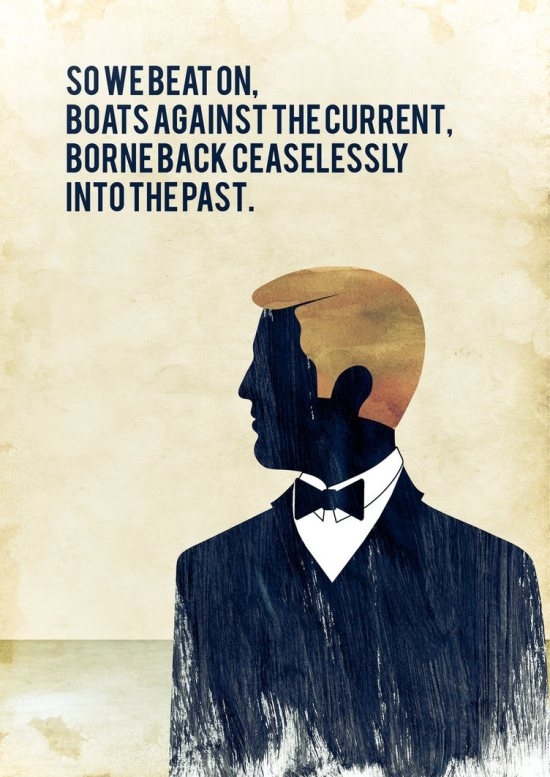
gatsby

A sense of the past

Gatsby has the characteristic romantic preoccupation with the past.  This is beautifully evoked by Fitzgerald in a telling passage, which reveals some of the hidden springs of his failure and of his tragedy.  His great delusion is a sad and common one: that the past can be restored and duplicated, and the effects of the passage of time erased.  Gatsby wants Daisy to abandon Tom Buchanan so that, after she is free, she may go back with him to Louisville to be married from her house, ‘just as if it were five years ago’.  When caraway tells him he can’t repeat the past like this he can see no reason whatever why: ‘I’m going to fix everything just as it was before.’  His longing to do so is perfectly comprehensible.  His life has been disordered since his parting with Daisy: he wants to ‘recover something, some idea of himself, perhaps, that had gone into loving Daisy’.  He returns in his poignant day-dream to a starting place, to a scene with Daisy, described in heightened, poetic, emotionally-charged language, that can make sober realities pale into unimportance.  The incident takes on almost an absolute value, for us readers as well as for Gatsby.  Little wonder that he wants to begin again from such a point:

One autumn night, five years before, they had been walking down the street when the leaves were falling, and they came to a place where there were no trees and the sidewalk was white with moonlight.  They stopped here and turned toward each other.  Now it was a cool night with that mysterious excitement in it which comes at the two changes of the year …

His vain hope of recapturing such a past is finally extinguished by Tom Buchanan’s exposure of his activities during the intervening years.  The romantic cavalier is mercilessly stripped of his glamour: ‘He and Wolfstein bought up a lot of side-street drug stores here and in Chicago and sold grain alcohol over the counter … I picked him for a bootlegger the first time I saw him.’  Tom reduces Gatsby’s thrilling aspirations to the level of the sordid: ‘I think he realises that his presumptuous little flirtation is over.’  The end of the quest for lost happiness is tellingly rendered:

But with every word she was drawing further and further into herself, so he gave that up, and only the dead dream fought on as the afternoon slipped away, trying to touch what was no longer tangible, struggling unhappily, undespairingly, towards that lost voice across the room.

Fitzgerald the moralist

Scott Fitzgerald was at heart a moralist.  He once gave as his reason for writing fiction ‘a desire to preach at people in some acceptable form’.  Moralists often find their natural outlet in satire, and Fitzgerald was gifted with a keen satiric eye and a keen sense of the absurdities of human nature.  Tom’s defence of ‘civilisation’ against the ‘inferior’ races provides a good example.  There are more good satiric portraits of minor figures like Catherine and Mr. McKee:

Her eyebrows had been plucked and then drawn on again at a more rakish angle, but the efforts of nature toward the restoration of the old alignment gave a blurred air to her face … He informed me that he was in ‘the artistic game’, and I gathered later that he was a photographer and had made a dim enlargement of Mrs. Wilson’s mother which hovered like an ectoplasm on the wall.  His wife was shrill, languid, handsome and horrible.

But these, and the description of the massive vulgarity of the Gatsby residence are isolated patches; Fitzgerald was much more attracted to the affirmation of what he saw as the good than to the denunciation of the bad.  The positives celebrated in The Great Gatsby are the simple virtues: the hopeful, wondering, questioning attitudes of mid-Western America, o the ‘broad, sprawling, swollen towns beyond the Ohio’, over against which, in rich contrast, is the urban sophistication, culture, boredom and corruption of the jaded East.

 Flaws in the novel

The significance of the title of the book in relation to all this is often missed.  Gatsby is great is so far as he stands for the simplicity of heart Fitzgerald identified with the mid-West; he is a vulgar, contemptible figure in so far as he revels in the notoriety that his worldly success lends to his name.  He is, of course, a man of limited understanding, failing at once to appreciate his own real claims to recognition (his idealism, his high romantic aspirations) and to recognise his error in thinking that he really belongs to the world he has entered.  In its way, too, the novel is limited in its treatment of its central figure.  After all, we are expected to find the supreme value of the story and its hero in its romantic aspirations, in his ‘heightened sensitivity to the promises of life’.  There is no voice in the novel, no point of view which seems to question the adequacy of this attitude.  To many readers, it must seem a poor enough one in face of the complexities of actual living.  What is perhaps more disturbing is that the novelist himself seems to find Gatsby’s romantic stance entirely adequate.  A remark of his seems to bear this out:

That’s the whole burden of the novel, the loss of those illusions that give such colour to the world so that you don’t care whether things are true or false as long as they partake of the magical glory.

If this is the best that can be set over against the amoral world of the established rich, many readers will leave the book down with a sense of disappointment.

Merits of The Great Gatsby

Against this, however, one must stress the considerable virtues of The great Gatsby: its poetic quality (Fitzgerald was a devoted reader of T.S. Eliot, who influenced him here), its almost flawless structure, Fitzgerald’s mastery of technique.  His use of detail to suggest symbolic meaning is particularly impressive.  Here it is interesting to note that one of the best symbols in the book, the grotesque eyes of T.J. Eckleburg’s billboard came to him by chance.  His publisher had a dust jacket designed for The Great Gatsby, a poor quality picture intended to suggest, by means of two enormous eyes, Daisy brooding over an amusement-park version of New York.  Fitzgerald’s brilliant reworking of this in the book is a tribute to his intuitive skill.  Again, the slow, gradual presentation of Gatsby is a tour de force.  We are more than half-way through the book before we know the important things about him.  The evocation of atmosphere and background is memorable and utterly satisfying; a detail or two will often suffice to fix indelibly a scene, a character or a mood:

With an effort Wilson left the shade and support of the doorway, and, breathing hard, unscrewed the cap of the tank.  In the sunlight his face was green.

One must not ignore the intelligent use by Fitzgerald of Carraway as narrator; a good deal of the colour and subtlety of the novel arises from the response of the narrator’s judgement and feelings to the events he describes.

Finally, the power and impact of the book are greatly enhanced by Fitzgerald’s concentration of his story and theme into a relatively few telling scenes.

About the Author....

f__scott_fitzgerald_2_by_echaz

Francis Scott Key Fitzgerald (September 24, 1896 – December 21, 1940), known professionally as F. Scott Fitzgerald, was an American novelist and short story writer, whose writing gives us a memorable fictional evocation of  America of the ‘roaring twenties’ and  of the Jazz Age. He is widely regarded as one of the greatest American writers of the 20th century.  Fitzgerald is considered a member of the “Lost Generation” of the 1920s. He finished four novels: This Side of Paradise, The Beautiful and Damned, The Great Gatsby (his best known), and Tender Is the Night.  A fifth, unfinished novel, The Love of the Last Tycoon, was published posthumously.  Fitzgerald also wrote numerous short stories, many of which treat themes of youth and promise, and age and despair (Wikipedia).


An Introduction to ‘Animal Farm’

Animal_Farm_-_1st_edition


The beast fable

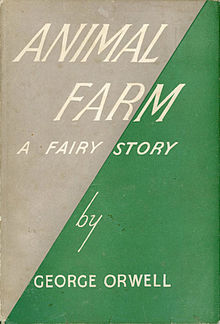
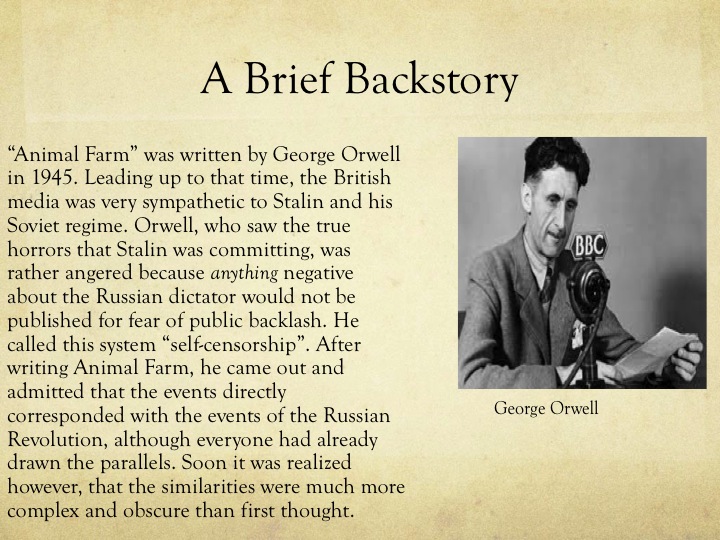
The critic C.S.Lewis once remarked that the qualification for judging any piece of workmanship from a corkscrew to a cathedral ‘is to know what it is, what it was intended to do and how it is meant to be used’.  George Orwell, with nice irony, subtitled Animal Farm ‘A Fairy Tale’.  It is, in fact, an extended allegory.  As a literary term, allegory is not really difficult to grasp.  The writer of allegory describes a subject under the guise of another subject which has apt and suggestive resemblances to the first one.  The allegorical work conveys a meaning other than, and in addition to, the literal meaning.  If we read a story and conclude that beneath its surface meaning another meaning may be discovered and that the real point of the story resides in this other meaning, then we may safely conclude that we have been reading an allegory.  Even the least qualified reader of Animal Farm will no doubt reach such a conclusion.

Animal Farm is a special kind of allegory, the beast fable.  Most of us are familiar with this universal literary form through our reading of Aesop’s Fables.  Those who have read the Fourth Book of Swift’s Gulliver’s Travels will scarcely be surprised to learn that Swift’s talking horses are literary ancestors of Orwell’s talking farm animals.  A fable is a story designed to inculcate a moral about some aspect of human behaviour.  Sometimes (as in the case of Animal Farm) the moral or lesson is implicit in the story; sometimes it is explicitly stated in brief form at the end.  Like other writers of beast fables, Orwell uses animals and birds to represent the deeds and motives of human beings; like them, too, he has his moral lesson to enforce.

Satirical allegory of the Russian Revolution

Every account of Animal Farm traces the fairly obvious parallels between the characters and motives of Orwell’s animals and those of the human beings they represent.  It was immediately clear to his original readers (in the mid-1940’s) that Orwell had written a fairly explicit satirical allegory of the Russian Revolution and the rise of Stalin, a circumstance which made it difficult for him to find an English publisher.  The parallels are easily traced.  Major is Lenin, although since he dies before the rising, the identification is not exact.  Napoleon is Stalin, and Snowball is Trotsky, whose quarrel with Stalin after Lenin’s death led to his expulsion from the Communist Party and from Russia.  Molly stands for those Russians who fled the country after 1917.  Boxer is an image of the loyal, uncomplaining proletariat, and Moses an unattractive representation of the Russian Orthodox Church.  The Battle of the Cowshed is clearly the Civil War that followed the 1917 Revolution; Western countries (Jones and his neighbours) sent troops to the aid of the dissenting White Russians.  The Battle of the Windmill is the German invasion of 1941.  Orwell pointed this out in a letter to his publisher.  He felt that at one point in the story he had been unfair to Stalin.  ‘All the animals including Napoleon,’ he wrote in the Windmill episode, ‘flung themselves on their faces.’  This he wanted altered to ‘All the animals except Napoleon flung themselves on their faces,’ pointing out that Stalin, after all, did remain in Moscow during the German invasion.

The moral lesson of the fable

So much for the main parallels between Orwell’s animals and their human counterparts.  What of the moral lesson of the fable?  His experiences during the Spanish Civil War and his close study of Russian politics made Orwell acutely conscious of what he called ‘the barbaric and undemocratic’ methods of Communist governments.  His main concern in Animal Farm was to make people in Western Europe see the Soviet regime for what it really was.

It appeared to him that since 1930 the USSR, far from moving towards socialism, showed clear signs of transforming itself into a hierarchical society in which the rulers (the pigs of the fable) were no more inclined than were the members of any other power elite to surrender their privileges.  Since it was the common view of Western European socialists that a genuinely socialist regime existed in Russia, Orwell saw it as one of his tasks to dispel this misunderstanding in a story that could easily be assimilated by almost anyone, and that would lend itself to easy translation into other languages.

At the end of Animal Farm it is impossible to distinguish the human beings from the pigs, the latter having entered heartily into commercial and social relations with their former enemies and abandoned the major slogan of the Revolution, ‘Four legs good, two legs bad.’  In his preface to the Ukranian edition, Orwell made an interesting (and perhaps surprising) comment on his ending.  A number of readers, he felt, might finish Animal Farm with the impression that it ends in the complete reconciliation of the pigs (the Soviet power elite) and the humans (the Western capitalist leaders).  This,  he pointed out was not his intention.  On the contrary, he meant the book to end on a note of discord.  He wrote it immediately after the Teheran Conference, which everybody thought, had established the best possible relations between the USSR and the West.  ‘I personally,’ Orwell observed with satisfaction, ‘did not believe that such good relations would last long; and, as events have shown, I wasn’t far wrong.’

EPSON scanner image

A novel of universal political truths

Some of the pleasure of reading Animal Farm lies in the reader’s gradual recognition of the parallels with modern Russian history.  The various identifications can be disclosed rather like the answers to a crossword puzzle, or chalked up on the blackboard like so many equations.  But the question arises: once we have made all the identifications what further interest are we likely to have in a work like Animal Farm?  It might be argued that even as an allegory of Soviet politics, the book has lost some of its original point, since Orwell clearly did not contemplate, for example, such developments as those associated with the Krushchev era, or the astonishing course taken by the Soviet system since the coming to power of Gorbachev in 1985.  Fortunately for Orwell’s reputation, his book is likely to attract readers long after the Russian experience has been forgotten, because it has large implications extending beyond the immediate circumstances of any single movement such as the Russian Revolution of 1917.   In several respects, Orwell’s fable embodies universal political truths.  What he describes is what happens sooner or later, to a greater or lesser extent, to all revolutionary movements.  The modern Chinese theory of continuous revolution as a means of preserving intact the ideals of the first revolutionaries is an interesting recognition of the dangers (so convincingly illustrated in Animal Farm) which attended all large-scale efforts at the betterment of the human lot.  Orwell’s book is a comment on the failure, as he saw it, of the Russian Revolution to fulfil the expectations of those who saw it marking a new era of true socialist democracy.  But it can also be read as a disillusioned recognition of the apparently inevitable failure of every great reforming movement to preserve its original momentum.  The French Revolution began in unbounded hope for a better world and petered out in the Jacobin terror.

Limitations of the moral fable

In Animal Farm, as in all moral fables, the author starts off with his abstract truth or idea, and uses his story to illustrate this, to give it life.  All the elements in the story are necessarily subordinated to the pattern dictated by whatever precepts the author desires to enforce on the minds of his readers.  Even these bald statements about the literary genre to which Animal Farm belongs suggest its almost inevitable limitations.  The major landmarks of fiction are exploratory in character; their important discoveries about human life and conduct emerge with the progress of the story.  Writers like the Orwell of Animal Farm, on the other hand, give the impression of having made their discoveries before composing their works.  The problem for all those who write fiction to illustrate pre-conceived ideas is that they must force a disorderly mass of experience into conformity with these ideas, which results inevitably either in some falsification of experience, or in a radically simplified view of it.  Inconvenient facts tend to be rigorously excluded.  Orwell, however, in choosing to illustrate what seems to be a universal human experience, is exempt from charges of distortion, whatever may be said about the limitations of his fable.

Orwell was one of those fortunate writers who recognised his limitations, who knew what suited his special talents and what did not.  Readers of his other novels will quickly realise that he found it extremely difficult to breathe life into his characters, none of whom is really convincing or memorable.  There is a sense in which Orwell is not really a creative writer, but a brilliant publicist, journalist, and apologist for liberal causes, who used the conventional fictional framework for his special purposes.  If he could not create life-like characters in his novels, he could at any rate write a great political fable.  What gives Animal Farm its vitality is not the kind of imaginative power one associates with a great novelist.  Such imaginative power was not really needed in this kind of work.  Orwell’s mind was one, which, like Swift’s, often contemplated the great human questions in political terms; like Swift, he found the beast fable an admirable vehicle for political ideas.  The almost perfect correspondence in Animal Farm between form and content at once helps to explain its astonishing popular success and to ensure its survival as a minor classic.

Slide02


An Introduction to ‘Lord of the Flies’


 de83d5f5f92194bb9cd10bac0c4f0fa8

Background note…

Lord of the Flies was published in 1954 and in it, William Golding sets out to create a disturbing and dystopian view of the world – a social experiment that goes horribly wrong.  The bleak aftermath of the second war to blight the Twentieth Century is still being felt in Britain, Europe and the rest of the world in the early 1950’s.  Images of the Holocaust and Hiroshima, along with personal war memories and experiences and other atrocities were still very raw in people’s minds.  This powerful novel can be included among other dystopian classics such as Aldous Huxley’s Brave New World and George Orwell’s 1984.  This genre of dystopian fiction represents the other extreme from Utopias, fictional representations of ideal political states or ways of life, the classical example here being St. Thomas More’s Utopia, a Latin work written in 1516.

Golding, as you will soon be aware, is very concerned with the pervasive influence of evil forces in our world, and he has few allusions about the counterbalancing forces of good.  It is possible to classify Lord of the Flies as a dystopian fable because in it Golding is casting a jaundiced eye on earlier and more optimistic variations on his theme, the best known of these being R.M. Ballantyne’s The Coral Island.   Lord of the Flies was written as a kind of parody of The Coral Island and Golding makes specific reference to it in his novel.  A very brief comparison with Ballantyne’s book helps us see what Golding is attempting in Lord of the Flies.  In The Coral Island, Ballantyne shipwrecks a group of upright, solid, church-going British boys, and allows them to build a decent imitation of British civilisation in their new and primitive surroundings.  In Lord of the Flies, the shipwreck is now a plane wreck; the boys are still middle-class British Christians.  Even the names of three of Golding’s main characters are similar to those in Ballantyne – Golding’s three central characters – Ralph, Piggy and Jack – are caricatures of Ballantyne’s heroes .  The vital difference between the two novels, however, is that whereas Ballantyne’s is thoroughly optimistic in spirit and outcome, Golding’s outcomes are disillusioning and pessimistic.

The need for social order

Lord of the Flies is a very grim illustration of the kind of situation that, as Golding sees it, must inevitably arise if the sanctions and controls of society are abandoned.  In this kind of situation, the great majority of human beings (whether boys or men) will choose destructive courses.  There will be the few who will choose order, whose acts reflect human decency and goodness, but they will be outnumbered and defeated by the evil tendencies of the many.  The ethos of Ballantyne’s island was that of the boy-scout camp; on Golding’s the greater number of the boys choose to enact the roles of savages, painting themselves, wallowing in an orgy of animal slaughter, sinking into bestial habits, engaging in torture, murder and sacrifice to false gods.

Speaking of false gods prompts a reference to the significance of Golding’s title for the novel.  This refers to Beelzebub, traditionally the most debased and disgusting of all the devils.  The young British Christians, most of all the choirboys, instinctively chose him, rather than the Christian God as the object of their worship.  This choice bears fundamentally on Golding’s views on human nature.  Golding is, above all, a didactic writer and he is trying, therefore, to teach us a moral lesson here.  One of his primary purposes is to expose what he sees as the shallowness of optimistic theories (he would see them as illusions) about human nature.  At one level, his novel can be read as a strenuous rejection of humanistic theories of human perfection.  It enacts an unrepentant belief in the traditional Christian doctrine of Original Sin; the doctrine which teaches that the first sin of Adam, as the old Catechism put it, ‘darkened the understanding, weakened the will, and left us a strong inclination to evil’.

A pessimistic world view?

This traditional view sets Golding apart from many of the modern ‘trendy’ currents of thought.  Few of us have escaped the influence of the romantic view of childhood as a time of glorious innocence; the cult of the noble savage has, since Rousseau, enjoyed widespread support in all kinds of fiction.  It was a common Romantic assumption that man was potentially a noble, upright creature if only he could be freed from the fetters of a corrupt society.  Golding is having none of this!  Not for him the vision of the child emerging in clouds of glory, or the inherent nobility of the savage life.  What he finds instead, is that only the slightest push, or the removal of sanctions or firm restraints, is needed for children, as well as for men, to tumble into unfathomable depths of depravity.  In Lord of the Flies he is trying to show us with what frightening ease man and boy can throw off all his superficial decency (‘off you lendings’ in Lear’s version) and regress back to that primitive state where ‘chaos is come again.’

To return to categories and literary genres for a moment, Lord of the Flies is a fable.  As Golding himself points out, the writer of fables is a moralist: ‘he cannot make a story without a human lesson tucked away in it’, very similar to the parables in the Gospels.  No matter how we look on this novel, however, it would be very difficult to describe Golding’s lesson here as a hopeful one.  For him, men are generally vicious, murderous and liable to extremes of self-degradation and animal behaviour.  What most forcibly strikes us as we read this novel is Golding’s intuition that, at best, civilising conventions and rules are passing things, but that what endures is man’s wild irrationality and his destructive urges.  A passing visit to Sky News or CNN or BBC News may confirm this for us on a daily basis!  Who would choose to live in Aleppo in Syria or the many cities in Iraq who have been condemned to untold barbarity in recent times?

 A realistic novel

Lord of the Flies has proved an extraordinary popular book, both from the point of view of general readership and among academics.  Golding may have conceived his novel as an allegory, but he is also a master of realistic fiction, and the book has a striking impact on the generality of young readers, for whom it is, here in Ireland as well as in Britain, a widely prescribed school text.  Golding was a teacher for a number of years, and has an instinctive understanding of, and feeling for, the characters and mannerisms of schoolboys.  One of the striking features of his method is his success in presenting his young characters in terms of idiom and linguistic habit (compare the under-educated, ill-spoken Piggy in this respect with Ralph and Jack).  The novel, for all its allegorical and symbolic overtones, is rooted firmly in real experience.  Physical sensations are admirably and tellingly rendered; the discomforts, unpleasantness, delights and other sensations associated with life on the island are evoked with astonishing realism.  The beautiful descriptions of island and sea are unforgettable.  Golding’s continuous success with the depiction of the physical realities of life, the rootedness of the book in the solid earth, is perhaps its most memorable feature for younger readers, most of whom, it is safe to suggest, can approach it on a realistic level without bothering unduly about its allegorical implications or its status as a moral fable.  Discussing the wider picture, the novel as fable or allegory or simply realistic novel with an eager English class, is one of the great joys and job satisfactions of the teacher of English Literature!

Symbolism

Academics have naturally tended to focus on the allegorical and symbolic features of the book, following Golding himself, who has strongly emphasised these in his critical comments.  There are numerous examples of symbols in the novel.  The shell or conch discovered by Ralph and Piggy has attracted a wide variety of such interpretations.  It is most obviously to be regarded as a symbol of the forces in the boys striving to uphold civilised standards and values.  The character of Simon attracts a good deal of symbolic weight also.  The pig’s head covered in flies is a symbol or sign of Beelzebub, the Lord of the Flies.  Simon’s hallucination of the monologue from the pig’s head is another symbolic feature.  But whatever importance one may attach to such matters, the vital consideration is that most of the episodes which obviously attract symbolic interpretations also work most successfully at a realistic level, which adds to the great appeal of the novel.

lord-of-the-flies-symbolism

Dream to nightmare

Golding has a remarkable gift for presenting abstract conceptions in compelling concrete terms.  One of the themes of the book that particularly appeals to younger readers is that it enacts a powerfully imagined version of the dream that most children cherish at one time or another of escaping from the restraints of a society controlled by adults.  What Golding does in Lord of the Flies is bring this dream to life.  But what he also does is to turn the dream into a virtual nightmare.  Escape from the stabilising forces of the adult world, instead of bringing about happiness, results in a riot of destructive individualism.  At the beginning, there is a vague, unsatisfactory sense of kinship and comradeship: Ralph and Jack, the two ‘mighty opposites’ of the later parts of the novel, can, at the beginning, look at each other ‘with a shy liking’.  The collapse of this sympathy, the breaking of most of the bonds of human kinship, is the stark reality which haunts Golding’s fable.  And even when the outside world comes to the rescue at the conclusion of the novel it only brings further reminders of disorder and war with the finding of the dead airman and the arrival of an armed warship.  There is little comfort, then, to be drawn from Golding’s dystopian novel: neither a ‘civilised’ environment nor the lack of it, seem to offer much hope of even limited perfection or happiness to human beings.

download (6)


An Introduction to ‘The Catcher in the Rye’


download (5)


This novel, first published on this day, 16th July in 1951, by the enigmatic J. D. Salinger, belongs to a category of fiction made popular by writers as diverse as Dickens and Joyce.  It is Bildungsroman, or novel about upbringing and education – a novel of maturation.  The heroes of novels of this type are invariably young people or children seeking to find their identities and roles in the big bad world.  Nineteenth-century examples are David Copperfield (1850) and Great Expectations (1861), both by Charles Dickens.  The most famous twentieth-century example is James Joyce’s Portrait of the Artist as a Young Man (1916).  Probably the most famous example from American fiction before Catcher in the Rye was the classic The Adventures of Huckleberry Finn by Mark Twain.  Many of these novels go far beyond the treatment of the educational development of the central figure, and concern themselves with profound spiritual and moral experiences.

 The Catcher in the Rye is the story of the efforts of an adolescent American to relate to a grown-up world that he finds deeply flawed and fundamentally unsympathetic.  The central figure, Holden Caulfield, leaves his boarding school and spends a weekend in New York City.  Here he finds himself alone in what he sees as a grown-up world of corruption, unkindness and hypocrisy.  The main theme of the novel is Holden’s resistance to growing up into this kind of world, which, as he sees it, undermines youthful innocence and integrity.  The novel has no real plot.  It consists mainly of the observations of Holden on his experiences, particularly on the ‘phoniness’ of those he encounters.  His attempt to reconcile himself to the values of the adult world is a failure.  He retreats from this failure into mental illness, and writes his story while under psychiatric treatment.

Resistance to loss of innocence

The title of the novel is a glance at Holden’s dream of protecting other, younger children from the curse of maturity, of saving such innocents before the world corrupts them.  One of Robert Burns’s most famous songs has the line, ‘If a body meet a body coming through the rye’, Holden has misheard the words and thinks the line should go, ‘If a body catch a body coming through the rye’.  He uses the mistaken version as a slogan for his own dream-activity.  He will catch the innocent children who play in the ryefield because they are in danger of falling over the unseen edge of a cliff.  His vision of his saving role is pathetic in its futility:

 ‘I thought it was “If a body catch a body”,’ I said.  ‘Anyway, I keep picturing all these little kids playing some game in this big field of rye and all.  Thousands of little kids, and nobody’s around – nobody big, I mean – except me.  And I’m standing on the edge of some crazy cliff.  What I have to do, I have to catch everybody if they start to go over the cliff – I mean if they’re running and they don’t look where they’re going.  I have to come from somewhere  and catch them.  That’s all I’d do all day.  I’d just be the catcher in the rye and all.  I know it’s crazy, but that’s the only thing I’d really like to be.  I know it’s crazy.’

 An uncaring adult world

Part of Holden’s depression arises from his awareness of himself as an innocent abroad in a world of phoney values, a world which, like Holden himself, needs love but does not know where to find it.  It is, in many of its manifestations, a world that believes that it can get on without love, or even without decency.  What passes for love in the adult world through which he moves is little better than selfish exploitation.  Most of those with whom he comes in contact are crudely dismissive of him and his concerns (the taxi-drivers, for example), try to exploit him for money, like the offensive pimp in the hotel, or seem ready to abuse him sexually, like Antolini, his former schoolmaster, to whom he turns in desperate need for help and advice.  It is not surprising that Holden cannot form a viable or stable relationship with adult society.  That society cannot give him the love and affection for which he craves.  These values seem to be associated in his mind with two things: death and the innocence that disappeared with the loss of childhood.

The death-motif and its association with love appear from time to time in Holden’s references to his much-loved brother, whose death from leukemia has blighted his family.  His longing to preserve innocence in a world given over to destroying it makes him the idealist who rubs obscenities off walls so that small girls will not have to see them.  In The Catcher in the Rye, Salinger, who clearly approves of his hero, raises fundamental questions about man’s inhuman treatment of his fellow-men.  What, we are forced to ask, makes New York an abode of indifferent, uncaring individuals?  Is the answer to be found in some radical flaw at the heart of human nature, or in society?  The novel suggests that human nature is not primarily to blame for the sufferings which Holden and others like him have to endure.  Salinger conveys a sense that the world is populated by fallible, foolish, pompous, careless, morally weak individuals rather than by evil ones, and that human beings are potentially loving and joyful if only society will permit them to satisfy these basic longings.  It was this aspect of The Catcher in the Rye that caused it to appeal most widely to a generation of American students in the nineteen-fifties.  As Anthony Burgess has pointed out, the novel was,

‘a symptom of a need, after a ghastly war and during a ghastly peace, for the young to raise a voice of protest against what the adult world was doing, or failing to do’.

Holden’s depression

The Catcher in the Rye has a single unifying theme: the nervous breakdown or intensifying depression of a sixteen-year-old boy.  The progress of Holden’s psychiatric illness is chronicled not from its origins but through its critical phase.  This is done with remarkable understanding of how depression actually works, and how it affects behaviour and the processes of thought.  Salinger is particularly impressive in his handling of the correlation between depressive illness and physical symptoms.  As his depression intensifies, Holden experiences psychosomatic symptoms, which feature a morbid fear of painful death (‘I figured I’d be dead in a couple of months because I had cancer’) and much physical distress (‘The thing is, if you get very depressed about something, it’s hard as hell to swallow’).  What we learn about him from his own narrative of his life makes his depressed state comprehensible enough.  The death of his much-loved brother Allie from leukaemia is one major influence on his mental and emotional states, leaving him with a grievance against the unfairness of things.  His emotional difficulties are not eased by his relationship with his parents.  His mother has been depressed since Allie’s death, and is not a positive force in his life, while his father, preoccupied with being successful, never discusses problems with him.

Holden is thus deprived of the parental guidance every adolescent needs.  His lack of emotional stability is not surprising.  The boarding school to which he is sent is no substitute for his parents.  His primary need is for the kind of understanding and sympathy that will see him through a difficult period in his life.  Whenever he seeks this from his acquaintances he is rebuffed or ignored.   As he ruefully remarks, Stradlater is not interested in a person’s ‘lousy childhood’, while Ackley will respond only if yelled at.  Both Ackley and Stradlater make little of the few achievements that might give Holden some badly needed self-confidence and self-esteem.  When Holden puts a heartfelt question to his history instructor (‘Everybody goes through phases and all, don’t they?’), the latter cannot answer him.  His old girl-friend Sally Hayes can do no better than the others in providing the understanding he needs if he is to keep depression at bay.  Carl Luce, an ex-schoolmate now at Columbia University, responds coldly and unfeelingly to Holden’s plea for help in sorting out his mental and emotional confusion, callously advising him to see a psychiatrist.

As a final despairing gesture, Holden turns to a man he respects, his teacher Mr. Antolini.  The latter can help him no more than the others could.  He lectures him at length, but fails to notice how deeply disturbed he is.  At this stage, Holden is at breaking-point, descending to deeper levels of depression, while Antolini is telling him that an academic education will give him an idea what size of mind he has.  Salinger provides some obvious pointers to Holden’s lack of mental stability in his numerous self-contradictions.  Our hero tells Antolini, for example, that a teacher at Pencey, ‘was intelligent and all, but you could tell he didn’t have too much brains’.  He also claims that there were a couple of classes he didn’t attend for a while, but that he didn’t cut any.  The outcome of the episode with Antolini is that Holden is more depressed than ever.  Convinced that society has finally failed him, he decides to run away and pretend to be a deaf mute, so avoiding, ‘any goddam stupid useless conversations with anybody’.  He will make no further efforts to gain the understanding of other people, and will renounce the ‘phoney’ world.

Phoebe, an agent of redemption

If he is to be redeemed from his hopelessly depressed state, this must now be through the voluntary, unsolicited intervention of somebody else.  His sister Phoebe becomes the agent of his redemption from total despair.  When Phoebe insists on running away with him, he comes to the conclusion that he cannot take responsibility for her, and decides that he must go home, not for his own sake, but for hers.  This gesture of submission is rewarded with a fleeting spell of intense happiness, lovingly described.  The sight of Phoebe going round and round on the carousel fills him with inexplicable joy and tranquility, although the contradictory account of how he fares in the rain is a sinister indication of his confused mental state:

‘My hunting hat really gave me quite a lot of protection, in a way, but I got soaked anyway.  I didn’t care, though.  I felt so damn happy all of a sudden, the way old Phoebe kept going round and round.  I was damn near bawling.  I felt so damn happy, if you want to know the truth.  I don’t know why.  It was just that she looked so damn nice, the way she kept going round and round, in her blue coat and all.  I wish you could’ve been there’.

 After his painful quest, involving disappointment, frustration, bitterness, depression and disillusionment, Holden has at last found something beautiful in a world he has so often condemned as ‘phoney’.  This does not necessarily mean that he novel has a happy ending.  We know that the carousel will have to stop, and Holden and his sister will have to return to the world from which all his instincts have been urging him to escape.  The best things that life has to offer him are the few fleeting moments of exaltation he has experienced watching Phoebe on the carousel.

Holden’s distorted view of the world.

The Catcher in the Rye is often read as a sympathetic account of a good-natured, sensitive boy confronted by a cruel, dishonest world, populated by freaks, exploiters and phoneys.  The following is typical of his view of other people:

 I was surrounded by jerks.  I’m not kidding.  At this other tiny table, right to my left, was this funny-looking guy and this funny-looking girl.

It is clear from the novel that Salinger likes Holden and expects his readers to like him, but the question must be asked, how likable is he?  Does he deserve to be taken at his own valuation as an idealist who suffers at the hands of others?  Are we to applaud his trenchant exposures of virtually all those who cross his path?

The presentation of Holden involves an obvious paradox: the childlike idealist with the vulnerable, sensitive nature can appear heartless and cruel in his comments on almost everybody else.  There is the curious fact that although he is constantly protesting against the phoniness of almost everybody else, he himself is far from exempt from this fault.  In this context, phoniness means hypocrisy, empty, insincere moralising and fraudulent attitudes and behaviour.  It is true that Holden is upset by such things; as he puts it, they cause him to ‘puke’.  The only people he can think of as being free from phoniness are his sister Phoebe, the two nuns he meets in the sandwich bar, and children in general.  Were he also to look more closely at himself, he would have to acknowledge that he shares the qualities he condemns in others.  He often tells lies, often pretends to be someone he is not, and can be quite bitter in his comments on his friends, while at the same time pleading for charity and kindness towards himself.

The key to Holden’s character is his mental confusion.  This shows itself particularly in his inability to see people and their activities in proportion.  Again, his lack of a proper sense of proportion expresses itself in an outrageously exaggerated habit of speaking.  By referring to almost everybody and everything in grossly inflated language, he can make relatively innocuous circumstances sound wicked and dangerous.

It is not enough for him to describe a woman who sits next to him at the cinema as the slightly inconsiderate person she is; he feels obliged to describe her as being ‘about as kind-hearted as a goddam wolf’.  He doesn’t like Ossenburger the undertaker, and takes exception to the man’s religious inclinations.  His dislike vents itself in great crude fantasies in which Ossenburger features as a monstrous fraud who shoves corpses into a sack and dumps them in the river, who prays fervently to Jesus to send him more corpses and who bores a captive audience with ‘about fifty corny jokes’.  He describes places and their atmospheres in the same wildly exaggerated fashion, particularly when their impact on him is unfavourable.  A hotel lobby cannot seem merely stale-smelling to him; it must convey the impression of ‘fifty million dead cigars’.  No wonder Phoebe tells him, ‘You don’t like anything that’s happening.’  This is because his view of reality is hopelessly distorted; his depressed state makes him so utterly negative about experience that he cannot see that even the worst people and situations have some redeeming qualities.

 ob_7d3cd6_wc-1a-catcherintherye

Analysis of ‘The Harvest Bow’ by Seamus Heaney

DSC_0023                             

The Harvest Bow

       by Seamus Heaney


As you plaited the harvest bow
You implicated the mellowed silence in you
In wheat that does not rust
But brightens as it tightens twist by twist
Into a knowable corona,
A throwaway love-knot of straw.

Hands that aged round ashplants and cane sticks
And lapped the spurs on a lifetime of game cocks
Harked to their gift and worked with fine intent
Until your fingers moved somnambulant:
I tell and finger it like braille,
Gleaning the unsaid off the palpable,

And if I spy into its golden loops
I see us walk between the railway slopes
Into an evening of long grass and midges,
Blue smoke straight up, old beds and ploughs in hedges,
An auction notice on an outhouse wall—
You with a harvest bow in your lapel,

Me with the fishing rod, already homesick
For the big lift of these evenings, as your stick
Whacking the tips off weeds and bushes
Beats out of time, and beats, but flushes
Nothing: that original townland
Still tongue-tied in the straw tied by your hand.

The end of art is peace
Could be the motto of this frail device
That I have pinned up on our deal dresser—
Like a drawn snare
Slipped lately by the spirit of the corn
Yet burnished by its passage, and still warm.

Commmentary:  This beautiful tender poem is taken from Heaney’s collection Field Work (1979).  In a way it is fitting that I’m publishing this blog post on Father’s Day because this poem explores the close relationship between Seamus Heaney the poet and Patrick Heaney his father.  Heaney’s Mossbawn poems contain numerous references to family members; his mother, his Aunt Mary, his grandfather, his brother and his father who is mentioned most notably in the poem ‘Digging’ but also in ‘Follower’ and other poems.

Heaney’s poetry contains many references to dying rural crafts and traditions and the harvest bow in one such tradition.  The bow was fashioned from freshly cut straw and often given by the maker as a token of love.  Here it is silently fashioned by the father and given to his son, ‘a throwaway love-knot of straw’.

Patrick Heaney emerges as a strong, no-nonsense, unsentimental country man who strides through his fields ‘whacking the tips off weeds and bushes’.  He is a man of few words, a man ‘tongue-tied’ who prefers to express himself in actions rather than words.  Like Barney Devlin in ‘The Forge’ or the ploughman in ‘Follower’ or his grandfather in ‘Digging’, who ‘cut more turf in a day/ than any other man on Toner’s bog’,  Heaney sees his father as a craftsman teaching the young poet-to-be that the artist expresses himself through his work.  Heaney sees in his father’s attention to detail the attitude he wishes to bring to his own work as a poet.

The poem is a tender exploration of the father/son relationship and it is clear that an unspoken understanding grows between them and is expressed through the gift of the harvest bow, which is being fashioned by the father as they both stroll together through the fields of stubble on an Autumn evening.  The poet fingers the harvest bow and reads it ‘like braille … gleaning the unsaid off the palpable’.  He then translates what he has read for us and puts it into words which he fashions and plaits and weaves into a poem.  This is reminiscent of the poet’s conclusions in ‘Digging’ – he wants to follow in his father’s footsteps but instead of digging with a spade he will use his pen.

This poem was published in 1979 at the height of the Northern ‘Troubles’ and it sees Heaney retreating again to a happy childhood memory to erase the pain of the daily catalogue of shootings and bombings.  The motto used at the beginning of the final stanza, ‘The end of art is peace’, therefore, is rich in meaning and open to many interpretations.  The obvious one is that father and son have achieved a moment of peace and harmony via their respective crafts and of course it has wider political implications also in the context of the continuing conflict in Northern Ireland.  Many commentators at the time accused Heaney of not taking sides, of not highlighting the atrocities of those dark days.  Maybe they have not delved deeply enough into his Mossbawn poems and elsewhere?  (There’s a thesis there for some enterprising young scholar!)

The harvest bow is a symbol of the love and understanding that has developed between the father and son, it is a ‘love-knot’ which joins them together.  The poet remembers those evening rambles with his father through the cornfields and we are struck by the juxtaposition offered us: the young eager poet striding towards his future while the father clings to the traditions and ways of the past:

And if I spy into its golden loops
I see us walk between the railway slopes
Into an evening of long grass and midges,
Blue smoke straight up, old beds and ploughs in hedges,
An auction notice on an outhouse wall—

The harvest bow can also be seen as an emblem of rural life and agricultural labour.  As I’ve mentioned earlier this poem was written during the ‘Troubles’ in his home place and this has a deep, disturbing effect on the poet.  Time and time again he retreats to the safety and womb-like comfort of his Aunt Mary’s kitchen in Mossbawn in an effort to seek some solace and comfort.  There is something deeply psychological and human about this regression of the poet.  He leaves us with this sharp contrast.  The harvest bow is an endearing and enduring symbol of love, a vestige of a long tradition that has been handed down through the generations, yet the poet is forced to live in a society riven with sectarianism and divisions and the annual ‘harvest’ of the dreaded Marching Season, year in year out.

In ‘Sunlight’ he returns to his Aunt Mary’s warm kitchen for consolation while here he looks to his father and the love  and understanding that has grown between them as a source of comfort at a time of personal and public upheaval and distress.

The end of art is peace
Could be the motto of this frail device

OLYMPUS DIGITAL CAMARA
A traditionally crafted Harvest Bow

Macbeth: Order violated, order restored….

logo

It is impossible to read Macbeth without being impressed by its repeated emphasis on the prevalence of evil forces in the world.  From the very start of the play an atmosphere of unnatural wickedness is established by the scene which opens with the stage direction Thunder and Lightening.  Enter Three Witches and ends with the reversal of values implied in ‘Fair is foul and foul is fair/ Hover through the fog and filthy air’.  In Macbeth, Shakespeare suggests a symbolic correspondence between three kinds of order:

  • Order within the universe,
  • Order within the commonwealth,
  • Order within the human being.

The disruption of good order in the kingdom is paralleled by the disruption of nature, represented by the storm and the other portents on the night of Duncan’s murder, as well as by the appearance of the witches and of Banquo’s ghost; it has a further parallel in Lady Macbeth’s mental disintegration.  The savvy Elizabethan audiences were only too aware that portents of evil and evidence of disorder in one area were often mirrored by even greater disorders elsewhere.  The themes of unnatural doings, chaos in the natural world and universal disease are constantly suggested in the more memorable images.  Little wonder then that critics, when they come to talk about the impression created by the play, conclude that in none of the tragedies, with the possible exception of Lear, is evil presented so forcibly.  Macbeth has been described as Shakespeare’s ‘most profound and mature vision of evil’, ‘a wrestling of destruction with creation’, ‘a statement of evil’, and so forth.

If any one point is insistently made by the imagery it is that Macbeth’s revolt against lawful authority involves much more than the murder of a king and the usurpation of his throne.  The initial crime is a huge symbolic gesture.  It releases forces of universal disorder.  John Holloway talks of Macbeth’s career as one  ‘of revolt against everything in the world’ (The Story of the Night, 1961, p.61).  Once the first evil step has been taken there is no turning back: men and nature are caught up in a process which causes havoc everywhere until the evil forces have played themselves out.  Images of disease and unnatural happenings give concrete expression to the major themes.  The thought of his plan makes Macbeth’s heart knock at his ribs ‘against the use of nature’ (I, iii, 137); the dead Duncan looks like ‘a breach in nature’ (i.e. as if nature had been wounded by his death in II, iii, 95).  Lady Macbeth’s sleepwalking is described as a ‘great perturbation in nature’ (V, I, 9).  The murder of Duncan (‘the Lord’s anointed temple’ II, iii, 50) is explicitly and repeatedly presented as a monstrous violation of the natural order; it is committed when ‘nature seems dead’ (II, I, 50); in preparation for it Lady Macbeth invokes the aid of those murdering ministers who ‘wait on nature’s mischief’ (i.e. assist the malignant forces in nature and accompanying natural disasters: I, v, 48).  The association between Macbeth’s crime and disruption in nature is further emphasised in the comment on the odd behaviour of the elements following Duncan’s murder: ‘Tis unnatural/ Even like the deed that’s done’ (II, iv, 10).  The same kind of association between evil deeds and disorder within the individual is implied in the Doctor’s comment on Lady Macbeth’s sickness: ‘unnatural deeds/ Do breed unnatural troubles’ (V, I, 72).

The effects on his country and its people of Macbeth’s identification with evil are suggested in a series of disease images, which appear with particular frequency in the last Act.  The point made by these images is that Scotland is sick, and the cause of her disease is Macbeth’s criminal career.  Health and disease are symbolically related to moral good and evil.  Macbeth’s speech to the Doctor is an extended disease metaphor:

                   If thou couldst, doctor, sound

                   The sickness of my land, find her disease,

                   And purge it to a sound and pristine health….

                   What rhubarb, senna, or what purgative drug

                   Would scour these English hence?

                                                                             V, v, 50

It is in relation to this kind of speech that the descriptions of the King’s Evil (IV, iii, 141 – 159) takes on its true importance.  At the hands of the good English king, diseased souls ‘presently amend’ (IV, iii, 138).  At Macbeth’s hands, ‘good men’s lives/ Expire before flowers in their caps,/ Dying or ere they sicken’ (IV, iii, 164).  Macbeth’s cause is ‘distemper’d’ (V, ii, 15).  Malcolm is to be the physician who will heal Scotland: ‘Sovereign’ as used by Lennox means both ‘royal’ and ‘powerfully medicinal’:

          Caithness:     Meet we the medicine of the sickly weal,

                              And with him pour we, in our country’s purge,

                              Each drop of us.

          Lennox:         Or so much as it needs,

   To dew the sovereign flower and drown the weeds.

                                                                                                V, ii, 26

The play depicts the restoration of order as well as its violation.  A whole society is disordered and sickly (‘Bleed, bleed poor country!’ Iv, iii, 32), and the order of nature has been disrupted.  Macbeth’s famous catalogue of dogs (III, I, 91) emphasises the idea of a proper order among animals as well as men; it is a fine stroke of irony on Shakespeare’s part to make the prime enemy of order concede its propriety.  The third movement of the play (which belongs to Malcolm and Macduff in the way that the first did to Duncan and the second to Banquo), shows violated nature preparing itself to put an end to the unnatural disintegration set in train by Macbeth’s acts, the process by which ‘the treasure/ Of nature’s germens tumble all together,/ Even till destruction sicken’ (IV, I, 58).  As Macbeth’s power begins to wane, supernatural aid is invoked on behalf of those who would restore the beneficent order of nature (‘the Powers above/ Put on their instruments…’ IV, iii, 231). The movement of Birnam Wood towards Dunsinane (V, iv, 4) is a vivid emblem of the reassertion of the natural order, ‘a dumbshow of nature overturning anti-nature at the climax of the play’ (John Holloway, op. cit., p.65).

It needs to be emphasised that while Shakespeare makes extensive use of religious, even specifically Christian images and ideas throughout Macbeth (see particularly Iv, iii), this does not mean that the play reaches ‘optimistic’ conclusions about its themes, or that it was written to suggest the superiority of a Christian view of life and action.  We should restrain any tendency we may feel to treat the major characters as diagrammatic illustrations of ‘good’ and ‘evil’ tendencies.  Shakespeare poses too many unanswered questions for us to be able to regard Macbeth as a celebration of the triumph of good over evil; like all genuine tragedies, it maintains a balance of vision.  An element of painful mystery remains even after the fragile triumph of the official forces of good order.  This is well described by Robert Ornstein:

‘If the anguish of the damned sounds musically in the ears of the saved, then there is comfort here for some; otherwise Macbeth is the most unpleasant of the tragedies.  Though order is restored at the close, though evil is purged and Macbeth receives the gift of oblivion, there is no sense of repose or reconciliation in its final scenes’ (The Moral Vision of Jacobean Tragedy, 1960).

Order is restored, as Ornstein points out; a ‘good’ regime is to replace an evil one, but what we have seen happen in Macbeth leaves us with the feeling that destructive forces can just as easily erupt again, and with similar consequences.  It is difficult to see the closing ‘restoration’ as anything more than provisional.  The final speeches of the ‘good’ characters, with their promises of better things to come lack the emotional weight necessary to dispel the gloomy visions conjured up by the Macbeths and their allies. In the Irish political context, this is, in fact, akin to Fine Gael, Fianna Fáil, Labour, The Greens, etc., telling us they will right all the wrongs of the previous Fine Gael,  Fianna Fáil/Progressive Democrats administration.  We all know by now from bitter experience that these election promises are often made to sound very hollow in time!


MacbethComic