Michael Hartnett’s ‘Move to The Park’

IMG_5066
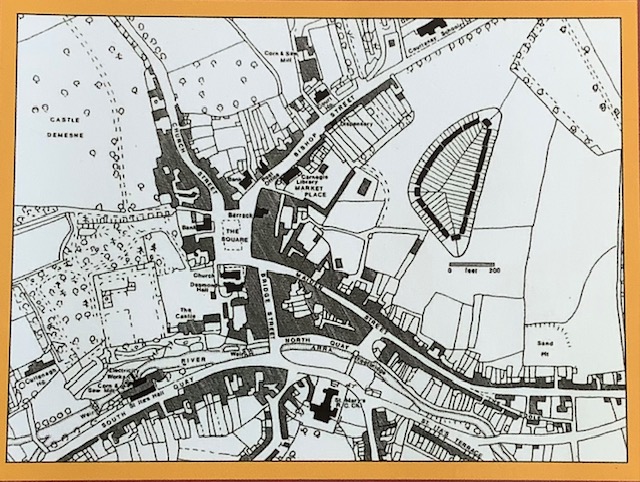
Inset of New Houses just before occupancy, September 1951. (Courtesy of Dr Pat O’Connor, The New Houses: A Memoir, p.9)

In late 1980, Hartnett began work on his best ballad, which is most loved and recited to this day, the ‘Maiden Street Ballad’.  The ballad stretches out for 47 verses and is a compendium of much of what he had written in prose about Newcastle West in articles for The Irish Times, for Magill magazine and for the local Annual Observer, the annual publication of the Newcastle West Historical Society during the 60s and early 70s.  There are also echoes of other local poems such as ‘Maiden Street’ and ‘Epitaph for John Kelly, Blacksmith’ included among the verses of the ballad.

‘Maiden Street Ballad’ was published by local entrepreneur Davy Cahill’s The Observer Press ‘with the help of members of Newcastle West Historical Society’.  Copies of the original are much sought after on eBay and elsewhere to this day.  It carried a very eloquent dedication, ‘This ballad was composed by Michael Hartnett in Glendarragh, Templeglantine, County Limerick in December 1980 as a Christmas present for his father Denis Harnett (sic)’. 

‘Maiden Street Ballad’ contains a number of autobiographical segments.  The early stanzas tell us about his childhood days where they rented accommodation first in Connolly Terrace and then in nearby Church Street before making the move to Lower Maiden Street where they rented a room from Legsa Murphy.

We rented a mansion down in Lower Maiden Street,

Legsa Murphy our landlord, three shillings a week,

the walls were of mud and the roof it did leak

and our mice nearly died of starvation.

Probably one of the most notorious segments is the ten ribald verses from 27 to 37 which describe a virtual pub crawl of all of Newcastle West’s 26 public houses which were doing business in 1980.  (Michael Hartnett’s 26 Pubs at Christmas!)   In another significant segment from verses 16 to 23, he eloquently documents the move from Lower Maiden Street to the new housing scheme in Assumpta Park.  These verses portray Hartnett at his best, they are witty, caustic, and often slanderous; his use of hyperbole pokes fun at his friends and those neighbours who were part of that mass exodus from the slums of Maiden Street and The Coole.

Hartnett says that the street finally ‘gave up the ghost’ in September 1951 when most of the inhabitants were rehoused in one of the 60 new houses in Assumpta Park.  Hartnett describes the operation, likening it to the hazardous Exodus of the Israelites escaping from Egypt to the Promised Land!  Unlike the ‘pub crawl’ sequence which describes in great detail the quirks and peccadillos of numerous characters, including many of his own family, there are only two people mentioned in the ‘move to The Park’ sequence – only passing reference is made to Dick Fitz and Mike Hart, two great stalwarts of the area.  Rather this segment describes his people, his neighbours, the real old stock of the town in a richly comic and exaggerated way.

In the late 40s and early 50s, the local authority had built up to 60 social houses to relieve the squalor, poverty and slum-like conditions in Maiden Street and The Coole.   They were built in an area of the town known as Hungry Hill, although the new development was officially called Assumpta Park.  The Hartnett family were but one of the lucky families to be given a new house and they moved into Number 28 in 1951.  Hartnett tells us that the ‘old street finally gave up the ghost’ and the mud-walled, galvanised cabins were abandoned down in The Coole and the people were tempted to move ‘to the Hill’s brand new houses’.   The ‘New Houses’ stood on a hill high and exposed above the town at the outer edge of a terminal moraine.  The original sixty houses were finally allocated on the 15th of September, 1951.  Dr Pat O’Connor, the author of ‘The New Houses: A Memoir’, whose family were allocated Number 24, remembers that ‘doors were still without numbers and entrances without gates’.  There was no street lighting or footpaths so it must have been a very eerie place to move to.

The relocation is described in almost Biblical terms with a delicious mixed cocktail of the Exodus story and the story of Noah’s Ark:

and some of the ass-cars were like Noah’s Ark

with livestock and children and spouses.

As well as the Bible, Hartnett is also influenced here by the writings of John Steinbeck and his iconic descriptions of the Great Depression in The Grapes of Wrath as well as the writing of Sean O’Casey and Brendan Behan who wrote about the tenements in Dublin and the gradual movement of people from places like Henrietta Street to Crumlin and Cabra in the 1940s, and Ballyfermot and Artane in the 50.

IMG_5068
The Park upon first occupancy, September 1951. (O’Connor, 12)

Hartnett is a very astute commentator on the social ills of his day and the Maiden Street Ballad, and this segment in particular, shows the level of poverty and deprivation experienced by the people in that part of the town in the early 50s.  They brought with them their ‘flourbags’, ‘their ‘tea chests’ and ‘three-legged stools’ and their ‘jam-crocks in good working order’.  At that time many of the households were so poor that they were unable to afford the bare necessities such as cups and saucers.  Jam was sold in one-pound and two-pound glass jars and these were used as substitutes for tea cups and milk glasses in most households.  Dr Pat O’Connor tells us that the new occupants had come from ‘the tattered tails of the town, where congestion and dereliction were rife, but (where) the sense of neighbourhood intimacy was well defined’.  Hartnett describes the move in a very light-hearted way, and he follows up by saying that they also brought their fleas, bed bugs and mice with them because they felt they were almost part of the family.  And now that they’ve moved up in the world the fleas also go to Ballybunion each year on holiday with their host families ‘though hundreds get drowned in the waves there’.

Many found it very difficult to make the necessary adjustments to their new surroundings and the poet pokes fun at their efforts to adapt to such new luxuries as piped water, electricity, toilets and bathtubs.  The novelty of two-storey houses had also to be grappled with – three bedrooms upstairs and a hallway, kitchen, scullery and bathroom downstairs.  Apocryphal stories circulated that one of the legendary early occupants, Forker O’Brien, famously used the bannisters as kindling for the fire!  Indeed, Hartnett would have us believe that many continued with the practices that had been commonplace in their former residences:

In nineteen fifty-one people weren’t too smart:

in spite of the toilets, they pissed out the back,

washed feet in the lavat’ry, put coal in the bath

and kept the odd pig in the garden.

They burnt the bannisters for to make fires

and pumped up the Primus for the kettle to boil,

turned on all the taps, left the lights on all night –

but these antics I’m sure you will pardon.

Hartnett continues in his light-hearted vein, and he lists the great improvements that have come about in peoples’ lives in the years following their relocation.  They are respected now and indeed have earned the respect of their fellow townspeople, and they have made great strides to better their situation.  Many can now boast of having regular employment, and motor cars and many even go on foreign holidays each year ‘in the Canaries’.  The poet’s sense of pride in his own local place is very evident in this section of the ballad and he compares other places he has visited in his travels, but none can compare to his native Newcastle West.

I have seen some fine cities in my traveller’s quest.

put Boston and London and Rome to the test,

but I wouldn’t give one foot of Newcastle West

for all of their beauty and glamour.

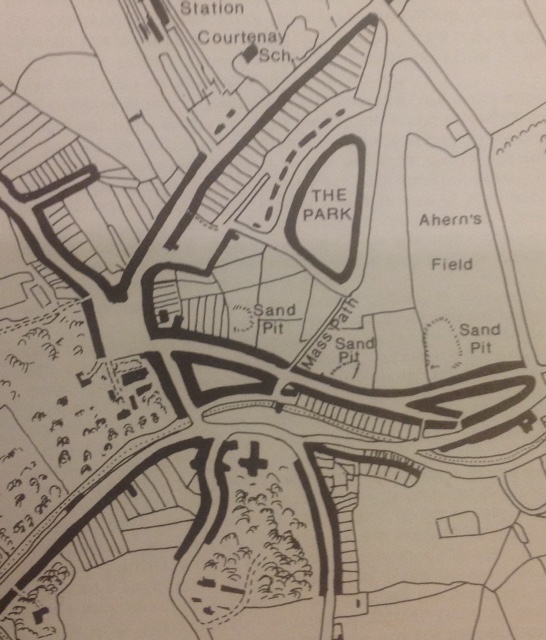
In those early days access to The Park was very limited and usually meant a long walk down through the Market Yard or Scanlon’s Lane or down New Road (now Sheehan’s Road) if one wanted to visit friends in Maiden Street or go to Mass on a Sunday.  Eventually, representations were made to local Councillors and with the second phase of houses being built in 1955 a Mass Path was constructed which gave residents easier access to the old haunts in Maiden Street and also easy access to the parish church, as the name suggests.  The residents of Maiden Street and The Coole were accustomed to being looked down on by the more well-to-do residents of the town and even now, as Dr Pat O’Connor points out, even though the residents of Assumpta Park were in a more exalted and elevated location they found that ‘by a curious process of inversion the people of the town (still) looked down on us’!
Maiden Street (2)
Detail from the map by Dr Pat O’Connor showing Assumpta Park and the Mass Path in relation to Maiden Street and the church.  Note also the three sandpits still in use at the time – Musgraves (now Whelan’s), O’Gorman’s, and Ahern’s.

Stanzas 22 and 23 paint a moving, nostalgic picture with the poet’s rose-tinted lens firmly in place.  We are invited to picture an idyllic scene almost straight out of Thomas Gray’s Elegy Written in a Country Churchyard.  It is high summer in Assumpta Park and the visibility is so good you can see Rooska to the north and the Galtees forty miles away to the east straddling the Limerick, Tipperary and Cork borders.  All is peaceful and neat and tidy and quiet ‘and the dogs lie asleep in the roadway’.  The stanza ends with a beautiful echo of a line from Act 3, Scene 2 of Macbeth – “Light thickens, and the crow/ Makes wing to th’ rooky wood.”  (I once heard Noel O’Connor, that great unsung hero and fount of wisdom, say that there’s a quote in Macbeth to solve every problem and cover every possible situation and permutation).  Hartnett, in a more benign and domesticated mood, gives us his variation on Macbeth’s more bloody intent:

and the crows to the tree tops fly home in black rows

and the women wheel out their new go-cars.

 Dr Pat O’Connor believed that making a new home in The Park was hardest on the women.  Yet, as usual, they were the quintessential homemakers.   In 1951 scarcely any worked outside the home, often supplementing family income by keeping lodgers or by fostering children, many of whom grew up seamlessly within the various families.

Hartnett’s love for this place is nourished by innocent childhood memories.  After all, the poem is meant as a Christmas present for his now ailing father and so he paints a picture which we are invited to contrast with the poverty and squalor of earlier childhood.  Hartnett is now forty years of age and remembering life as a ten-year-old in his favourite place, his home in 28 Assumpta Park:

when the smell of black pudding it sweetens the air

and the scent of back rashers it spreads everywhere

and the smoke from the chimneys goes fragrant and straight

to the sky in the Park in the evening.

The residents of Assumpta Park, then and now, are indeed lucky to have as their chroniclers Dr Pat J. O’Connor, one of the most pre-eminent human geographers of his generation, and Michael Hartnett one of Ireland’s great twentieth-century poets.  Both have left us their differing yet unique perspectives of an era of great change and of a wonderful social engineering project that worked.  Hartnett would definitely point to it as an example that the present government should try to emulate!

231147404_3994158964029080_5415516130120616571_n
A group of workers photographed on-site during the building of the second phase of the houses in 1955.  Photo courtesy of Newcastle West Olden Times Facebook Page.  These houses were built by Edmond Power.  Included above: Jack Power (back left), alongside Jackie Brouder, Edmond Power (back right), Mike Harte (front left), Mossy Hurley with child (front right), with Jer Hough and Tommy Fox in line alongside.

Works Cited:

O’Connor, Patrick J. The New Houses: A Memoir. Oidhreacht na Mumhan Books, 2009

Postscript

I came across this little-known poem of Hartnett’s recently which further details the trauma that was involved in the ‘Move to The Park’.  There is an Irish version as well.

Off to the New Houses

I was there when the street expired.

When the cabins were put under lock and key;

Gloom and delight were left imprisoned,

The birth-room, the death-room;

And under the floor and on the wall

The mouse and the spider were lonely.


Donkey and trap, wheel-barrow, hand-cart

Safely transporting our ancestral bedding,

My father’s mug, my mother’s sugar-bowl:

We shifted all under cover of night.

And under the floor and on the wall

The mouse and the spider were lonely.


We shifted all that mattered

Except the heart of the old tortured street:

After a pause for porter, my father and his friends went

To move it to us at once.

It was bigger than ten cows’ hearts,

Weals and wounds and scabs all over it.

But its history and grief notwithstanding

There was a living pulse of blood there still.

Late in the night it was put on a cart

And they pulled it across a field

But the heart expired before journey’s end

And we still can’t wash out the bloodstains.

And still under the floor and on the wall

The mouse and the spider are lonely.

Michael Hartnett
 

Free Resources for Leaving Cert Poetry 2025

image (1)
  Portrait of Eavan Boland http://www.irishtimes.com. Illustration: Dearbhla Kelly

I have been posting English notes on my blog, Reviews Rants and Rambles, since I retired as an English teacher and an Advising Examiner for English Higher Level.  I have brought all those links together here in one post or blog  – an Index of all the posts I’ve written that are relevant to Leaving Cert English Poetry 2025.  Bookmark this to save you the trouble of constantly searching the internet each time you want to do some background work on a particular poet or author. It’s imperfect and won’t suit every student, class, or teacher but it’s my version of a ‘Pop-Up-One-Stop Shop’ and you know the drill: just click on the link if it’s relevant to your studies!  My choice of poets is personal and you will easily see where my own preferences lie by simply viewing the number of links provided for each text or poet!

However, Caveat Emptor!  Leaving Cert Student Beware !!  These are resources that you should use wisely.  They are my personal responses to the various texts and you should read and consider them and decide to study them if you find them useful.
IN OTHER WORDS, MAKE YOUR OWN OF THEM, ADD TO THEM, OR DELETE FROM THEM AS YOU SEE FIT.
Eavan Boland

Major Themes in Eavan Boland’s Poetry

The Beauty of Ordinary Things  In the Poetry of Eavan Boland

Child of Our Time by Eavan Boland

Emily Dickinson

An Overview of the Poetry of Emily Dickinson

T. S. Eliot

Observations on ‘The Love Song of J. Alfred Prufrock’ by T. S. Eliot

The Religious Poetry of T. S. Eliot (with a particular focus on ‘Journey of the Magi’ and

‘A Song for Simeon‘)

Gerard Manley Hopkins

The Poetry of Gerard Manley Hopkins

An Analysis of Inversnaid by Gerard Manley Hopkins

An Analysis of Spring by Gerard Manley Hopkins

Analysis of ‘The Windhover’ by Gerard Manley Hopkins

The Terrible Sonnets,  not so terrible after all!

Commentary on ‘Pied Beauty’ by Hopkins

Patrick Kavanagh

The Poetry of Patrick Kavanagh

Some Recurring Themes in the Poetry of Patrick Kavanagh

Analysis of Patrick Kavanagh’s Use of the Sonnet

An Overview of Patrick Kavanagh’s Poetry

A Christmas Childhood by Patrick Kavanagh

Advent by Patrick Kavanagh

Canal Bank Walk by Patrick Kavanagh

‘Patrick Kavanagh is a very Religious Poet’  Discuss

‘A sense of loss pervades much of Patrick Kavanagh’s poetry’  Discuss

Patrick Kavanagh’s Poetry is full of Honesty, Integrity and Simplicity’   Discuss

‘Patrick Kavanagh is a poet of the Ordinary’   Discuss

Bonus Kavanagh Stuff – Have a read!  Enjoy!

Luke Kelly : Raglan Road (A Parade of Posts for St Patrick 1)

An Introduction to ‘Tarry Flynn’ by Patrick Kavanagh

Stony Grey Soil by Patrick Kavanagh

Derek Mahon

Derek Mahon:  An Overview

Sylvia Plath

The Poetry of Sylvia Plath

fullsizerender

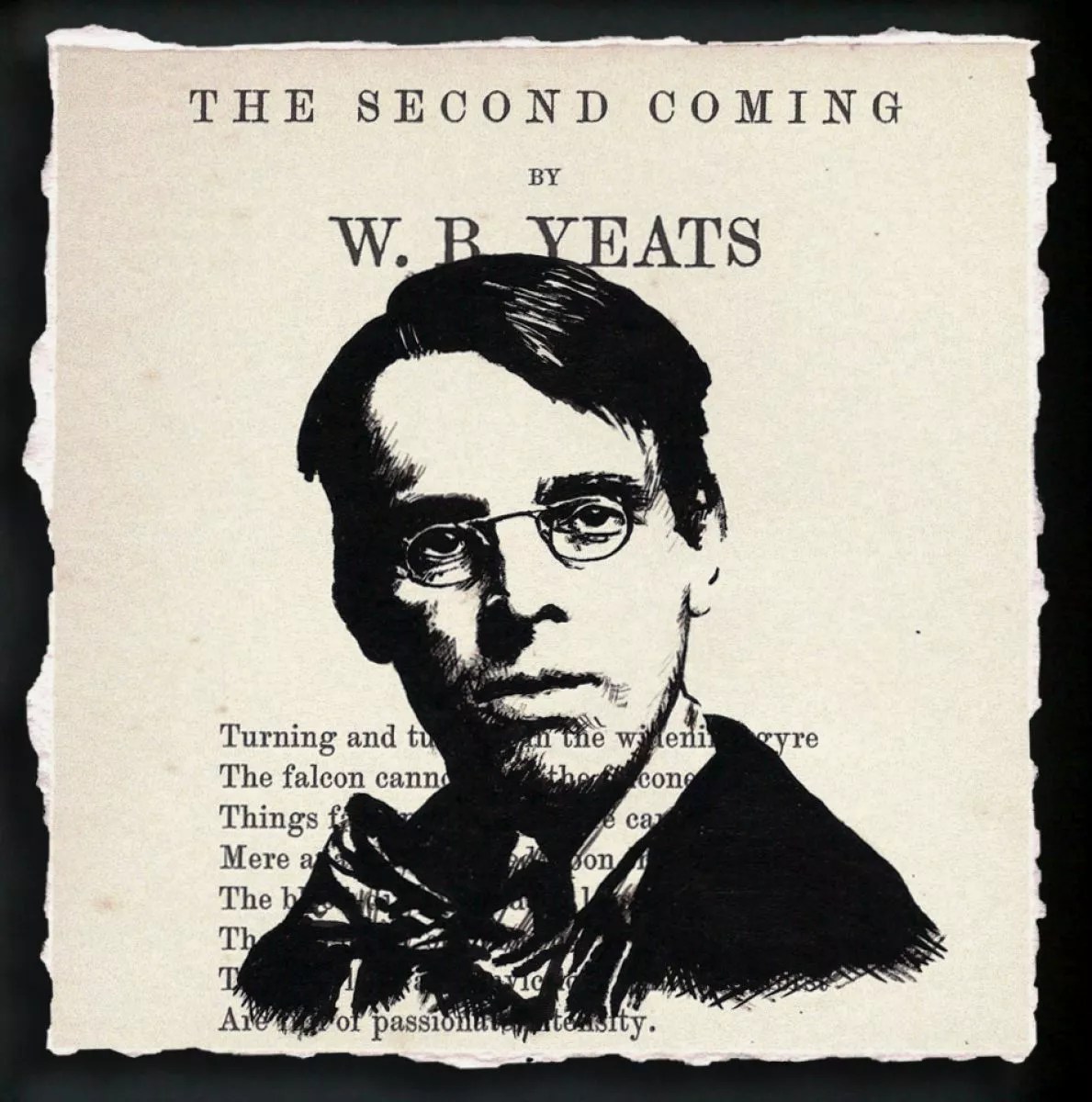
The Second Coming by W.B. Yeats – A Poem for Our Time

2354f8aaf8f740849907452ec6867daf
W.B. Yeats – The Second Coming (2014). Acrylic painting by Peter Walters.

The Second Coming


Turning and turning in the widening gyre

The falcon cannot hear the falconer;

Things fall apart; the centre cannot hold;

Mere anarchy is loosed upon the world,

The blood-dimmed tide is loosed, and everywhere

The ceremony of innocence is drowned;

The best lack all conviction, while the worst

Are full of passionate intensity.

Surely some revelation is at hand;

Surely the Second Coming is at hand.

The Second Coming! Hardly are those words out

When a vast image out of Spiritus Mundi

Troubles my sight: somewhere in sands of the desert

A shape with lion body and the head of a man,

A gaze blank and pitiless as the sun,

Is moving its slow thighs, while all about it

Reel shadows of the indignant desert birds.

The darkness drops again; but now I know

That twenty centuries of stony sleep

Were vexed to nightmare by a rocking cradle,

And what rough beast, its hour come round at last,

Slouches towards Bethlehem to be born?

Source: The Collected Poems of W. B. Yeats (1989)

 Commentary

The Second Coming surely holds the distinction of being the most plundered poem in the English language. To fully understand the poem, we are required to have some biblical knowledge as well as a basic understanding of Yeats’s vision of history.  The biblical reference is twofold: the poem blends Christ’s prediction of his own second coming with St. John’s vision of the coming of the Antichrist, the beast of the Apocalypse.  This is ‘the rough beast’ of the second last line of the poem.  Yeats makes the rough beast even more disturbing and sinister by assigning its place of birth to Bethlehem, the place of Christ’s birth, associated over the course of two thousand years – until recent times – with peace, mercy, gentleness and forgiveness.

To understand Yeats’ cosmology it is essential to read his book, A Vision where he explained his views on history and how it informed his poetry. Yeats saw human history as a series of epochs, what he called “gyres.” He saw the age of classical antiquity as beginning with the Trojan War and then that thousand-year cycle was overtaken by the Christian era, which he suggests is now coming to a close. That is the basis for the final line of the poem, “And what rough beast, its hour come round at last/ Slouches towards Bethlehem to be born?”  In his mystical book, A Vision, he foretold the birth of a new, violent, bestial anti-civilisation and the simultaneous destruction of the two-thousand-year-old Christian cycle.  The second coming of the poem is thus not that of Christ but of his opposite, the slouching, revolting figure of the beast whose birth will herald in a new age of anarchy to be ‘loosed upon the world’ (line 4).  Yeats’s thesis in A Vision is that each epoch or period of history is eventually overthrown by some massive upheaval.  This may explain why Yeats used the phrase “the second birth” instead of “the Second Coming” in some of his first drafts.

It is in this context that the opening lines of the poem should be read: ‘Turning and turning in the widening gyre / The falcon cannot hear the falconer’.  The falcon here is an image of man rapidly losing contact with Christ the falconer as he moves along the widening gyre of history.  The next six lines paint a grim picture of the beginning of a new age, marked by worldwide anarchy and violence (‘The blood-dimmed tide is loosed’).  As the gyre widens, ‘things fall apart; the centre cannot hold’.  The end of the Christian age is granted the revelation of the character of the new age. The tide of violence has already begun to move, and as it does, it begins to drown ‘the ceremony of innocence’ which, in Yeats’s symbolic system, stands for order and harmony as opposed to the personal and social violence of the ‘blood-dimmed tide’.

The ‘vast image out of ‘Spiritus Mundi’ (line 12) is a favourite Yeatsian idea.  According to Yeats, Spiritus Mundi is a storehouse of ideas deriving from the great universal memory common to all humankind, and is also the source of prophecy, since, he believed, history repeats the same predestined cycles every two thousand years or so.

The more terrible events associated with the coming of the Antichrist are all in the future, but in lines 3 – 8, Yeats suggests that his world is already experiencing a foretaste of the grim future heralded by the birth of the ‘rough beast’.  There was plenty of evidence all around him in 1919, the year he composed the poem.  Yeats began The Second Coming during the tense, eventful month of January 1919. The ‘war to end all wars’ was barely over and the Russian Revolution, which dismayed him, was still unfolding, while another war was brewing on his doorstep. On 21 January, the revolutionary Irish parliament met in Dublin to declare independence while, in a quarry in Soloheadbeg in Tipperary, Dan Breen and other members of the IRA killed two officers of the Royal Irish Constabulary ushering in the War of Independence. This war threatened to uproot the Anglo-Irish ascendency and the civilisation it represented, many elements of which appealed to Yeats himself.  Empires and dynasties were all in a state of flux as a result of this anarchy and revolution that had been loosed upon the world. The birth of Yeats’s daughter, Anne, in February, was also fraught with danger. During her pregnancy, his young wife Georgie Hyde-Lees had been stricken by the Spanish flu that was burning through Europe at that time in the wake of the war.  All these events conspired to put Yeats in an apocalyptic frame of mind.

For Yeats, the Incarnation of Christ was a violent, turbulent event, after which ‘twenty centuries of stony sleep / were vexed to nightmare by a rocking cradle’.  This new incarnation, that of the slouching ‘rough beast’ will unleash universal horrors.  Its sinister possibilities are hinted at in the suggestion that even the predatory desert birds, for all their savagery, are ‘indignant’ at its coming.

The poem gives us a frightening account of the fate in store for the post-Christian world.  Social anarchy and massive destruction are made worse by the collapse of moral values among the leaders of nations: ‘The best lack all conviction, while the worst / Are full of passionate intensity’.  He predicts that evil will triumph in the public sphere because those political leaders who might be expected to defend humane values (and basic human rights) lack the determination to resist those who preach violence and intolerance.

As I mentioned earlier, The Second Coming has become perhaps the most plundered poem in the English language – only Heaney’s From ‘The Cure at Troy’  comes a close second, with its ‘let hope and history rhyme’ so beloved of politicians.  At 164 words, The Second Coming consists of almost nothing but quotable lines. Someone reading it for the first time in 2024 might resemble the apocryphal theatregoer who complained that Hamlet was nothing but a bunch of quotations strung together. Whether or not it is Yeats’s greatest poem, it is by far his most useful.  As Auden wrote in “In Memory of WB Yeats” (1939), “The words of a dead man / Are modified in the guts of the living.”  We have to admit, after its first one hundred years, this poem was built to last.

As our world has recently been wrenched out of joint by the Covid-19 pandemic, many people are turning to poetry for wisdom and consolation. However, The Second Coming fulfils a different role, as it has done in crisis after crisis, from the Vietnam War to 9/11, to the genocides in Rwanda or Syria or Gaza,  to the election of Donald Trump and to the looming prospect of his imminent re-election: it provides us with an opportunity to confront chaos and dread, rather than to escape it. This is surely why Fintan O’Toole has proposed the “Yeats Test”: “The more quotable Yeats seems to commentators and politicians, the worse things are.”

bwgqngybqe-1577215055

The Christmas Tree by Danny Barry

This beautiful video has been produced by Danny Barry’s grandson, Dan Barry. The poem is narrated by the poet Michael Hartnett and it is taken from a radio documentary that he did in 1979 for RTE Radio entitled Poems Plain.  The programme was produced by Donal Flanagan. The video contains copyrighted material that is being used for educational purposes under the doctrine of ‘fair use’. The use of this material is not intended to infringe upon the copyright owner’s rights. The material is used here solely for educational and non-commercial purposes.  Dan Barry has suggested a small but necessary edit to verse four and the printed poem below reflects those changes.

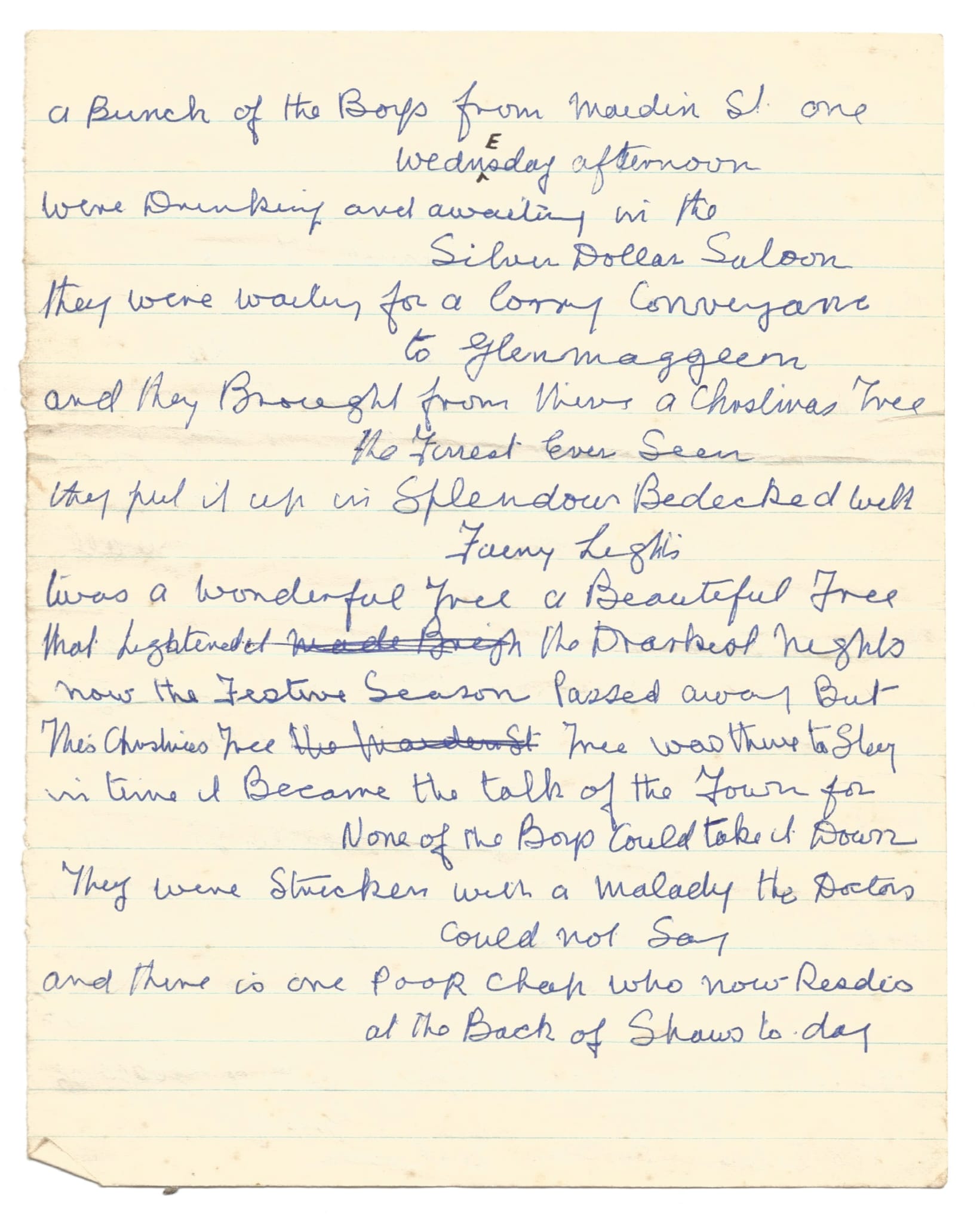
Danny Barry’s poem, ‘The Christmas Tree’, deals with an actual happening. A few men from Maiden Street in Newcastle West decided to erect a Christmas tree in the street. They cut it down in Glenmageen, an area reputed to be haunted by a witch known as Sprid na Barna.  Glenmageen is located about four miles south of Newcastle West and people can now visit the townland as they walk or cycle on the new Limerick Greenway. The stories of Sprid na Barna were well known, and the area near the present-day Barna Gardens was greatly feared by the local people. Indeed, it was said that only a few tough men would go home after dark along the road she haunted.  Michael Hartnett is fulsome in his praise for the poet:

Danny Barry’s simple evocation of Sprid and her victims is extraordinary.  Not because it is great poetry, but because he does not question the truth of the event at all. By the way, the Silver Dollar Saloon, which is a strange Hollywood, Western-type name, is a pub in Newcastle West, which was then run by the Flynn family, and is now run by the Kelly family.

The poem is purely mischievous and no insult should be taken by anyone, dead or alive, concerning the story told by the poet.  Danny Barry is ‘ball hopping’ here and there are distinct similarities between this poem and many later written by Michael Hartnett, such as ‘The Balad of Salad Sunday’.

The Christmas Tree

A bunch of the boys from Maiden Street, one Wednesday afternoon,

Were drinking and awaiting in the Silver Dollar Saloon,

Waiting for a lorry to convey them to Glenmageen.

And they brought from there a Christmas tree, the finest ever seen.


They put it up in splendor, bedecked with fairy lights.

It was a wonderful tree, a beautiful tree, that lightened the darkest nights.

Now, the festive season passed away, but this Christmas tree was there to stay.

In time it became the talk of the town, for none of the boys dared take it down.


They were stricken with a malady the doctors could not say,

And there is one poor chap who now resides at the back of Shaw’s today.

Now, you have heard of Sprid na Barna, that very naughty dame,

That evil maid of Glenmageen, of the haunting ghostly fame.


The clergy had to banish her between the tree and the bark.

No more she would haunt and terrify the neighbours after dark.

Now the moral of this ditty I want you all to know

Twas a tree that grew in Glenmageen twenty years ago.


Now what I am trying to tell you will cause you all to frown

That the amadans from Maiden Street have brought auld sprig to town.

Now when the blackthorn blooms again and the sheepdogs howl at the full of moon

You could meet auld sprig with a glass of grog in the Silver Dollar Saloon.

Note: The reference to ‘auld sprig’ in the last line is a local mispronunciation of ‘sprid’

4DE7AD7D-9765-4545-AC1F-8B8BF89BA495

791999D0-BB90-426F-B052-5DFF9973A6B2

 The original manuscript of the poem in Danny Barry’s own handwriting – you can see that it was a work in progress from all the crossing out!

Free Resources for Leaving Cert English Students 2020

Because of the ongoing school closures and the uncertainty and anxiety which this causes all Leaving Cert students, I have brought together here in one post links to a series of relevant notes which you may consider useful in your English course studies for 2020.  These notes cover Single Text, Comparative and Poetry Sections.

Caveat Emptor!  Leaving Cert Student Beware !!  These are resources which you should use wisely.  They are personal responses to the various texts and you should read and consider them if you find them useful.   IN OTHER WORDS, MAKE YOUR OWN OF THEM, ADD TO THEM OR DELETE FROM THEM AS YOU SEE FIT.  ALSO, YOU MIGHT SPREAD THE WORD, DON’T KEEP THEM ALL TO YOURSELF!

THE SINGLE TEXT

(You know the drill, click on the link!)

Hamlet

Shakespearean Tragedy Defined

Hamlet: An Introduction

Hamlet: The World of the Play

The Problem with Hamlet – is Hamlet

Hamlet’s ‘Antic Disposition’ – That is the Question!

Hamlet’s Delay

Death and Deceit in Hamlet

The Moral Question in Hamlet

The King and Queen in Hamlet

Polonius and his family in Hamlet

Comparisons and Contrasts in Hamlet

Ghosts and the Supernatural in Hamlet

funny-Shakespeare-spoilers-Hamlet-Macbeth-King-Lear

Persuasion

Some Themes in Persuasion by Jane Austen

Characterisation in the novel Persuasion

Fairy-Tale Motifs in Persuasion by Jane Austen

The Playboy of the Western World

An Analysis of the characters of Christy Mahon, Pegeen Mike and the Widow Quin in The Playboy of the Western World by J.M. Synge


THE COMPARATIVE STUDY QUESTION IN 2020

RATIONALE
This section was introduced in order to bring some variety and interest to the manner in which texts are studied at Leaving Cert. level and to give students another perspective on the potential of literature in their lives.

Although literary texts are aesthetic artefacts they can be gainfully approached from a range of other viewpoints, e.g. cultural, historical, social, which can enrich our understanding of the role and significance of literature.

Studying texts comparatively from these perspectives invites students to interact with the different worlds encountered and to make discriminations and evaluations. Such study will hopefully reflect back on the student’s own world and raise her or his awareness of it.

MODES OF COMPARISON

For each Leaving Certificate course, three modes of comparison will be prescribed. This means that the texts chosen for comparative study must be studied under these particular modes (headings).

This year the modes of comparison at Higher Level are as follows:
• Literary Genre
• Theme or Issue
• Cultural Context

Two of these three will be examined in 2020.

Literary Genre
This mode focuses on the ways that texts tell their story. This is also a legitimate basis for comparison: whether it is a tragic play, a detective thriller, a film, a historical novel, an autobiography or a travel book. (The amazing thing is that all these differing genres are available for study on this course!).

The following questions should be asked about the texts being studied by you:
• How is this story told? (Who tells it? Where and when is it told?)
• Why is the story told in this way?
• What effects do all these have?
• Is there just one plot or many plots? How do these relate?
• What are the major tensions in the texts? Are they resolved or not?
• Was this way of telling the story successful and enjoyable?
• How do the texts compare as stories?
• Is the story humorous or tragic, romantic or realistic?
• To what genre does it actually belong?
• Because your three texts are so different you have to be very aware of how different the experience of encountering a novel, a play, and viewing a film is.

Theme or Issue
This involves comparing texts on a prescribed theme(s). These would have to be themes that were pervasive and central to the texts chosen for study e.g.

  • Isolation and Loneliness
  • Relationships
  • Family
  • Childhood
  • Fantasy and reality

These themes/issues will be the messages or concerns that the writer or film director wishes to impart to the audience. In most texts, there will be a number of themes/issues worth considering

Your task, therefore, in this section is to compare and contrast the same theme as it is treated by different authors or film directors.

Cultural Context
Compare the texts focusing on social rituals, values and attitudes. This is not to be seen as a sociological study of the texts alone. It means taking some perspectives, which enable the students to understand the kind of values and structures with which people contend. It amounts to entering into the world of the text and getting some insight and feel for the cultural texture of the world created. This would imply considering such aspects as the rituals of life and the routines of living, the structures of society, familial, social, economic, religious and political: the respective roles of men and women in society, the position of children, the role and nature of work, the sources and structures of power and the significance of race and class.

When you answer a question in the Comparative Section remember that you have to be selective in emphasising the most meaningful similarities and differences between texts. The more similar they appear to be, the more provocative and challenging it is to contrast them and to draw out differences between them. Remember also that when you draw out surprising or disputable similarities or differences, you require detailed support from the texts.

In a Comparative answer, it is vitally important to compare and contrast these different ways of looking at life, or to examine if there is coherence or a lack of coherence between all these differing viewpoints.

THE COMPARITIVE STUDY

EXAM HINTS

• There are three modes of comparison this year – literary genre, themes and issues, and cultural context. Two of these modes will be examined this year.

• Four questions will be offered in this section to cater for the variety of texts that have been studied. (Only one question is to be answered from this section.) You must read each question carefully and in full to see if it suits your own set of texts.

• Some questions will be in the form of a statement to be discussed. Others will be presented in parts with the marking for each part clearly stated following the question.

• It is vitally important that you remember that the questions here will be mode-specific and not text-specific. Remember that you must approach this section with the comparative headings in mind and then you must apply them to your chosen texts.

• You should bear in mind that, as with the single text, e.g. Hamlet, you must avoid the easy option of merely summarising the story. This will fill up pages (and pages!) of foolscap and will give the impression of writing a lot but will not give the examiner the opportunity of awarding marks. Remember, THINK, ANALYSE, PROVE AND SUPPORT your points as you go.

• The most important words to remember in writing answers here in this section is COMPARE and CONTRAST. You should present texts alongside one another and then compare, contrast and think about interesting parallels and divergences as they arise.

• Remember to have your KEY MOMENTS well prepared for this section so that you can make use of them in comparing one text with another.


Links to Notes on Comparative Texts

A Doll’s House

Study Notes on A Doll’s House by Henrik Ibsen

Persuasion

Some Themes in Persuasion by Jane Austen

Characterisation in the novel Persuasion

Fairy-Tale Motifs in Persuasion by Jane Austen

Wuthering Heights

Major Themes in Wuthering Heights

The Depiction of Childhood in Wuthering Heights – Some Observations on Characterisation in the Novel

Grace Notes on Wuthering Heights

Silas Marner

Themes in ‘Silas Marner’

Silas Marner – The Characters

Imagery in ‘Silas Marner’

Fairy-Tale Elements in Silas Marner

Silas Marner by George Eliot is a radically disturbing social document…

The Great Gatsby

Introducing ‘The Great Gatsby’

The Spinning Heart

The Spinning Heart by Donal Ryan


THE POETRY SECTION IN 2020

I include links to FIVE of the eight poets on your course here – simply click on the link.

Eavan Boland

Major Themes in Eavan Boland’s Poetry

The Beauty of Ordinary Things – In the Poetry of Eavan Boland

‘Child of Our Time’ by Eavan Boland

Emily Dickinson

An Overview of the Poetry of Emily Dickinson

Robert Frost

AN ANALYSIS OF THE POETRY OF ROBERT FROST (1874 – 1963)

Some Personal Thoughts on ‘The Road not Taken’ by Robert Frost

Analysis of ‘Spring Pools’ by Robert Frost

Commentary on ‘A Tuft of Flowers’ by Robert Frost

Adrienne Rich

Exploring the Poetry of Adrienne Rich (1929 – 2012)

Hidden Riches in The Poetry of Adrienne Rich

William Wordsworth

William Wordsworth’s Poetry

Tintern Abbey – An Analysis

Analysis of ‘Upon Westminster Bridge’ by William Wordsworth


REMEMBER ALL THIS WILL PASS – STAY SAFE AND KEEP THOSE CLOSE TO YOU SAFE ALSO.  IN ACTUAL FACT, MOST OF THESE SHAKESPEAREAN TRAGEDIES WOULD HAVE BEEN AVERTED IF PEOPLE HAD STAYED HOME…..

IMG_4062 (1)

The Poetry of Seamus Heaney

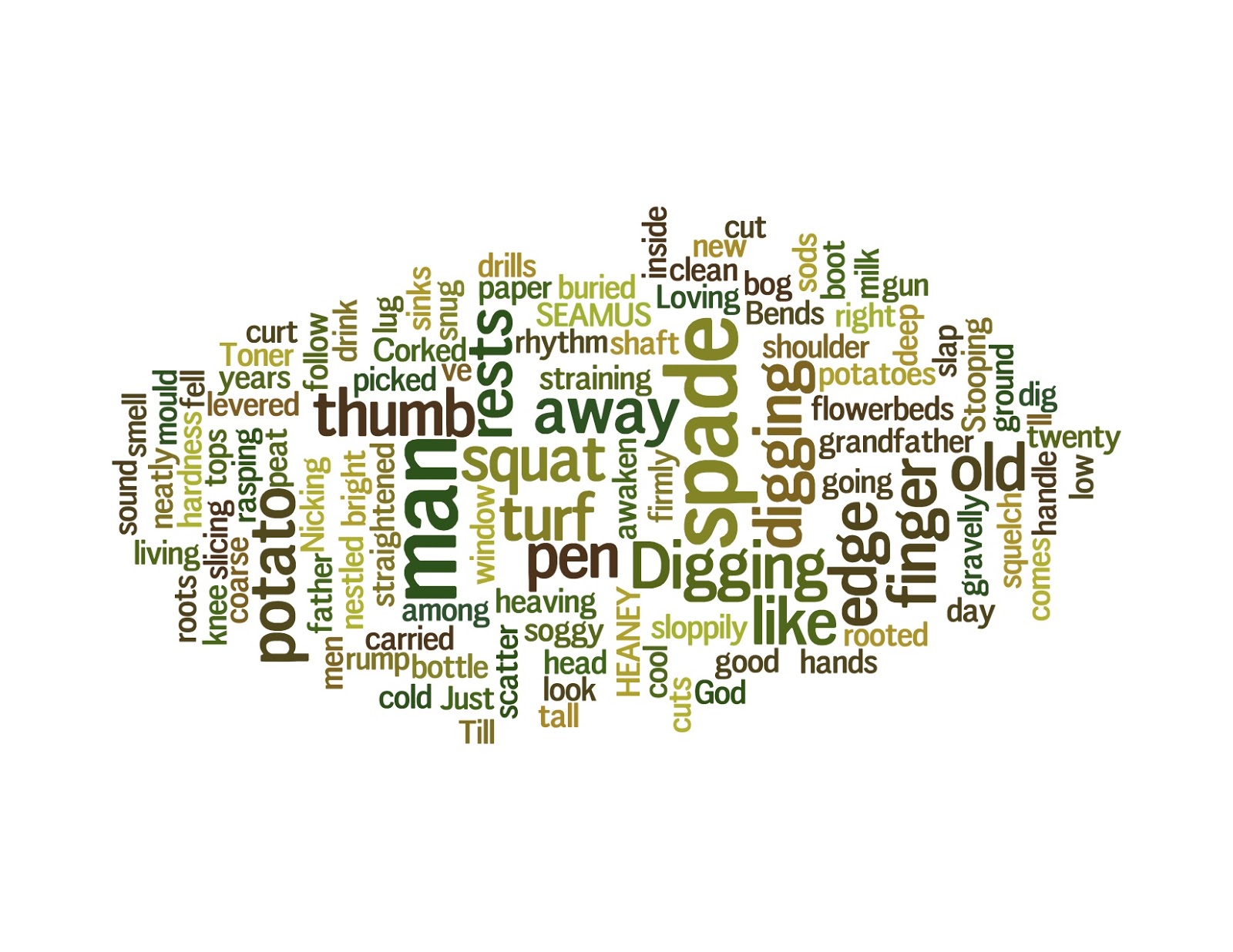
Digging

by Mary Hanley

(Note:  Leaving Cert Poetry questions have in recent years become more sophisticated and focused on particular aspects of the poet’s work.  The first ever question on Heaney simply expected the candidate to give their personal reaction to his poems – today the focus is given in the question and these are the major aspects which you must address in your answer.  This is then policed firmly by the Examiner’s by their application of the PCLM marking criteria.)

Sample Answer:  Would you agree that Seamus Heaney is an essentially backward looking poet, finding answers only in the past?

Soundbites are dangerous and the thesis stated above does not do Heaney or his poetry justice.  I agree that Seamus Heaney is “an essentially backward looking poet”.  However, I remain steadfastly reserved about Heaney “finding answers only in the past”.  This statement does not give the whole scope of his poetry true justice.  It only skims the surface, and using Heaney’s own analogy, if we are to truly understand his work we must go “down and down for the good turf” before we can get a true estimation of his worth.

Irishness, tradition and identity remain the cornerstones of Heaney’s poetry.  He celebrates local craftsmanship – the diviner, the digger, the blacksmith and the breadmaker.  He hankers back to his childhood and the community of that childhood for several reasons.  Indeed, part of the excitement of reading his poetry is the way in which he leads you from the parish of Anahorish in County Derry outwards in space and time, making connections with kindred spirits, both living and dead, so that he verifies for us Patrick Kavanagh’s belief that the local is universal.  For example in ‘The Forge’ he appears at first glance to be looking back with fond nostalgia at the work of the local village blacksmith.  However, the real subject of the poem is the mystery of the creative process.  The work of the forge serves as an extended metaphor for the work and craftsmanship of poetry.  Even the uncouth and uncommunicative blacksmith of his childhood can create!

Heaney has been branded a nostalgic romantic, a poet whose head remains steadfastly stuck in the sand, and a man when confronted with political violence and trauma regresses back in time to the womb-like warmth of his aunt’s kitchen in Mossbawn.  “Sunlight” is seen as a prime example of Heaney’s romanticism and escapism.  This poem was, after all, written at the height of the ‘Troubles’.  Yet, seemingly in denial of such violence, he hankers back to the security of his childhood.  Can it therefore be said that he is essentially a backward looking poet, finding answers only in the past?  Undoubtedly, Heaney travels back in time but it is to find answers for the present day realities.  On another level, this poem is a search for alternative human values, values no longer to be found in present day society.  Heaney can draw strength from his picture of childhood Eden – ‘the helmeted pump’, ‘scones rising to the tick of two clocks’ and ‘love, like a tinsmith’s scoop sunk past its gleam’.

Heaney is a poet, like Kavanagh and Hartnett, who has remained attached to his home place and the values and traditions of his parents.  ‘All I know is a door into the dark’.  Poets, too, have to force themselves to go into the dark, the unknown.  Their craft is multi-faceted.  They are pioneers, working at the frontier of language.  They are translators, translating for us events that we cannot grasp.  He translates the atrocities of Northern Ireland by excavating and exploring the past.  Heaney can travel through ‘the door into the dark’ only by drawing strength from the past.

The bog plays a major role in the poetry of Heaney.  This soft, malleable ground is ‘kind black butter.  Melting and opening underfoot’.  The bog is the memory of the landscape.  It draws us inwards, downwards and backwards through history.  Our bogs are as deep as the American prairies are wide.  Heaney talks about the ‘Great Irish Elk’ and ‘butter sunk under’.  In offering the poet an opportunity to consider its hoard from the past it affords him some deeper understanding of the present.

It is obvious from his poetry that Heaney needs to distance himself from the immediate face of danger.  Unlike Longley, Heaney is not eager to touch it, to write about it, to feel its flank and guess the shape of an elephant.  He needs space.  He uses the rich tapestry of history to give him perspective and a parallel to confront ‘the Troubles’.  In ‘The Tollund Man’ the discovery of a book gives Heaney a new perspective to explore the past and examine the present.  Make no mistake about it, Heaney here is talking about Northern Ireland.  It is difficult to interpret but this poem is a direct response to the continuing murders and violence of the 70’s and 80’s.  Heaney’s style may not be as direct as Longley’s, but I believe it is still very effective.  I believe he is saying here these atrocities, albeit sometimes more brutal, are just modern day versions of an age old custom.  In every society, people are sacrificed to a political or religious goddess, whether it is the goddess Nerthus or Kathleen Ni Houlihan.  One common motif linking the three parts of the poem is that of a journey.  The sacrificial journey of the Tollund Man, the journey of the brothers ‘flecked for miles along the lines’ and the pilgrimage of Heaney in the final part.  I believe there is one more journey to be made and this Heaney skilfully passes on to the reader.  We, the readers, have to make the final journey ourselves to discover and interpret, to read between the lines and around the happenings of the time the poem was written, to get at the true meaning of the poem.  This analogy can be transferred to all of Heaney’s poems.  He doesn’t do all the work for us but the meaning is more valued when we get to the essence of the poem ourselves.

                   ‘Out there in Jutland in the Old Man killing parishes,

I will feel lost, unhappy and at home.’

No one can deny that Heaney is “essentially a backward looking poet”.  Yet he makes no apologies for it.  The influence of Kavanagh and his writings on Monaghan gave him a strength to continue writing about the traditions and customs of his local community.  The cynic may see it as escapism but Heaney finds inspiration about the present in his wealth of memory.  He finds a metaphor for the finely crafted work of the poet in such poems as “The Forge”.  The bog offers Heaney a perspective.  In “Bogland” and “Tollund Man” Heaney finally turns to the security of his youth to find an answer to the shocking realities of violence and death.  It stands as an antidote to the brutal reality of the wider society.  Heaney’s poetry also stands as an antidote, dealing with harsh issues in a gentle retrospective yet effective way.

                   ‘Then grunts and goes in with a slam and flick

To beat real iron out, to work the bellows.’

Therefore, I would be in agreement with The Field Day Anthology of Irish Writing when it says of Heaney’s poetry that it is, ‘excavating in every sense, reaching down into the ground and back into the past’.

Digging by Seamus Heaney copy